The Artistry of Motherhood: Depicting Parenthood Through Modern Art


A few weekends ago I took my middle child to the National Gallery of Victoria, ostensibly to see a touring exhibition and actually because it was raining and we had nowhere else to be. She is seven, and she has the unusual gift of stopping in front of motherhood paintings I would have walked past, and asking why. We stopped, that afternoon, in front of a Renaissance Madonna and Child — I no longer remember which one, which is part of the point — and she asked me why the baby looked so much like a tiny adult, and why his mother wasn't smiling. I did not have a satisfactory answer for either question. I have been thinking about it ever since, which is what good questions from seven-year-olds do.
Motherhood paintings are an enormous and largely under-read body of work — older than the novel, older than the family photograph, and unevenly served by the way museums tend to talk about it. What follows is one parent's working tour through the genre, anchored to specific works and artists, with particular attention to the ones I think my daughter — and her brothers, when their turn comes — will be glad to have been shown.
Madonnas and the long ground
The canonical Western image of motherhood is the Madonna and Child. For the better part of a thousand years, this was the only mother whose interiority was permitted to enter a serious gallery wall. Raphael's Conestabile Madonna (c. 1502–04) and Caravaggio's Madonna of the Pilgrims (1603–5) are good examples to look at side by side, because Caravaggio does something the Renaissance painters generally would not: he uses a real Roman woman as his model, with dirty feet and a tired stance, and lets the religious image absorb the ordinary one. The Conversation's recent piece on motherhood paintings names Caravaggio alongside Ter Borch, Vuillard and Kollwitz as part of "the complexity of motherhood" canon (The Conversation), and I think the Caravaggio is where you see the pivot beginning — when the mother in the painting starts being a mother before she is a symbol.
It is worth pausing on what this lineage did, structurally, to the picturing of motherhood for the next four hundred years. It made the iconic image of a mother a person who is composed, holy, somewhat sorrowful, and looking either at her child or at the viewer with restraint. Any painter who wanted to paint motherhood as it was actually being lived — exhausted, irritable, ambivalent, tedious — had to work against this image, not toward it.
Cassatt and the 19th-century pivot
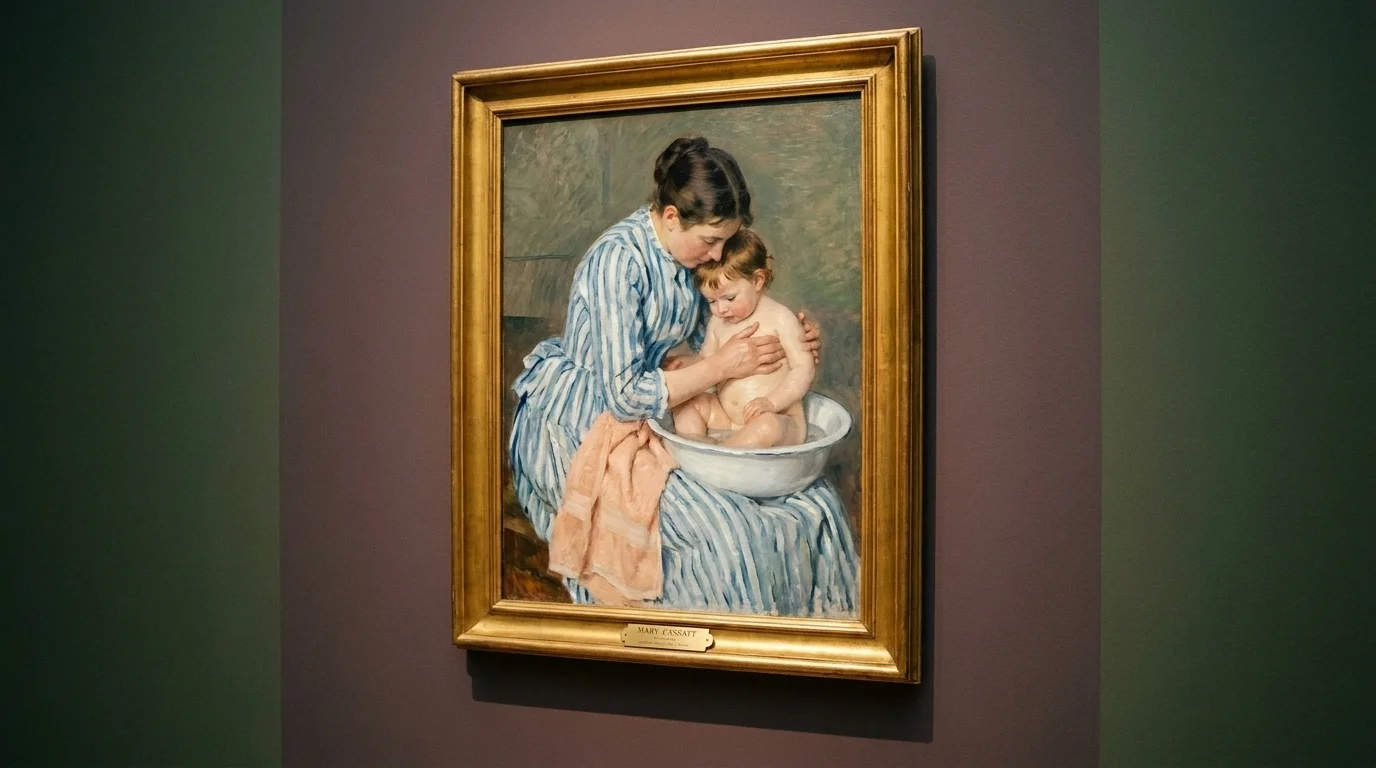
The pivot did, eventually, happen, and Mary Cassatt is one of the names that did the pivoting. The Child's Bath (1893) — Cassatt is bathing a young child, both heads bent forward, the mother's striped dress and the child's small body fitted to each other in the composition — is one of the most reproduced mother-and-child works of the nineteenth century, and the reason is not sentimentality. It is the angle of the picture. Cassatt paints the everyday physical work of motherhood — the carrying, the bathing, the holding — as the proper subject of a serious painting, not as a domestic aside.
She does this in a moment when Whistler is painting his Arrangement in Grey and Black No. 1 (1871) — the picture the rest of us know as Whistler's Mother — which does the opposite. Whistler's mother sits, dignified and frontal, as a formal portrait subject who happens to be a mother. The two paintings together, both nineteenth-century, mark the two ways forward that the twentieth century then took: motherhood as portrait subject (a woman who is a mother), and motherhood as physical labour (a woman doing the work of mothering). The contemporary work that matters tends to take the second road.
Mothers, not Madonnas: the ambivalent canon
The twentieth century is when motherhood in art got difficult, and the artists I would point a serious reader toward are the ones who let it.
Käthe Kollwitz's The Mothers (1921–22) — a woodcut of women clinging together to shield children from war and loss — is one of the most uncompromising images of maternal terror in the canon. Kollwitz lost her own younger son, Peter, in the First World War, and almost everything she made after that is, in one way or another, a mother accounting for the cost of holding a child in a world that will not necessarily let her keep him.
Alice Neel's Nancy and Olivia (1967) is a different mode of the same honesty. Neel paints her daughter-in-law Nancy holding the baby Olivia, both of them slightly exhausted, slightly skeptical, looking out at the viewer in a way that does not soften the situation for the viewer's comfort. PBS SoCal places this painting in its list of the most powerful 20th-century motherhood artworks for exactly this reason — Neel is documenting the texture of early motherhood rather than performing it (PBS SoCal).
Mary Kelly's Post-Partum Document (1973–79) is the conceptual hinge. Across six years and over a hundred and thirty discrete pieces — including, famously, framed nappy liners stained with her infant son's faeces — Kelly turned the daily admin of mothering into the subject of a major work. It is the piece every 2020s motherhood exhibition cites, and it is the piece that made it possible to take the subject seriously inside an art-historical frame. Judy Chicago's Birth Project (1980–85) does the parallel labour for birth itself — until then a subject so taboo in fine art that the surrealists were almost the only people allowed near it.
Tala Madani's recent Shit Moms series, in which mothers made out of excrement attend to their children with grim devotion, is the contemporary inheritor of all of this. Art Basel's piece on the parenthood-in-art moment names Madani alongside Caroline Walker, Camille Henrot, Billie Zangewa and Judy Chicago as the artists reframing the genre (Art Basel). Shit Moms is, among other things, a useful corrective to the Madonna lineage. It cannot be aestheticised.
I should say something about why this canon matters to a parent who is not a critic. The Madonna images I grew up looking at in churches in Cork did not give me a vocabulary for what motherhood actually costs. The Kollwitz, the Neel and the Kelly do. They are, in a way I did not expect, easier to be in a room with — easier, for a non-artist parent, to recognise.
When the work is in bronze
Louise Bourgeois's Maman (1999) is, by some distance, the most famous contemporary sculpture about motherhood. A nearly nine-metre bronze spider, it now stands in the courtyards of the Guggenheim Bilbao, Tate Modern (in its first incarnation), the National Gallery of Canada, and several other institutions. Bourgeois titled it Maman — the French and Italian word for "mum" — and explicitly intended it as a tribute to her own mother, a tapestry restorer. The spider holds its egg sac visibly under its abdomen, the legs at once protective and threatening. Bourgeois said the spider was, for her, what a mother was: a patient repairer, weaving and re-weaving, dangerous to anyone who threatened the children.
Brazilian artist Celeida Tostes's Passagem (1979) is the other sculpture I would point you to. Tostes made, in life-size ceramic, the act of a woman emerging through a small clay opening — birth from the inside, made by the woman doing it. PBS SoCal includes Passagem in its 20th-century list and it is the piece on that list least often reproduced in English-language coverage (PBS SoCal).
Ruth Asawa, the Japanese-American sculptor who raised six children alongside her career, threaded the experience of motherhood through her hanging wire works — small, repeating, suspended forms that come out of the hand-craft tradition the post-war American art world did everything it could to push to the margins. PBS SoCal makes the case for her on those grounds too.
Sculpture is, I think, the most under-served corner of the motherhood-art conversation, which is a strange thing to say given that the most famous contemporary work in the genre is a sculpture.
The camera in the room
Photography has, in the last twenty years, become the medium where motherhood is most plainly told. Mickalene Thomas has built a long body of work centred on her mother Sandra Bush — Ruth Millington places Thomas in her shortlist of the contemporary artists redefining the subject, alongside Chantal Joffe, Celia Paul and Mahesh Baliga (Ruth Millington).
Andi Galdi Vinko's Sorry I Gave Birth I Disappeared But Now I'm Back won the 2023 Kraszna-Krausz Foundation Photography Book Award — a quietly significant signal that the format of the photobook about motherhood has now reached the point where major awards are made for it. The title alone is one of the best one-line summaries of the new-parent experience I have read.
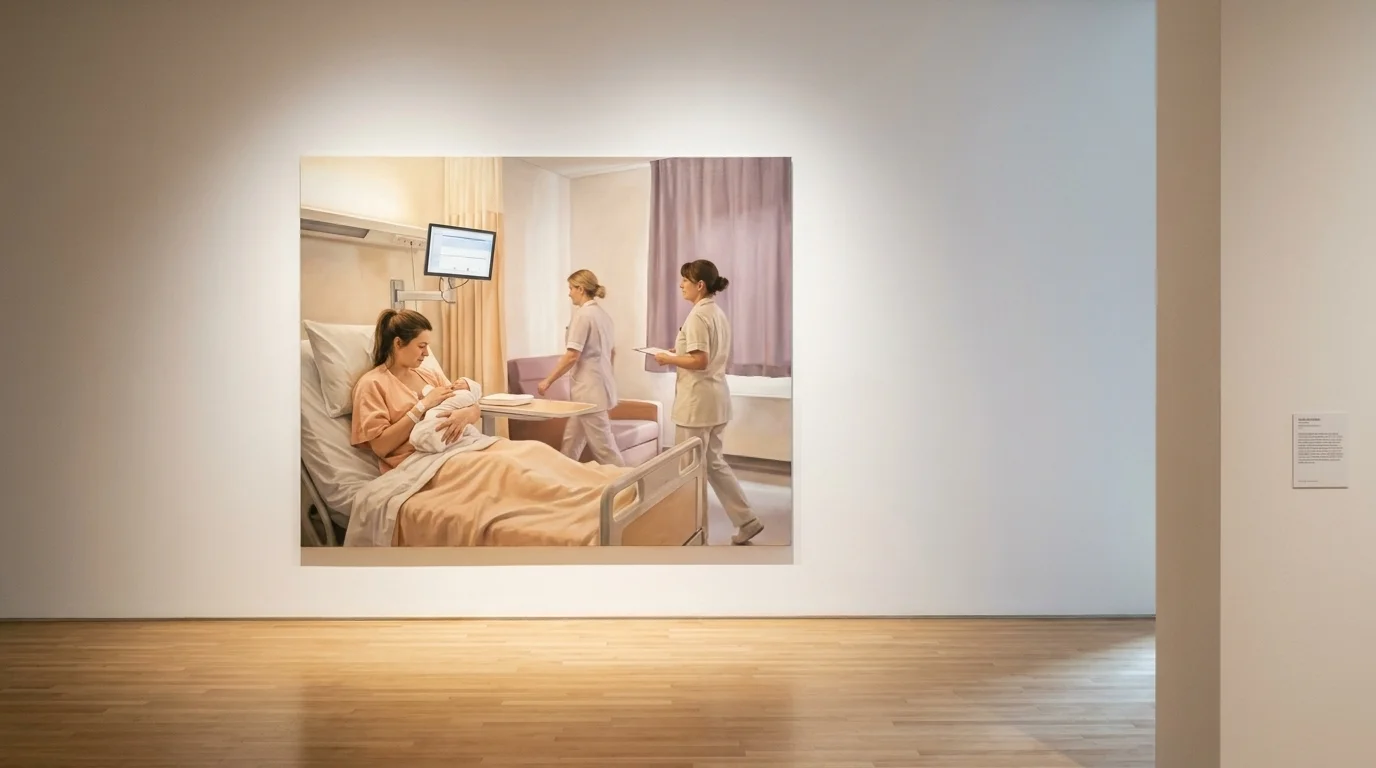
Caroline Walker is technically a painter rather than a photographer, but her Birth Reflections series (2024–25) — large-scale paintings of the hospital interiors and staff of contemporary maternity wards — works at the same level of social-document seriousness, and was the centrepiece of CNN Style's 27 May 2025 feature on how motherhood is being reframed in art (CNN Style). If you have only one new artist to look up after reading this, Walker is the one.
Outside the Anglo-European frame
A great deal of writing about motherhood art behaves as if Paris, London and New York invented the subject. They did not.
Frida Kahlo's My Birth (1932) — a small, brutal painting of Kahlo's own face emerging from the body of a deceased mother on a sheeted bed, with an icon of Mater Dolorosa watching from the wall above — is the historical anchor for any honest account of birth as a subject. It is also, by a wide margin, the first painting on this list that a major institution actually had trouble hanging. Madonna (the singer) bought it; she has said that anyone who can't handle it is not someone she could imagine being friends with.
Billie Zangewa, who grew up in Malawi and is based in South Africa, makes large hand-stitched silk tapestries of her own domestic life — bathing her son, working at a desk while he plays nearby, sitting alone in a kitchen at the end of the day. She is one of the artists Art Basel names as central to the parenthood-in-art reframing (Art Basel). Her medium — appliquéd silk, traditionally domestic, gendered — is part of the argument.
Tala Madani is Iranian-American; Mahesh Baliga is Indian; Celeida Tostes was Brazilian. Mickalene Thomas is African-American. None of them is making motherhood art "from elsewhere" in a way that needs flagging. They are simply making the work, often more interestingly than the canonical European centres have been making it lately, and the listicles that leave them out leave them out for reasons that are about the listicle and not about the art.
The 2020s reframing
It would be hard, looking at the institutional record of the last two years, to argue that the taboo is intact. Acts of Creation: On Art and Motherhood — a Hayward Gallery touring exhibition curated by Hettie Judah — opened at Arnolfini Bristol in March 2024, with 100+ artworks by 60+ artists across four themes (Creation, Maintenance, The Temple, Loss) (e-flux). It travelled, in 2025, to Dundee Contemporary Arts. The Museum of Arts and Design in New York opened Designing Motherhood: Things that Make and Break Our Births on 4 October 2025, running until 15 March 2026, with 60+ craft and design objects and over twenty contemporary artists including LaToya Ruby Frazier, Ani Liu, Tabitha Soren, Joan E. Biren and Jess Dugan (MAD Museum).
Hettie Judah, talking about the long shape of the change, has said that artists "were constantly being told that motherhood wasn't a subject for important art" (Art Basel). I find that quote useful, partly because it gives an honest account of why the canon was thin for so long — not because there was no work, but because the work was not allowed to count as important. The 2020s have, in a useable sense, lifted that ban. The interesting question now is what happens to the genre's seriousness as it moves from the long taboo into the gallery mainstream.
A small note to close
What I notice, walking the museums now with my children, is that the room has more honest mothers in it than it used to. There are paintings my own mother would not have been shown by her teachers. There are sculptures that admit the shape of birth. There are photographs that record a maternity ward as it is rather than as it ought to be. My daughter, the one who asked the question, has grown up assuming this is the ordinary stock of the museum, which is a small thing and a large one. I do not know if she will end up loving the Caroline Walkers or the Cassatts or the Kahlos. I know they are all hanging in the same building now, and that the building has admitted them.
Frequently Asked Questions
Mary Cassatt's The Child's Bath (1893) is among the most reproduced mother-and-child works of the 19th century. Picasso, Käthe Kollwitz, Gustav Klimt and Alice Neel each painted definitive 20th-century examples, and Caroline Walker and Mickalene Thomas are the leading contemporary voices working in the genre today.
Louise Bourgeois's Maman (1999) — a nearly nine-metre bronze spider, named with the French and Italian word for 'mum' — is the best-known contemporary sculpture about motherhood, and stands at the Guggenheim Bilbao, Tate Modern and other institutions. Brazilian artist Celeida Tostes's Passagem (1979) is a touchstone for self-birthing imagery in ceramic.
Mary Kelly's Post-Partum Document (1973–79) and Judy Chicago's Birth Project (1980–85) are usually cited as the conceptual openings. The 2020s reframing wave — anchored by exhibitions Acts of Creation (Hayward, 2024) and Designing Motherhood (Museum of Arts and Design, 2025) — has institutionalised the genre.
As curator Hettie Judah has documented, artists were repeatedly told that motherhood was not a serious subject for art. Judy Chicago has called it a subject 'shrouded in myth, mystery, and stereotype'. The Madonna and Child canon dominated for centuries; ambivalent or physical accounts of mothering had to work against that image rather than within it.
Acts of Creation: On Art and Motherhood (Hayward Gallery touring exhibition, opened Arnolfini Bristol March 2024, Dundee Contemporary Arts Feb–Jun 2025) and Designing Motherhood: Things that Make and Break Our Births (Museum of Arts and Design NYC, 4 October 2025 – 15 March 2026) are the two largest. Both feature 60+ artists across painting, sculpture, craft and design.
Caroline Walker's Birth Reflections (2024–25), Tala Madani's Shit Moms series, Billie Zangewa's appliquéd silk domestic tableaux, Camille Henrot's Wet Job, and the photographic and craft work surfaced by Acts of Creation and Designing Motherhood are the most-cited recent reference points. CNN Style's May 2025 feature on Walker is a useful entry point.