
Breaking Barriers: Empowering Single Dads to Thrive in Modern Parenthood


The question I hear most often from single dads in my consult room is whether the research says something specific about how their children are doing — whether being raised primarily by one father, rather than by two parents or by one mother, shows up in the developmental literature as a risk factor or a non-factor. The honest answer is that the literature is thinner than parents assume and that what it does show is mostly about the structural conditions of the household, not the gender of the parent inside it. Roughly 2.6 to 3 million households in the United States are now headed by a single father, with about 3.3 million children living with one as their primary parent (Statista, 2025; Gitnux, 2026). Single fathers make up about ten percent of all parents living without a partner, up from 7.3 percent in 2007 (O'Mara Law Group, citing 2022 Census). That is enough children to make the question worth answering carefully.
What the household actually looks like
The first useful thing to put on the table is that single-father households are not a worse-off version of single-mother households. They are, on the structural metrics that drive child outcomes, somewhat better-resourced on average and somewhat worse-served by the surrounding social system. Median single-father income is approximately $57,000 per year, about 25 percent higher than the median for single mothers (Gitnux, 2026). Fifteen percent of father-only households live below the poverty line, compared to twenty-eight percent of mother-only households (2022 Census, via O'Mara Law Group). Single-father employment runs near 88 percent.
That is the income side. On the support side, the picture inverts. Thirty-eight percent of custodial fathers receive no financial support from the non-custodial parent, compared to twenty-nine percent of custodial mothers (O'Mara Law Group, citing Census). Thirty-one percent of single fathers live with their own parents, a higher multi-generational housing rate than for partnered fathers and a strategy most often adopted for childcare coverage and cost-sharing rather than out of choice (ParentingReviews). I name these together because they cluster: the average single-father household has more income on paper, less support from the other parent, and a higher rate of compensating by absorbing grandparents back into the home. This is a structural pattern, not a personal failing pattern, and it is worth distinguishing because the two are routinely conflated in popular discourse.
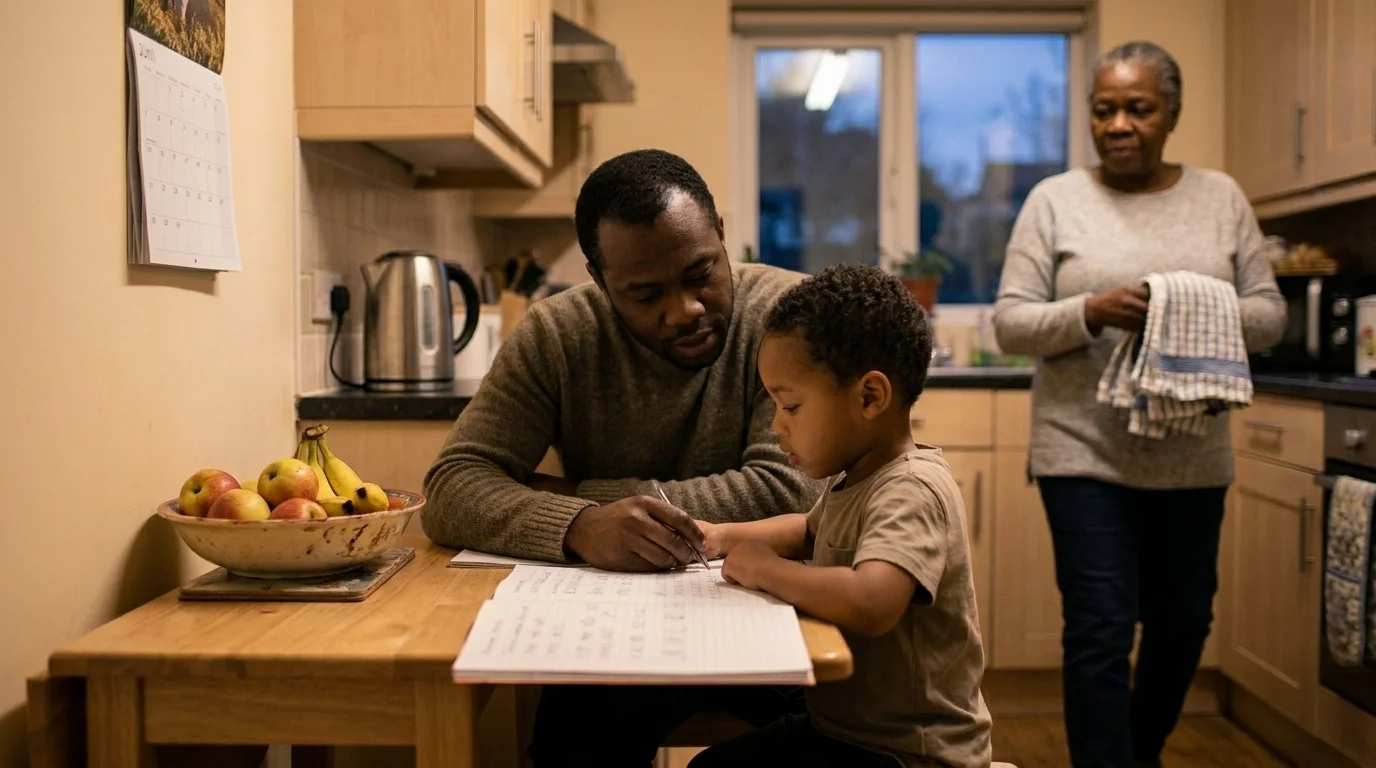
The stress signal — and why it matters
Sixty-five percent of single dads in the most recent U.S. survey data report high stress from balancing work and parenting, and forty percent specifically struggle with daily childcare logistics (Gitnux, 2026). These are self-report numbers, which means they are not measuring distress in the clinical sense — they are measuring how parents describe their own load when asked. That distinction matters because parent-report scales tend to capture the felt experience accurately but tend to over-attribute the cause to the role itself, when the load is often a consequence of how thin the surrounding support layer is. A single father with an employer that offers flexible scheduling and a school district with full-day care reports lower stress than a single father with neither. The stress is real; what produces it is the absence of structural slack more than the presence of a second parent.
This is also the point at which it becomes useful to talk about single-father mental health directly, because the popular discourse here is unusually thin and the research is unusually clear, in the small literature that exists.
What the research actually says about single-father mental health
The strongest recent finding comes from a 2025 Swedish national-register population study published in the Scandinavian Journal of Public Health. It compared psychological-distress rates between single fathers, single mothers, and partnered parents across the Swedish adult population and confirmed what a smaller body of earlier work had been suggesting: single fathers carry an elevated risk of psychological distress relative to coupled fathers (Sage Journals, 2025). A comparable signal appears in a 2023 Japanese cross-sectional study of national health-check data, which estimated distress prevalence at roughly 8.5 percent among single fathers versus 5 percent among partnered fathers — a small absolute gap, a meaningful relative one (PMC, 2023).
A note on interpretation. These are observational studies, not randomized trials. They tell us that single fatherhood and psychological distress travel together at population scale; they do not tell us that being a single father causes distress in any individual case. The most plausible mediating factors — social isolation, financial strain that is structural rather than personal, the absence of the daily co-parent who notices a shift in mood before the affected parent does — are themselves the things to address, not the role status. This is the recurring shape of population mental-health findings: the predictor names the elevated-risk group, the lever sits one or two layers underneath.
A separate, longer-standing finding worth flagging is the editorial framing in The Lancet Public Health describing single fathers as "neglected, growing, and important" in the research literature (Lancet Public Health). That phrasing reflects an honest read of the evidence base. Single mothers have been studied at orders of magnitude greater depth, and a significant share of what we believe we know about single-parent outcomes is actually what we know about single-mother outcomes generalized — sometimes accurately, sometimes not — to the smaller cohort of fathers. The clinical reality is that we are advising single dads partly on rigorous evidence and partly on extrapolation. When I say "we don't know yet" about a particular question in this area, I mean it literally.

Where to go for support, when the research ends
Because the research ends earlier than parents would like, the next layer of the answer is structural: knowing which specific programs and resources are oriented to single fathers, and which of them have actually been built with the population in mind rather than retrofitted from materials originally written for single mothers. The Maternal Mental Health Leadership Alliance maintains an annually-updated "Resources for Fathers" list — the 2025 edition names Postpartum Support International's Help for Dads program (coordinator-staffed, with closed Facebook peer groups), Dads with Wisdom (facilitated virtual and in-person dad groups), Boot Camp for New Dads (a peer father-to-father model with curriculum), Postpartum Men, and several others (MMHLA Resources for Fathers, 2025). For depression-specific support, the most evidence-anchored men-targeted free resource I am aware of is HeadsUpGuys, a Movember-funded online platform developed at the University of British Columbia (HeadsUpGuys). For peer dialogue without curation, the r/SingleDads subreddit remains the largest unmoderated single-dad community online; the trade-off is the usual one for forum spaces — high authenticity, no quality control, no clinical oversight.
These named programs are starting points, not substitutes for clinical evaluation. If you are reading this at eleven o'clock at night because something specific has been worrying you — your own mood, your child's behaviour at school, the shape of a separation — the named resources above are reasonable first stops, and a primary-care visit or a referral to a clinical psychologist is the right next stop after that. The structural finding is that single dads carry a measurable elevated risk and a measurable under-served support layer. The individual finding has to be done in a room, with a person, with the time to ask the questions a population study cannot.
That is where the research, honestly, currently ends.
Frequently Asked Questions
Single fathers now make up about ten percent of all parents living without a partner — about 2.6 to 3 million U.S. households — and they are doing the full range of parenting work without a co-parent in the room. That fact, repeated at population scale, is changing the assumption that primary caregiving is a maternal role. The shift is structural rather than ideological: it is what the demographic curve looks like, not what any individual is trying to prove.
A 2025 Swedish population study published in the Scandinavian Journal of Public Health found that single fathers carry an elevated risk of psychological distress relative to coupled fathers, and a 2023 Japanese national health-check study estimated distress prevalence at roughly 8.5% in single fathers versus 5% in partnered fathers. These are observational findings — they tell us single fatherhood and elevated distress travel together at population scale; they do not establish causation in any individual case. The most plausible mediators are social isolation, structural financial strain, and the absence of a daily co-parent.
The Maternal Mental Health Leadership Alliance maintains an annually updated Resources for Fathers list (2025 edition) that names Postpartum Support International's Help for Dads, Dads with Wisdom (facilitated virtual and in-person groups), Boot Camp for New Dads, and Postpartum Men. For depression-specific support, HeadsUpGuys — a Movember-funded platform developed at the University of British Columbia — is the most evidence-anchored free men-targeted resource. The r/SingleDads subreddit offers raw peer dialogue without curation.
The single most useful structural step is reducing the load that produces the stress, not the stress itself — using whatever flexible-work option the employer offers, building a small reliable circle of one or two adults who can step in for emergencies, and treating sleep as non-optional rather than the first thing cut. Sixty-five percent of single dads report high stress from balancing work and parenting (Gitnux, 2026), and that figure shifts considerably when even one piece of structural slack is added back into the week.
Custodial fathers are more likely than custodial mothers to receive no financial support from the non-custodial parent (38% versus 29%), and single-father households compensate at a higher-than-average rate by absorbing grandparents into the home (about 31% live multi-generationally). A supportive network is, in practice, what fills the structural gaps the formal support system does not cover. The peer-group layer also addresses the social isolation that population studies consistently flag as the mediating variable behind elevated single-father distress.
Check Out These Related Articles
Thriving Amidst Single Parenthood Challenges: Inspirational Stories of Strength and Resilience

The Art and Science of Nursery Colors: Creating Stimulating Yet Soothing Environments for Infants

Navigating Parenthood Milestones: Expert Insights on Raising Children