Beyond Academics: Fostering Creativity in Children


The reason I want to write about creativity in children — and the reason this is worth the next ten minutes of your time as a parent — is that the trend line is not flat. The single largest study of children's creative-thinking scores, Kim's 2011 analysis of 272,599 K-12 students across six normative samples of the Torrance Tests of Creative Thinking, found that creative-thinking scores in U.S. children have significantly declined since 1990, even as IQ scores rose — with the steepest decline among kindergartners through third graders. Newsweek put it on the 2010 cover, and the data has not improved since.
What has changed is the conversation. A December 2025 Crayola / Talker Research survey of 2,000 U.S. parents of 8-to-12-year-olds found that 85% of parents agree "creativity equals success for my child's future," and 73% believe creativity will matter more for their children than for previous generations specifically because of AI. That is the modern shape of raising creative kids: parents understand the stakes, the measurement says the inputs are weakening, and the AI tools now arriving in classrooms have not yet been domesticated for creative development. So the question this article is built to answer is the practical one — what does evidence-anchored creative development in children actually look like, in 2026, beyond academics?
What creativity actually is (and how scientists measure it)
It is worth pausing here, because "creativity" is one of those words people use to mean roughly fourteen different things. The framework that has held up best over fifty years of research is the one J.P. Guilford introduced in his 1950 American Psychological Association presidential address and elaborated in 1956: the distinction between convergent thinking (one correct answer — what schools mostly test) and divergent thinking (many possible answers from a single starting point — what creativity actually requires).
Guilford's framework became measurable through the Torrance Tests of Creative Thinking, developed by E. Paul Torrance in 1966 and re-normed five times since. The TTCT scores divergent-thinking output on four dimensions: fluency (how many ideas), flexibility (how varied), originality (how unusual), and elaboration (how developed). It is the closest thing the field has to a standardized creativity ruler, and it is the instrument Kim used in the analysis above.
Two other names belong in this paragraph, because no parent-facing competitor I have read names them. Mihaly Csíkszentmihályi's research on flow — the state in which a person becomes wholly absorbed in a moderately challenging task — is the developmental psychology of intrinsic motivation, and it is the mechanism behind the creative engagement you have probably seen in your own child when they refuse to come to dinner because they are drawing. And Sir Ken Robinson's 2006 TED talk "Do schools kill creativity?" — the most-watched TED talk of all time — is the cultural argument that gives the empirical findings their teeth.
A correlation/causation caveat, in plain language: TTCT scores have declined and IQ scores have risen over the same period, which tells us these things are travelling in opposite directions in the population; it does not, on its own, tell us which causes which, or what part schools, screens, or schedules each contribute. The signal is real. The exact lever to pull is the part the research is still arguing about.
What a creative home actually looks like
The most useful single finding for parents on the strategy side comes from the Crayola / YouGov 2024 survey of 707 children ages 6–12: when asked what motivates them creatively, 46% of children said being recognized for the effort involved, versus only 22% who said an adult saying "your art looks good." Read those two numbers twice. The standard adult instinct — to compliment the output — is roughly half as motivating for children as the boring-sounding alternative of noticing how hard they worked or what they tried.
The operational version, then, is small and repeatable. What part was hardest? in place of that's beautiful. I noticed you tried it three different ways in place of you're so creative. What were you trying to do here? in place of what is it? The materials matter less than this; an open box of crayons used by a child who is praised for the trying will outperform a fully kitted-out craft cabinet used by a child who is praised for the result. (NAEYC's own guidance for families puts this same instinct under the heading "process over product," and it has been their position for years.)
A short word on screens, because the question always arrives. The evidence on screen time and creativity is messier than the headlines, but the practical principle holds: a screen that displaces creative time costs creative time, and a screen that scaffolds or sparks it (a documentary about a sculptor, a museum livestream, a tutorial the child returns to once and then sets aside) does not. The variable is what the screen is replacing, not the screen itself.
Related Article: Unveiling the Secrets of Neuroplasticity in Child Development
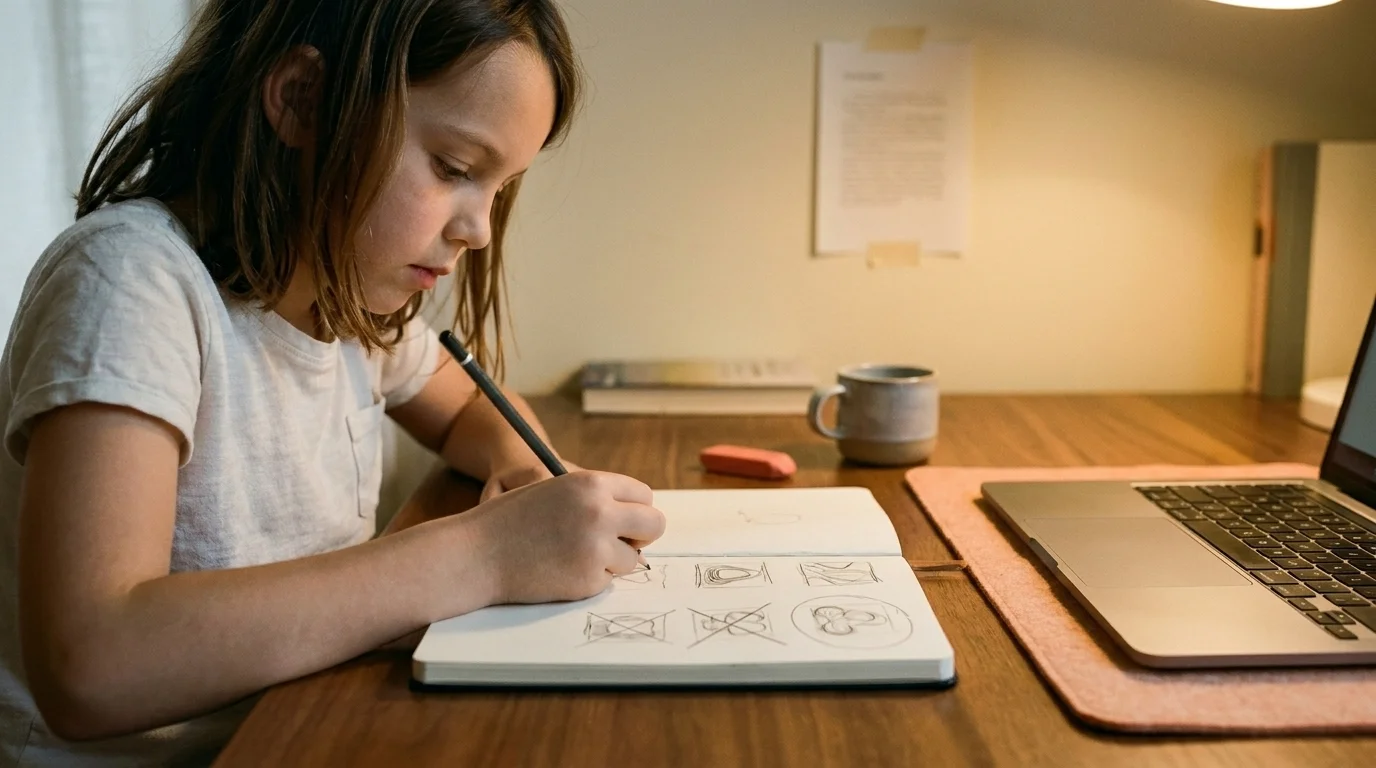
Visual art: process over product
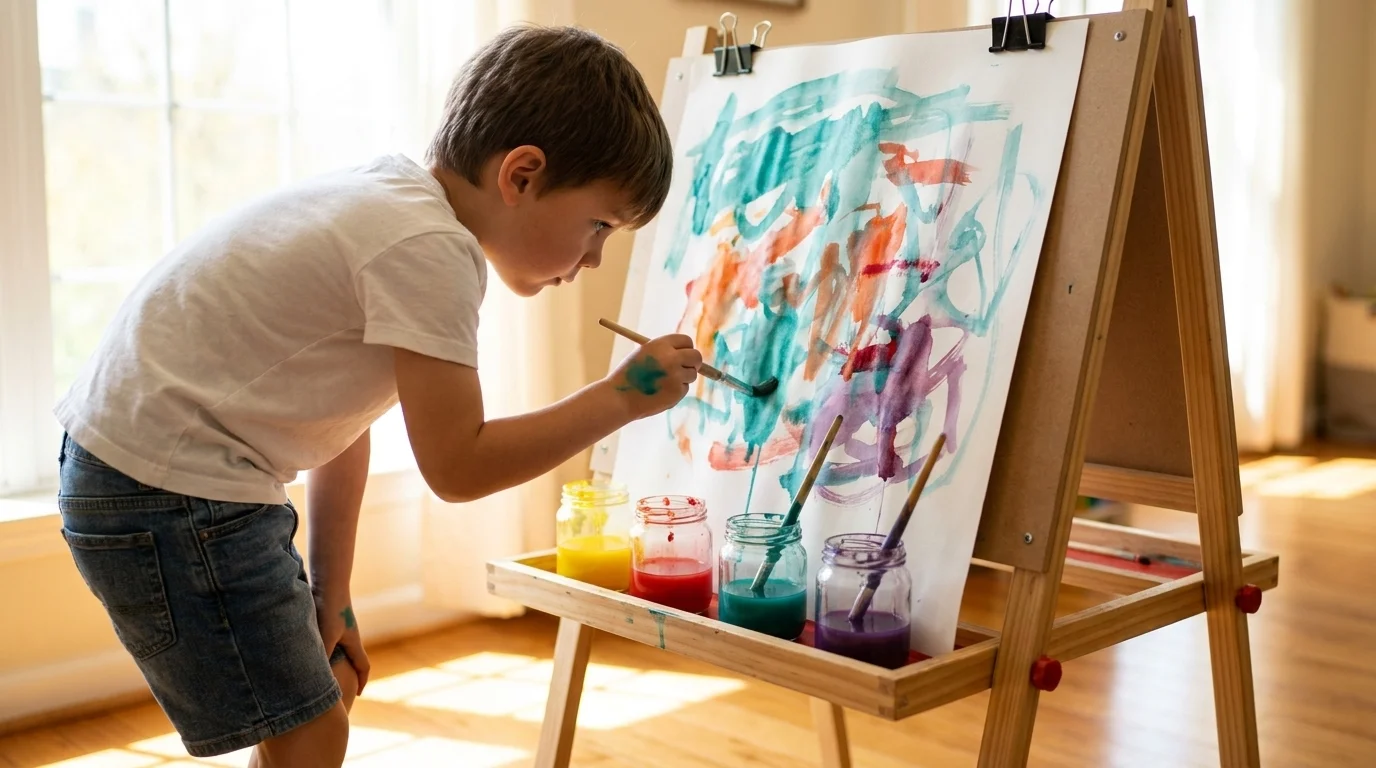
The visual-art modality is the easiest to get wrong in service of the fridge. The Reggio Emilia tradition — developed in northern Italy in the 1940s and now influential across early-childhood education — frames children's art as a "hundred languages" of expression rather than the manufacture of objects suitable for adult display. The practical translation: prefer materials that have no built-in "right answer." Plain paper over coloring books. Loose clay over a kit. A brush, water, and three colors of liquid watercolor over the twelve-piece set with a picture on the box.
A toddler script: set out two colors of paint and one sheet of paper, sit down with your own piece of paper next to them, and paint a mark you would not normally make. Say nothing about their painting. After three minutes, ask what they noticed. A school-age script: give them a blank index card and say, "draw the inside of a feeling." A tween script: hand them a magazine and a pair of scissors and ask them to make one image out of three pages, without explaining why.
Music: improvisation, not just lessons
The thing I want to flag here, because the lessons-vs-improvisation distinction is largely missing from parenting articles, is that formal music lessons and creative musical development are not the same intervention. Lessons build technique and discipline. Improvisation — humming a song you make up in the car, banging on pots in a rhythm you invent, singing nonsense words to the dog — builds the divergent musical thinking Guilford was describing.
A toddler script: put on instrumental music and dance for one song with no rules, including stopping and starting. A preschool script: give them a wooden spoon and a few overturned containers and ask them to play "the sound of being happy," then "the sound of being a thunderstorm." A school-age script: hum or sing the first line of a song they know; they have to make up the second line. A tween script: have them set the alarm-clock tone on their phone to a melody they composed in a free music app.
Related Article: Cultivating Resilience in Children: Building Emotional Strength
Storytelling and writing: the narrative engine
Stories are the easiest place to practise divergent thinking because there is no equipment to buy and no end product to evaluate. The developmental psychology behind narrative imagination — children's growing capacity to imagine perspectives, sequence events, and entertain counterfactuals — is one of the most heavily studied areas of preschool cognition.
A toddler script: at bath time, ask "what if the duck could only talk underwater?" and play it out. A preschool script: take turns telling a story one sentence each, starting with "one day, a very small bear opened a very large door…" A school-age script: ask them to retell a real event from school from the perspective of the wrong person in the room. A tween script: give them this prompt — "write 200 words in which the most important sentence is the one you don't write" — and read it without commenting on whether they "did it right."
Divergent-thinking exercises: the Guilford prompt, age-adapted
The most direct way to practise divergent thinking is to do the kind of task the TTCT actually measures: list as many uses as you can for an ordinary object, in a fixed amount of time. Guilford called it the Alternate Uses Task. It needs no setup, scales from age three upward, and is the single highest-yield two-minute activity I know of for creative cognition.
A toddler script: hold up a wooden spoon and ask, "what else could this be?" — accept "telephone, hat, shovel" without correction. A preschool script: set a two-minute timer with a brick or a shoe and ask, "how many things could this be?" A school-age script: list 30 uses for a paperclip on a piece of paper before the timer runs out. A tween script: three constraints — list 15 uses for a tennis ball, none of which is a sport, ball-shaped, or in your bedroom. The discipline is not the volume of ideas; it is the willingness to say the dumb ones out loud.
Let them fidget
A finding worth knowing about, because it is brand-new and counterintuitive: Oppezzo and colleagues' 2025 Journal of Educational Psychology study, summarized by Stanford's Accelerator for Learning, tested 32 sixth-graders and 43 seventh-graders in a within-subject design on a divergent-thinking task (uses for bricks and tires, scored on a novelty ratio). Roughly 80% of the sixth-graders and 82% of the seventh-graders produced more novel ideas when allowed to fidget on a wiggle stool than when asked to sit still — with no significant change in attention or memory.
That last clause is the one I want you to hold. The standard objection to letting children move is that they will lose focus, and the evidence in this sample said they did not. Body movement during a creative task appears to be doing useful cognitive work. The conservative parent move is permissive: at the homework table, the dinner table, the reading bench, let the legs swing and the hands fidget.
Beyond academics: the creativity crisis and the AI era
This is the modern version of the conversation Robinson started in 2006, and it has acquired teeth. The relevant 2024–2025 evidence:
A 2024 CHI conference study by Wadinambiarachchi and colleagues on generative-AI-assisted ideation found that humans exposed to AI-generated images during an ideation task experienced higher design fixation and lower fluency, variety, and originality than humans working from a blank prompt. The result is not a death knell; it is a methodological warning. When the ideation pool is pre-narrowed by AI output, the human ideation pool narrows further to match it.
A 2025 Scientific Reports study by Bellemare-Pepin and colleagues found that ChatGPT-4o, DeepSeek-V3, and Gemini 2.0 outperformed adult humans on both the Alternate Uses Task and the Remote Associates Test — the two most-used divergent- and convergent-thinking instruments in the literature. This is the technical underpinning for what the Crayola / Talker survey caught at the household level: 35% of parents in the December 2025 survey worry AI is reducing their child's creative thinking, and 30% fear AI will limit their child's workforce opportunities. The children, interestingly, are less alarmed — only 22% worry AI will hurt their own creativity, and 68% display hand-made work at home.
What I would tell a parent in my office, when this question arrives at the end of an appointment about something else, is this. Use AI as a constraint or a critique partner, not a substitute for the child doing the ideation themselves. "Generate three ideas first; then ask the model what it would do; then notice where your ideas differ" is a pedagogically sound use of these tools. "Ask the model to do it and copy the best one" is the use that the 2024 CHI data says erodes the thing you came here to build.
Creative development by age
A short reference grid, because every modality above benefits from a developmental anchor:
- Toddler (1–3): movement and material. The work of this age is sensory: paint on hands, dough in fists, voice into the room. Provide unstructured materials and a tolerance for mess. Avoid kits.
- Preschool (3–5) — creativity in early childhood: the symbolic leap. Pretend play, drawing as representation, "this stick is a sword." Their drawings start to mean something specific even when you can't tell what. Ask, don't guess.
- School-age (6–10): rules and remixes. They can hold and bend a structure now. The age of fan fiction, of music made on free apps, of inventing playground games with eight rules. Praise the trying, not the product.
- Tween (10–13): voice and audience. Creative work starts to be for someone — a peer, a stranger online, an imagined reader. Their willingness to take creative risks is fragile and often-recoverable. Read what they show you. Comment on the part you noticed, not the part you wished they had done.
Three modern threats to creative development
Three patterns I see consistently in clinic, and that the literature broadly supports as risks rather than discrete diagnoses: over-scheduling, where every hour of the week is assigned to a structured activity and the unstructured creative time that produces flow has nowhere to live; screen saturation, where the displaced activity is the cost, not the screen itself; and AI displacement of ideation, the newest one — where the easier route is to ask the model and the harder, more useful route is to think first. The parent move for each is the same in shape: protect a window, every week, that is unscheduled, off-screen, and ideation-first.
Creative confidence: praise the process, not the product
The single line to close on, because it returns us to where we started: the Crayola / YouGov 2024 data on what motivates children creatively found that 92% of children ages 6–12 say creative activities boost their confidence, and 53% wish they could spend more creative time with their parents. Read those two numbers as a single sentence. Your children are telling you what they want. The work of fostering creativity in children, in the end, is mostly showing up — alongside them, with a piece of paper of your own, paying attention to the trying.
For the play-mediated mechanism — imaginative and unstructured free play — and how it drives cognitive and social development, see our companion guide on the power of play in child development.
The literature is humble about which lever, in any individual home, will move the needle. What it is not humble about is the direction of the trend, the value of the cognitive skill, and the fact that the adult in the room is the variable most under your control.
Frequently Asked Questions
Creativity strengthens divergent thinking — the ability to generate many original ideas from one starting point — which developmental psychologist J.P. Guilford distinguished from convergent (one-correct-answer) thinking in 1956. It supports problem-solving, emotional expression, and intrinsic motivation. In the December 2025 Crayola/Talker survey of 2,000 parents, 85% agreed creativity equals success for their child's future, and 73% said it will matter more for their children because of AI.
Lead with materials that have no built-in 'right answer' — plain paper over coloring books, loose clay over kits, three colors of liquid watercolor over the twelve-piece set with a picture on the box. Then change how you talk about what the child makes. The Crayola/YouGov 2024 survey of children ages 6–12 found that 46% are motivated by being recognized for the effort versus only 22% by 'your art looks good.' Praise the process. Ask what was hardest. The materials matter less than the talking.
Toddlers (1–3) want sensory and movement-based work — paint on hands, dough, dancing to music. Preschoolers (3–5) move into symbolic play and drawing as representation. School-age children (6–10) can hold structures and remix them — making up rules, retelling stories from new perspectives, listing 30 uses for a paperclip. Tweens (10–13) start creating for audiences and need their willingness to take risks protected. The constant across ages is the same: unstructured time, open-ended materials, and praise that lands on the trying.
Divergent thinking is the ability to generate many original ideas from a single starting point — coined by psychologist J.P. Guilford in 1956 and measured by the Torrance Tests of Creative Thinking (TTCT) since 1966 on four dimensions: fluency, flexibility, originality, and elaboration. It's the cognitive engine behind creativity, and unlike IQ, it can be strengthened through practice — across art, music, storytelling, and the Alternate Uses Task ("list as many uses as you can for a brick in two minutes").
Yes, by the most widely-cited measure. Kim's 2011 analysis in the Creativity Research Journal of 272,599 K-12 students across six normative samples of the Torrance Tests of Creative Thinking found significant declines in creative-thinking scores since 1990 — even as IQ scores rose — with the steepest decline among kindergartners through 3rd graders. The methodology has been debated, but the finding is the empirical spine of the modern "creativity crisis" conversation in education and parenting.
The 2024–2025 evidence is mixed but worth taking seriously. A 2024 CHI study (Wadinambiarachchi et al.) found human ideation became less fluent, varied, and original when scaffolded by AI-generated images — design fixation rose. A 2025 Scientific Reports study (Bellemare-Pepin et al.) showed AI models now outperform adults on standard divergent- and convergent-thinking tests. In the December 2025 Crayola/Talker survey, 35% of parents worried AI is reducing their child's creative thinking. The practical move: use AI as a constraint or critique partner, not a substitute for the child doing the ideation themselves.