
The Juggling Act: Balancing Motherhood and Professional Life


It's 6:47 on a Tuesday. You logged off Slack at 6:30 with a half-finished proposal in a draft. The four-year-old is in the bath, the eight-year-old is asking what's for dinner for the third time, and your partner is on a call he said would take twenty minutes — that was thirty-five minutes ago. You haven't eaten lunch. You're not tired, exactly; you're something more specific than tired. The clinical name for the loop in the back of your mind — that you should be doing all of this better — is mom guilt.
That last feeling has a name now: working mom guilt. It is statistically near-universal — a 2026 Kantar/Teleflora national survey found 91% of mothers experience it, and 94% of working mothers report it specifically. What's different about 2026 is that we finally have the vocabulary, the data, and a few peer-reviewed frameworks for understanding what's actually going on. What's also different is that most of the advice in your search results is still ten years old, written for a labour market that doesn't exist anymore, in a country whose childcare math you may not share.
I wrote this guide as both a financial journalist and someone who once stood in that 6:47 kitchen scene with a cold mug of coffee. The honest answer in this domain is often: this is a structurally bad deal, and here's why, and here's the small set of moves that genuinely help. We'll do the math, we'll name the conditions, and we'll get to a partner-conversation script that actually works.
What These Conditions Are Actually Called
Before we go anywhere else, four definitions. They each have research and clinical practice behind them, and naming them is the first thing the Kantar guilt research and the Cleveland Clinic burnout research agree about.
- Mom guilt — the persistent feeling that you are failing at motherhood, work, or both, regardless of objective evidence. Cleveland Clinic and the Kantar 2026 data treat it as a near-universal experience among modern mothers, not a personal flaw.
- Depleted Mother Syndrome (DMS) — a framework popularized by Cleveland Clinic's Dr. Amy Sullivan, PsyD describing chronic exhaustion, cynicism, and a sense of underperformance after sustained caregiving with too little support. It is not a formal DSM diagnosis. It is a clinical shorthand for what many mothers actually present with.
- Mental load — the cognitive and emotional labour of running the household: noticing what needs to happen, planning it, remembering it, delegating it, and following up. The Bright Horizons Modern Family Index 2025 measures it: working mothers carry 74% of the mental load; working fathers, 48%.
- Matrescence — the developmental identity shift a woman undergoes upon becoming a mother. The term was coined by anthropologist Dana Raphael and modernized in clinical use by Dr. Aurélie Athan at Columbia. The framing matters: matrescence is treated as a life stage analogous to adolescence — disorienting, hormonal, identity-restructuring, and not a failure to "bounce back."
If those four words let you re-read the last week of your life with new labels, that's the work.
The Numbers
Pulled together because every guide on this topic talks in vibes when it should be talking in data:
- 91% of mothers experience mom guilt. 94% of working mothers do. (Kantar/Teleflora, April 2026)
- ~50% of Gen Z moms and 40% of millennial moms feel guilty daily. (Kantar 2026)
- 65% of working parents report burnout; 70%+ of mothers feel burned out at least weekly; 81% of working moms feel burned out balancing work and family. (Wellhub / Bright Horizons 2025)
- 74% / 48% — share of the parenting mental load carried by working mothers vs. working fathers. (Bright Horizons Modern Family Index 2025)
- 64% rise in the share of women reporting poor or fair mental health between 2016 and 2023. (JAMA Internal Medicine, cited by Starglow Media)
The takeaway isn't "everyone is doing badly so don't worry about it." The takeaway is that what feels like a personal failure is, statistically, a structural condition.

Related Article: The Modern Moms Guide to Juggling Work, Kids, and Self-Care
Mom Guilt and Mom Rage: What's Actually Driving It
A 2026 peer-reviewed study in Equality, Diversity and Inclusion — "Blame, balance and beyond: the cognitive mechanics of 'mom guilt' in working mothers" — identifies five cognitive themes that frame and sustain mom guilt:
- Perceived unfairness — recognizing that you are doing more than your share.
- Self-policing under gendered norms — judging yourself by standards you didn't consent to.
- Normalization of unequal workloads — accepting "this is just how it is" because the alternative requires confrontation.
- Trade-off rationalization — telling yourself the math works when it might not.
- Compensatory over-performance — over-scheduling, over-baking, over-planning to make up for working.
The Kantar 2026 survey adds the trigger-level data: the top reported drivers of mom guilt are not enough quality time (36%), feeling distracted or overwhelmed (33%), and comparing oneself to other moms (30%). The same survey found 61% of mothers cite themselves as the primary source of guilt; 28% blame social media; 71% feel pressure to be a "perfect" mom.
What this combined picture tells me, having looked at this kind of data for a decade: most of the guilt is downstream of structural unfairness, and a meaningful fraction is upstream of it — generated internally and then attributed to the structure. Both are real. The first one needs negotiation. The second one needs different tools.
The "different tools" part is where the older "self-care = bubble bath" advice actively fails women. The clinical alternative gaining traction in 2026 is DBT (Dialectical Behavior Therapy), specifically the distress-tolerance and emotion-regulation skills. Two named techniques that mothers I've interviewed actually use:
- TIPP — Temperature, Intense exercise, Paced breathing, Progressive muscle relaxation. A 90-second physiological reset for the moment when guilt has spiked into rage. Splash cold water on your face, do twenty jumping jacks, and the system regulates faster than you can talk yourself down.
- Opposite action — when guilt tells you to over-perform (skip lunch to make a school event you don't actually need to attend), do the opposite of what the emotion is pushing toward. Eat lunch. Skip the event. Notice what doesn't break.
Mom rage — the 1,300/mo search query nobody talks about politely — is, in my reading of the research and the lived experience, mostly what mom guilt looks like when the body has run out of compliance. TIPP is for that.
How to Explain the Mental Load to Your Partner
This is the section the search data tells me you actually came for, even if you typed something else. The query "how to explain mental load to husband" gets ~590 monthly searches and almost no useful answers. Here is the most useful thing I can tell you: the conversation that doesn't work is the one about help. The conversation that works is the one about ownership.
Help means you remain the manager. He might wash the dishes you asked him to wash; you remain the person who noticed they needed washing, decided it was time, and asked. Ownership means he is the manager of a thing — start to finish, including the noticing and the planning. The 74% / 48% split won't move until ownership transfers, not just hands.
A working script, drawn from what I've heard work in dozens of households:
"I want to talk about how we run the house. Not about who does which chore — about who runs which chore. Right now, I am the manager of basically everything: meals, the calendar, school forms, doctor appointments, birthday parties, gifts, laundry rotation, what we're out of, what's due when. You help with a lot of it. The problem is that managing it is itself the work, and I'm the only one doing that part.
I'd like to hand off three of these completely. Not 'help with' — own. I'm thinking: school forms and communication, pediatrician appointments and follow-ups, and weekly meal planning plus groceries. Owning means you notice when something needs to happen, you decide when, you do it or delegate it, and I don't ask. If something falls through the cracks, that's information for us, not a reason for me to take it back.
Can we try this for six weeks and then talk about how it's going?"
What this script gets right: a frame (running vs. doing), a specific list (three things, not "help more"), a clear definition of ownership, and an end date for the trial. What it doesn't do: blame, escalate, or moralize. The data is on your side without you having to wield it; the case has already been made by the Bright Horizons Modern Family Index.
A jurisdiction note for couples on different ground: in two-mother households, in single-parent-with-grandparent households, and in households where the working partner already does carry equivalent load, the same conversation still applies — the principle is reassigning managerial work, not gendered work. Adapt accordingly.
Childcare Math: When Working Pays and When It Doesn't
Here is the section that's largely missing from every other article in this space. The question "should I work?" is downstream of the question "what does working actually pay, in this household, on this schedule, in this jurisdiction?" Let's actually do the math.
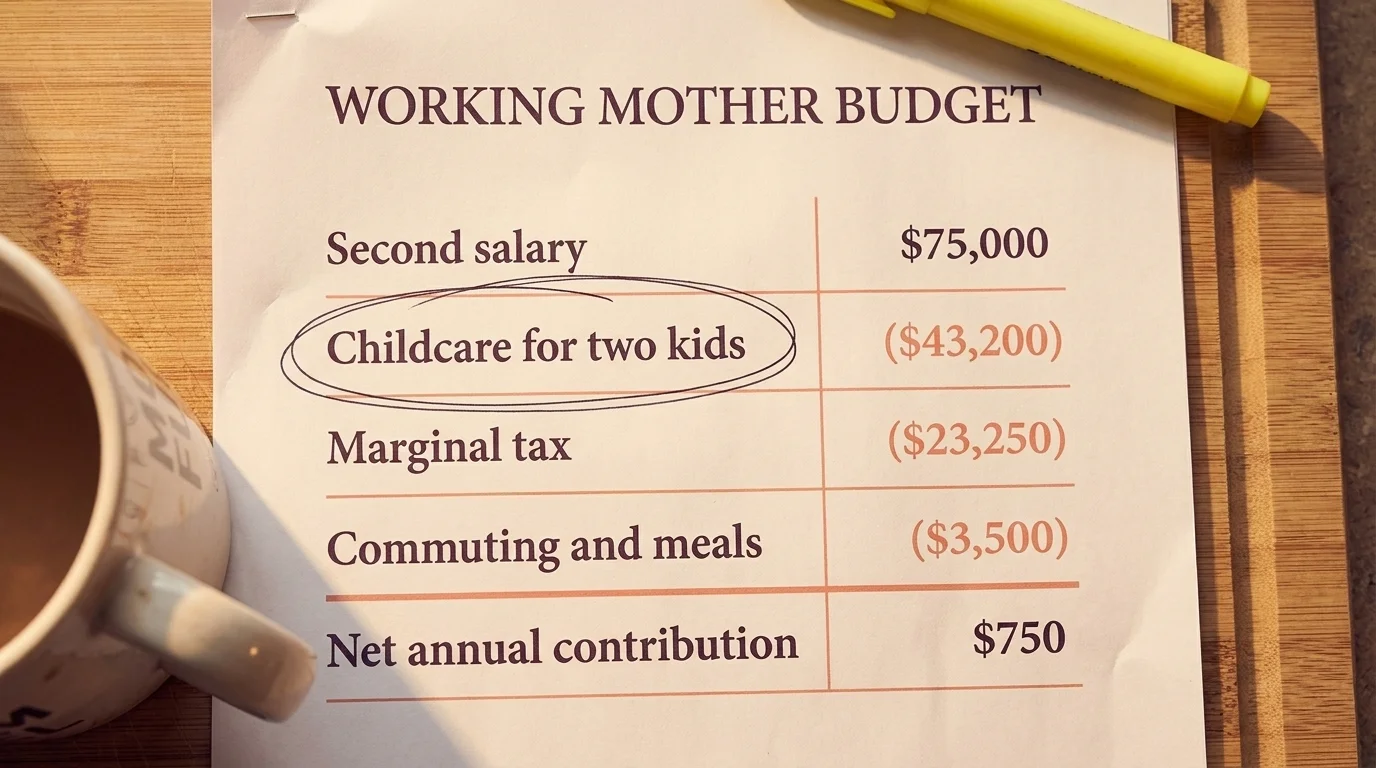
A worked example for a Canadian household with one toddler and a school-age kid, second earner considering returning at $75,000 CAD:
- Gross second salary: $75,000
- Marginal federal + provincial tax (Ontario, ~31% combined on this bracket): -$23,250
- CPP, EI: -$4,300
- Childcare for two kids — pre-$10/day market rate, GTA, $1,800/month/child × 12 × 2: -$43,200
- Commuting + work meals + work clothing: -$3,500
- Net annual contribution to household: ~$750
For a US household at $75,000 USD with the same childcare profile in a major metro, the marginal-tax math is similar but the childcare subsidy environment is much thinner. The dependent-care FSA caps at $5,000 of pre-tax savings; a Child and Dependent Care Credit recovers a small percentage on a small base; the rest is full-cost. Net contribution often lands in the same low-thousands range — sometimes negative.
The number that doesn't appear in either calculation but should: the lost-compounding cost of pausing retirement contributions during a 2- to 4-year break. A $20,000-per-year RRSP/401(k) gap, compounded at 6% over 30 years, is roughly $158,000 of retirement wealth not deposited. That cost is real, and it is the strongest financial argument for staying employed in some structure even when the year-one math looks bad.
What this means for you: the calculation should never be "should I work?" — it should be "what work structure pays?" Three combinations that frequently shift the math from break-even to actually-worth-it:
- One parent at 4 days, one at 5 — saves a day of full-rate childcare without halving income; the marginal-tax effect on the dropped day is small.
- Hybrid or remote roles that eliminate commuting and meal costs — the $3,500 line item above is bigger than people think.
- Subsidized childcare access, where it exists. Which brings us to Canada.
A note on Canada's $10-a-day program — what's real, what isn't
The federal Canada-Wide Early Learning and Child Care program targeted an average of $10/day per regulated space by March 2026. The headline is real; the access is uneven. As of late 2025, 122,788 of a planned 250,000 new spaces had actually opened, held back partly by an early-childhood-educator workforce shortage. Provincial implementation varies: Quebec has had subsidized care for decades and integrated quickly; Ontario, BC, and Alberta are mid-rollout with long waitlists; Newfoundland and Saskatchewan have moved fast on rate cuts but not space creation.
The uncomfortable equity finding is in The Northern Star's analysis: higher-income households (29% of $100K+) report knowing someone using the program at meaningfully higher rates than lower-income households (16% of <$50K) — a structural problem when waitlists reward early registration and stable employment, both of which correlate with income.
What this means for you: if you live in Canada and are doing this math, your provincial waitlist position is the variable that matters more than any spreadsheet I can draw. Get on it before the second trimester. If you're in the US, the question is whether your employer offers a dependent-care FSA and you can find regulated care at all — both of which are increasingly rare in 2026.
What Doesn't Work
A short list of advice you've probably read in this space that the data, the lived experience, or the honest conversation contradicts:
- "Lean in." Sheryl Sandberg's framing, useful in 2013, presumes a labour market and a household structure that aren't generally available in 2026. If leaning in means absorbing more work without renegotiating the underlying split, the 74% / 48% mental-load gap grows. Lean in only after the ownership conversation, not instead of it.
- "Self-care is a bubble bath." The bubble bath is fine. It is not treatment for chronic depletion. The Cleveland Clinic framing of DMS treats it as a sustained-stress condition; it responds to structural changes (sleep, support transfer, boundary setting), not 20-minute interventions. If your "self-care" is a thing you have to schedule between two work shifts, it is a fourth shift.
- "Just communicate with your employer." Employer flexibility promises survive contact with the calendar at very different rates depending on the manager, the team culture, and how much your role is measured by output vs. presence. The honest version of this advice: get the flexibility in writing in your offer letter or your performance review, not in a hallway conversation.
- "Find your village." A genuine community helps; "find one" as instruction is empty. Most working mothers I know have rebuilt one specific exchange — a school-pickup swap, a sick-day backup, a Friday-night-meal trade — rather than a generalized village. Build the exchange.
- "Bounce back." Matrescence is not a failure to bounce back. It is a developmental stage. The body, the identity, and the values are reorganizing. Pretending otherwise is one of the cleaner ways to generate guilt.
Matrescence: The Identity Shift Nobody Warned You About
The reason "rediscovering yourself" advice tends to land flat is that it assumes the self in question is the pre-baby self, waiting somewhere to be re-found. The matrescence framing — again, from Dr. Aurélie Athan at Columbia — is more useful: there isn't one. There is a new self, in formation, and the question is what to integrate, not what to recover.
This shows up in the workplace too. The mother who returns from leave is not the employee who left. Her cognitive style has changed (hypothesis-driven research suggests parents' executive function reorganizes around interruption and prioritization). Her risk tolerance has changed. Her tolerance for low-stakes corporate theatre has, in my experience interviewing returning mothers, almost always dropped sharply. Returning to the same job and expecting to be the same employee is a category error.
Two practical moves:
- Treat the first year back as a rebuild, not a continuation. Renegotiate scope where possible. Drop the commitments that no longer fit who you are, not who you were.
- Find one peer who is two years ahead of you. Not a mentor; a peer. Someone who has done the rebuild and can tell you what fell into place and what didn't. This is the highest-leverage relationship in this period of life.
What This Means for You
If you remember three things from this article, make them these. One: the conditions you are dealing with have names — mom guilt, depleted mother syndrome, mental load, matrescence — and naming them is genuinely the first useful step, because it converts a private failure into a measurable condition with research and treatment. Two: most of the math problems in this space don't get solved at the individual level; they get solved by transferring ownership of the mental load, by choosing the right work structure for your jurisdiction, and by building one or two specific exchanges rather than a vague community. Three: the things that actually move the needle — the partner conversation, the work-structure renegotiation, the DBT skill, the Canadian provincial waitlist — are not glamorous. They're spreadsheet moves. That, in this domain, is the good news.
The kitchen scene at 6:47 doesn't fully resolve. It gets less corrosive when you stop treating it as evidence about you and start treating it as evidence about the system you're operating inside. That is, in the end, the most useful framing this entire body of research offers a working mother in 2026.
Frequently Asked Questions
Honestly — most generic time-management advice (prioritize, set goals, schedule) fails working mothers because it treats time as the bottleneck when the actual bottleneck is the mental load. The higher-leverage move is to transfer ownership of recurring tasks (school forms, pediatrician appointments, weekly meal planning) entirely to a partner or paid support, not just to schedule them more efficiently. Bright Horizons 2025 data shows working mothers carry the mental load 74% of the time vs 48% for fathers; closing that gap matters more than any productivity system.
It matters, with one important caveat: employer flexibility promises survive contact with the calendar at very different rates depending on the manager, the team culture, and how much your role is measured by output vs presence. The practical version of this advice is to get flexibility commitments in writing — in your offer letter, in a performance review, or in a documented manager agreement — not in a hallway conversation. Verbal promises tend to evaporate when a project deadline lands.
Because chronic depletion has measurable health consequences — JAMA Internal Medicine reported a 64% rise in women reporting poor or fair mental health between 2016 and 2023. But the frame of 'self-care = bubble bath' actively fails women: it treats a structural condition with a 20-minute intervention. The clinical alternative gaining traction in 2026 is DBT (Dialectical Behavior Therapy) — specifically distress-tolerance skills like TIPP and emotion-regulation skills like opposite action — which target the actual physiological and cognitive drivers of mom rage and depleted-mother depletion.
Depleted Mother Syndrome (DMS) is a popular term used by clinicians like Cleveland Clinic's Dr. Amy Sullivan to describe the chronic exhaustion, irritability, and emotional numbness mothers experience after months or years of unrelenting caregiving with too little support. It is not a formal DSM diagnosis but is widely recognized in mental-health practice and shares features with parental burnout.
Frame it as ownership, not help. Pick three specific recurring tasks (e.g., scheduling pediatrician visits, tracking school forms, planning weekly meals) and hand them off completely — not 'remind me to do X' but 'you own X from now on.' Bright Horizons 2025 data shows working mothers carry the mental load 74% of the time vs 48% for working fathers; closing that gap requires transferring responsibility, not just visibility.
It is statistically near-universal. A 2026 Kantar national survey found 91% of mothers experience mom guilt, and 94% of working mothers report it specifically. Around half of Gen Z moms and 40% of millennial moms feel guilty daily. That doesn't make it healthy — it means you are not alone, and naming it is the first step in a peer-reviewed cognitive framework (Emerald 2026) that helps mothers separate guilt from genuine misalignment between their values and their schedule.
Often less than it appears at first glance. The 'second-earner' calculation must account for marginal tax rates on the second income, full-cost childcare (which only partially drops once Canada's $10-a-day program is accessible — 122,788 spaces opened of a 250,000 goal as of late 2025), commuting and meal costs, and the lost-compounding cost of paused retirement contributions during a career break. A clear breakeven analysis often shifts the decision from 'should I work?' to 'what work structure pays off?'
Matrescence is the developmental identity shift a woman undergoes upon becoming a mother — analogous to adolescence — popularized in modern usage by Dr. Aurélie Athan at Columbia. Working mothers who recognize matrescence as a real life-stage transition (rather than a 'failure to bounce back') tend to have more realistic expectations of themselves at work and home, and report less guilt and identity loss.