The Art of Mindful Parenting: Nurturing Peace and Connection at Home


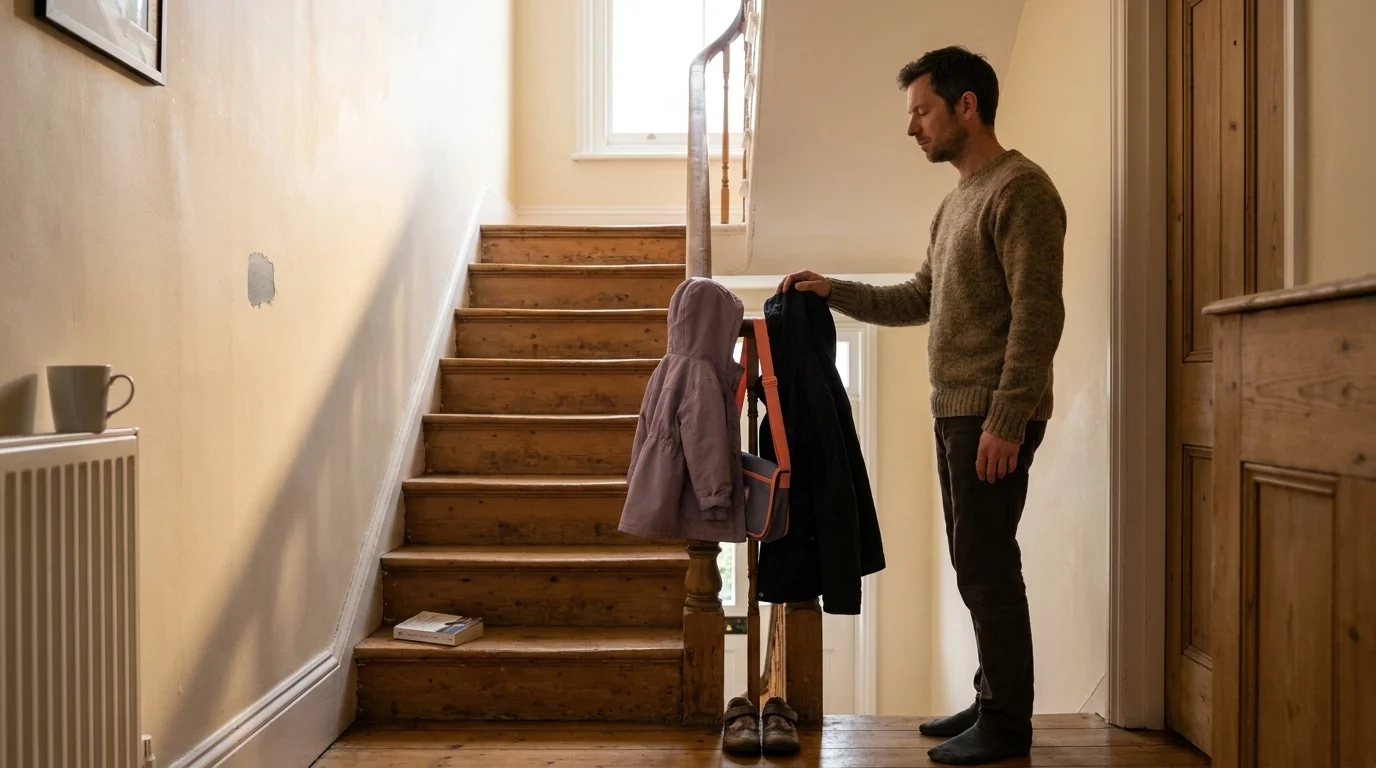
It is half-past seven on a Tuesday morning, and the seven-year-old has decided that the school shoes are an insult, and the four-year-old has decided that the seven-year-old's distress is interesting enough to copy. I am at the bottom of the stairs with two coats and a packed lunch and a half-finished cup of tea on the radiator, and the part of me that aspires to calm parenting and the part of me that is going to be late are, for the next ninety seconds, in a quiet civil war that no one else in the house knows is happening. Calm parenting — the phrase I will be using here, because it is the one parents actually search for, and because what is in front of me is closer to it than the more grandiose phrases on offer — does not at this moment mean serenity. It means whether or not I, the largest nervous system in the room, can borrow myself a thirty-second pause.
There are two things to say about that morning before going further. The first is that nearly seventy-five per cent of parents tell Zero to Three that parenting is their primary challenge and that they do not feel they have enough support — which I read each time as a quiet permission slip. The second is that the line that keeps surfacing in 2025 mainstream parenting writing, most recently in Geek Mamas and in Mark Bertin's contributions to the Child Mind Institute, is that the biggest source of stress for children is their parents' stress. If you read that sentence at the right hour it will land as a verdict; I would ask you to read it instead as the most useful piece of information available, which is that the lever is on your side of the room. This article is the at-home practice playbook — the morning, the afternoon, the night, and the language of repair when one of them has gone badly. For the research and the lineage behind the practice, see the companion essay, The Role of Mindfulness in Modern Parenting. What follows is what I have actually done at the bottom of the stairs.
What calm parenting actually looks like at half-past seven
The most useful single distinction I have read in the recent literature is the one Hollywood Life lifted from the family-mindfulness practitioner cohort in December 2025: the difference between a ritual and a routine. A routine completes a task. A ritual signals — to your own nervous system first, and then to the smaller nervous systems in the house — that this part of the day will be entered slowly, with breath and attention, and that whatever else is happening is being deliberately let go of for the next four minutes.
What this looks like at half-past seven, in my house and possibly in yours, is the difference between charging up the stairs to find the missing shoe and standing for one beat at the bottom of the stairs first. The first version optimises the morning; the second one mostly holds it. I do not always manage the second. When I do, what comes out of my mouth at the children is several degrees calmer than what was about to. Mindful parenting at home, at this hour, is mostly that beat at the bottom of the stairs.
A practical word about time, because the most common reason people abandon this kind of practice before it begins is the conviction that they do not have enough. The 2025 family-mindfulness writing has converged on a much lower floor than the meditation literature used to suggest — Kidypulse and others put the threshold at twenty-four seconds of attention to the breath. Twenty-four seconds is not the practice in the long run. It is the doorway through which the practice can come in.
Borrowing your nervous system
The reason any of this works on a child rather than only on the adult who is doing it — and the reason mindful parenting in 2026 has, very correctly, replaced most of the older "behaviour-management" vocabulary with the language of co-regulation — is what Mona Delahooke calls the bottom-up model in Brain-Body Parenting (Harper, 2022), the book that Tina Payne Bryson endorsed at launch and that has continued to set the practitioner-tier vocabulary through 2025. The short, plain version of the model is this: small children's nervous systems regulate by borrowing the regulation of the larger nervous systems around them. The four-year-old in the doorway is not, in the strict sense, having a bad attitude. She is having a body that does not yet know how to come down off a peak by itself, and she is borrowing — or trying to borrow — yours.
This is the line that, when I first read it properly, made me change how I stood in the room. The work is not to manage the child's behaviour; it is to be regulated enough that there is something for her body to borrow from. Most of the practices below are not, really, for the child. They are for the adult who is going to be in the room with her at five o'clock in the afternoon.
What I have actually said in the next sixty seconds
The reason this section is unusual for the genre is that I will be quoting myself rather than offering you a tip-sheet. Parenting articles tend to give scripts as bullet lists, and the format does several things at once — it abstracts the sentence away from the room it was said in, it implies one correct line per situation, and it strips the trying tone of voice that actually does the work. I will instead tell you what I have said in the five scenes that recur most often in our house, and you can lift the sentences if they are useful and ignore them if they are not.
When the four-year-old is in the middle of a tantrum, the line I keep returning to is you really wanted the triangles, or whatever the specific thing is, said in the kind of voice you would use for a small dog who has hurt its paw — without performance, without negotiation, without any attempt to teach a lesson. With a school-age child the same move sounds slightly different — that's a fair thing to be upset about, even if I'm going to say no in a minute — and with a teenager it becomes shorter still, often only yeah, that's hard. The age varies what the sentence says. The function is the same: a small loan of regulation, made out loud, before any of the cognitive work of the room can begin.
For the sibling fight at five past five on a Tuesday — the moment the practitioner literature is most quiet about — the line that has earned its place in my house is I'm not going to work out who started it; I'm going to help both of you feel safer first. It is unsatisfying to a child who wants to be vindicated, which is, I think, the point. The fight cannot end while either child is still in a body that is too hot to be reasoned with. For the screen-time hand-off, where my own performance is at its weakest, I have stopped saying two more minutes — which is a number neither of us believes — and started saying I'm going to come and watch the rest of this with you before we turn it off. The transition is the same; the difference is that I have made myself the one doing it. For the dinner-table refusal, especially with the four-year-old, the line I keep returning to is the boring, factual you don't have to eat it; you have to stay at the table, which deflates the bargain and refuses the row. And at bedtime, after the seven hundredth glass of water request, the line I have come to is I'm not coming back up after this one, and I love you very much, said at the door, said the same way every night, said until it stops needing to be said.
None of these are spells. Half of them, on a hard week, do not work. What they have in common is that they are short, that they assume the child's distress is real, and that they do not require the adult saying them to be calm yet — only to be willing to act as though they could be in thirty seconds. Calm parenting, at the level of language, is mostly the choice of a short sentence over a long argument.
The five-second pause that stops the yelling before it starts
The other thing that has changed for me, slowly, is the breath. I am not going to claim this dramatically. I will say that two named protocols circulate widely now in the family-mindfulness practitioner literature and that both of them work better than nothing. The first is the 3-4-5 breath promoted by Nurtured First in 2025 — inhale for three, hold for four, exhale for five — which is the version I tend to use because the longer exhale is the part that does the actual physiological work. The second is the 4-5-6 variant given in Zero to Three's mindfulness-for-parents guidance, which is the same shape one beat longer. Pick one. Use it once a day for a week. The point is not the pattern, which is interchangeable; the point is that you have rehearsed a pattern, so that when you are about to yell at the school-age child for the third time in an hour, there is a body-level thing you have practised doing instead. This is, for what it is worth, the most reliable piece of "parenting without yelling" advice I know — not a sentence the child hears, but a sentence the adult's own body speaks first.
The five practices, written as one essay not five tips
The practical "family mindfulness activities" the search engine keeps wanting me to list — and which I refuse to list, because the listing of them is the thing that has historically made parents abandon them — are these five, which I will name in a sentence and then walk through in two paragraphs. Mindful breathing for kids, in our house, is a sixty-second game in which the seven-year-old and I take turns blowing the petals off an imaginary dandelion and noticing how slow we can make the last one. Gratitude rounds at dinner — a single sentence each, no follow-up question allowed — sound twee on the page and stop sounding twee at the table around the third Tuesday. A three-minute walking meditation is a route round the block that, by family agreement, is done without conversation, which gives the four-year-old a great deal more credit than she normally gets and is often the surprise on Saturday mornings.
A sensory calm corner — a single armchair in the corner of our kitchen, a soft blanket folded on it, two or three objects that the child has chosen — is, in retrospect, the most useful single piece of furniture in the house, because it gives the child a place to take a feeling that is not their bedroom and not a punishment. And a bedtime body-scan, two minutes from the toes upward, the kind that you would not have time to do as an adult, is the practice that the child will ask for again, in my limited experience, more reliably than any of the others. They are not five tips. They are five doors into the same room.
Mindful versus gentle versus conscious versus peaceful versus respectful
A word on vocabulary, because the search bar will, by this point in the article, have shown you several near-neighbours of mindful parenting. Gentle parenting, popularised in the contemporary English-speaking conversation by Sarah Ockwell-Smith and others, is a broader orientation toward empathic, non-punitive discipline; this article would fit comfortably inside that umbrella. Conscious parenting, the Shefali Tsabary lineage, sits a little closer to depth psychology — the parent's own interior work as the precondition for the child's freedom. Peaceful parenting, the Laura Markham lineage, names a goal in the room rather than a method. Respectful parenting, the Janet Lansbury / RIE lineage, foregrounds the child's competence and the adult's restraint. They are not the same, and the differences matter when you are reading. They overlap, however, in the place that this essay has been describing — the place where the adult's regulation is the first move and the child's response is the second — and any of them, in practice, will deposit you back at the bottom of the stairs at half-past seven with a slightly longer pause than you had before.
The phone in the hand at the back door
The conventional version of the screen-time conversation is about minutes — how many of them, how monitored, how negotiated. The mindful version of it is about attention. A parent on a phone is, in the phenomenology of the room, somewhere else; the child knows this and does not have the language to describe it. The single move I have made that has changed the late-afternoon hour most reliably is the one that asks the least of the children — I put my phone face-down on the worktop when I come in through the back door, and I do not pick it up again until the four-year-old is in bed. The minutes on her side of the screen budget have not changed. The minutes on mine have. The room is calmer. That is, as far as I can tell, mostly that.
The language of repair
I would like to write about the part of mindful parenting at home that the older books mostly left out, because it is the part that has saved me on the worst evenings and because the 2025 practitioner literature — particularly Nurtured First and Dr. Becky Kennedy's work — has only recently named it cleanly. There will be evenings when none of the above will hold and you will, in the end, shout. The thing that matters then is not whether the shouting happened. It is what is said in the next hour. The line I have used most often, said at the doorway of the seven-year-old's room after I have given myself a long enough pause to mean it, is I want to try that last bit again. Not I'm sorry, which is the line the child cannot hold without taking on the work of comforting me, and not you made me, which is the line that is not true. I want to try that last bit again. And then I say what I would have said the first time if I had not been so tired, and we agree to call it the version that counts. The repair is the practice. There is more weight in it, in my experience, than in any of the things I did when I was getting it almost right the first time.
A week, walked
If you would like the practice on a domestic clock, the week I would suggest is small and unremarkable. Monday is the 3-4-5 breath, once, before the first hard sentence of the day. Tuesday is the imaginary-dandelion game with the youngest, before tea. Wednesday is the phone face-down at the back door. Thursday is the gratitude round at dinner, one sentence each, no follow-up. Friday is the three-minute walk round the block without conversation. Saturday is the sensory corner, used by whoever needs it, no comment from the adult. Sunday — and this is the only adult-only practice in the list — is the ten minutes between you and any co-parent, after the children are down, in which the two of you name the hardest moment of the week and one sentence you will try together in the coming one. None of these is on a worksheet. They are all small enough to survive the week in which they meet your actual life, which is, in the end, the only test worth passing.
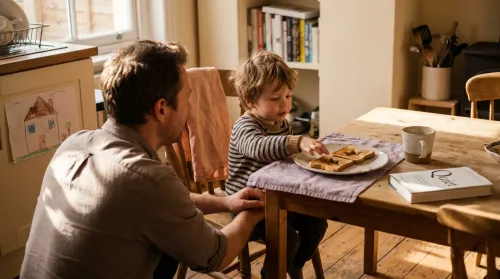
The toast incident I opened with, since I have promised honesty, ended with both children having a half-triangle and a half-square and a pile of crusts and me drinking the tea on the radiator cold. It was not what I had hoped the morning would be, and it was, in the end, nothing very much like the optimised version of mindful parenting tips that the internet sometimes promises. It was a calmer ten minutes than it would otherwise have been. That, for me, has come to be enough.
For the lineage and the research behind the practice — Kabat-Zinn, Bögels, Duncan/Coatsworth/Greenberg's 2009 model, the 2025 evidence updates — see the companion piece, The Role of Mindfulness in Modern Parenting. This essay was the kitchen and the practice; that one is the desk and the reading. They were written, deliberately, to be read together.
Frequently Asked Questions
A short sentence said in a calm voice, naming the feeling, with no attempt to teach a lesson. For a toddler or four-year-old: "You really wanted the triangles" — said the way you would speak to a small dog that has hurt its paw, without performance or negotiation. For a school-age child: "That's a fair thing to be upset about, even if I'm going to say no in a minute." For a teenager, shorter still: "Yeah, that's hard." The function across ages is the same — a small loan of regulation, made out loud, before any cognitive work can begin.
Rehearse a named breath protocol when no one is yelling, so your body has something to do when they are. Two patterns circulate widely in the 2025 practitioner literature: Nurtured First's 3-4-5 breath (inhale 3, hold 4, exhale 5) and Zero to Three's 4-5-6 variant. The longer exhale is the part that does the parasympathetic work. Use it once a day for a week before you need it. The point is not the pattern — they are interchangeable — but that you have rehearsed one, so the body-level move is available the next time you are about to yell.
The bedtime body-scan, two minutes from the toes upward, asked for one body part at a time. "Notice your toes. Notice your knees. Notice your shoulders." No agenda beyond the noticing. In our house this is the practice the child asks for again more reliably than any other, in part because it is the only one in which the child is the focus and the adult is the quiet voice. Cost: two minutes. Equipment: none. Start tonight.
The line that has carried the most weight in our house, said at the doorway after a long enough pause to mean it, is "I want to try that last bit again" — not "I'm sorry" (which makes the child do the comforting work) and not "you made me" (which is not true). Then say what you would have said the first time. The repair, not the failure-of-calm, is the practice. The 2025 practitioner literature — particularly Nurtured First and Dr. Becky Kennedy's Good Inside platform — has been clear about this: a parent who repairs is teaching the child a skill the parent who never loses it cannot.
Use a single 10-minute Sunday window, after the children are down, with no phones. Two prompts: name the hardest moment of the week, and choose one sentence you will both try together in the coming week. That's the whole ritual. The 10 minutes is short by design — it has to survive the week in which you are tired. Alignment between adults is not built in the long argument; it is built in the same short sentence said by both of you for a few weeks running. If you cannot agree on the sentence, agree on the breath protocol instead and revisit the sentence the following Sunday.