
Revolutionary Parenting Tech: Integrating AI and IoT for Seamless Family Management


AI parenting in 2026: the number to start with
If you are a US parent reading this in 2026, the AI parenting conversation begins with one number you should know before anything else. According to Pew Research Center's February 2026 survey of 1,458 teen-and-parent pairs, 64% of US teens use AI chatbots, but only 51% of parents realize their teen does (Pew Research Center). That is a thirteen-point gap between what is happening in your child's bedroom and what you think is happening in your child's bedroom, and it is the single most important fact in this article.
The same survey found that about 40% of US parents have never had a conversation with their teen about AI chatbots, despite more than 90% of parents having heard of them. So the gap is not really a knowledge gap on the parent's end. The parent has heard of ChatGPT. The parent owns one. The parent has not had the conversation.
This piece is the conversation. I am going to do what I always do here — separate three layers: what the platforms technically allow, what teens are actually doing with them, and what a parent's realistic range of responses looks like. I am going to name specific products and specific risks. I am going to skip the "AI is the future of parenting" framing and the "AI is destroying childhood" framing in roughly equal measure, because both are bad guides to what your fourteen-year-old is doing with ChatGPT at 11pm.
A note on scope before we start. The original version of this article (published February 2024) was largely about IoT and smart-home gear — thermostats, fridges, security cams. Some of that hardware still matters, especially for very young children (nursery cams like Nanit, Cubo Ai, and Miku Pro are still serious products and I will name them where they fit). But the live conversation in 2026 is not about the thermostat. It is about the chatbot.
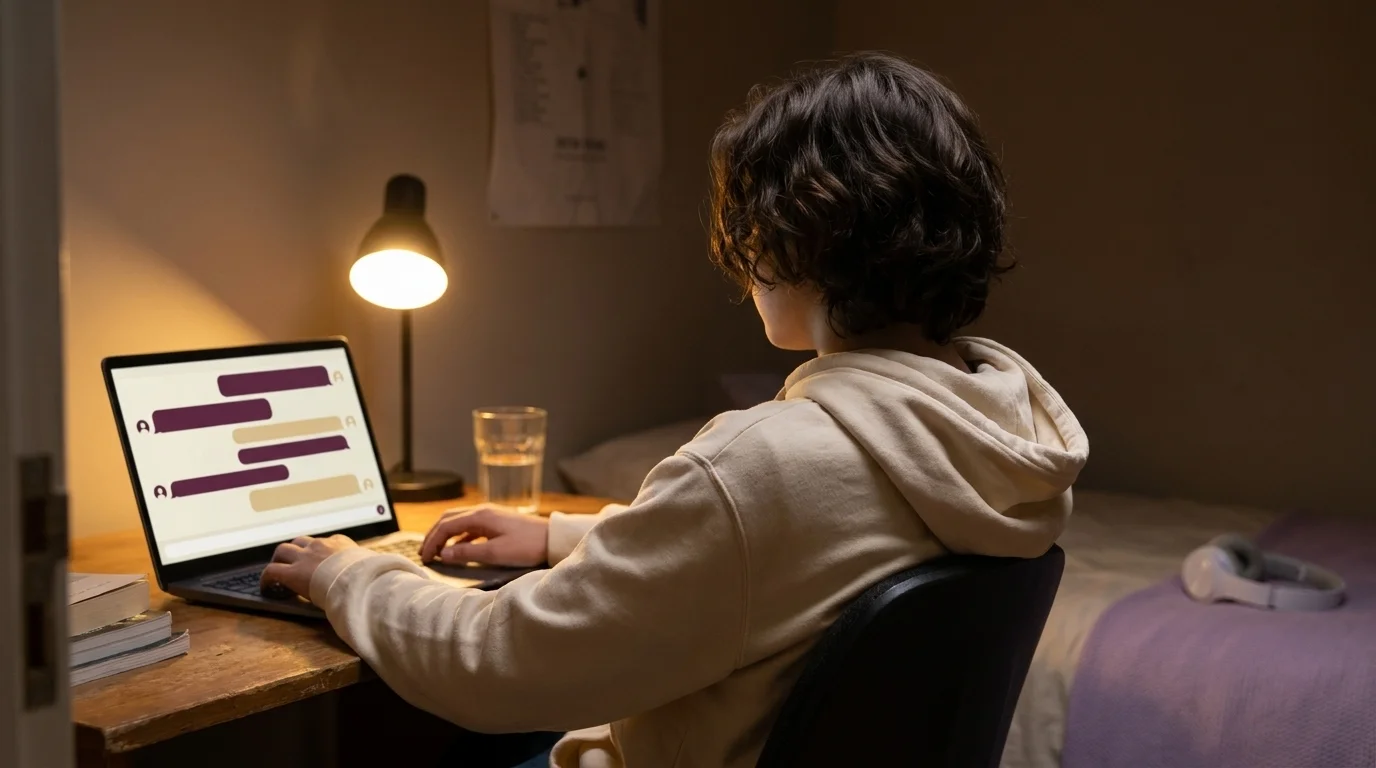
AI as co-parent vs. AI as confidant — the line the data draws
Inside the Pew survey is a more interesting number than the perception gap. When parents were asked which uses of AI they approve of for teens, the approval rates split sharply by use case. Roughly 80% of parents approve of teens using AI for information lookup. Only 18% approve of teens using AI for emotional support or advice. That is the lowest-approval use case Pew measured, by a wide margin.
This is, I think, the single most important moral consensus to come out of the parent-teen AI conversation so far, and it is worth saying out loud. AI as co-parent — help me research the science fair, draft an email to the coach, plan a trip, summarise a chapter, debug a math problem — has wide parental approval and corresponds roughly to what AI is actually good at. AI as confidant — listen to me about my friend group, help me decide whether to break up with my girlfriend, talk to me about my parents — is the use parents reject, and it is also the use that has produced the worst documented outcomes.
The Common Sense Media survey reported via IAPP (February 2026) found that 72% of US teens have used AI companions, one-third say AI conversations are as satisfying as — or more than — human ones, and half distrust the information they receive (IAPP). All three of those numbers can be true at once. A teenager can prefer talking to a chatbot, distrust what the chatbot says, and keep talking to the chatbot anyway. The reason — and any middle-school English teacher will recognise this — is that talking to a chatbot is socially cheap. The chatbot does not roll its eyes. The chatbot is awake at midnight. The chatbot does not tell other people what you said. None of those properties make the chatbot a good confidant; all of them make it an easy one.
The platform layer here is simple to describe. Most general-purpose chatbots — ChatGPT, Gemini, Claude, Copilot — are not designed as companion products and will, with default settings, redirect explicit emotional-support conversations toward professional resources. Most purpose-built companion chatbots — Character.AI, Replika, Meta AI Studio personas, hundreds of smaller apps — are designed precisely as confidants and are engineered to retain the conversation. The norm layer is that teens use both, often in the same week, and rarely tell their parents the difference. The parent layer is that the most useful conversation you can have with your kid is not about "AI" in the abstract but about which kind of AI conversation belongs in which category — and which category, in your house, the kid is allowed to have with a machine.
Related Article: Navigating the Digital Age: Parenting in the Era of Technology
What changed on January 1, 2026: SB-243 and the FTC inquiry
The regulatory landscape changed materially this year, and most of the parenting press has not yet translated the change into what it means for a household.
California SB-243, signed by Governor Newsom on October 13, 2025 and effective January 1, 2026, is the first US state law specifically targeting AI companion chatbots used by minors (California Senator Padilla press release; Skadden analysis). The provisions, in plain English:
The chatbot must disclose to a minor user that it is an AI, not a person. The chatbot must send a break reminder to a minor user at least every three hours of continuous interaction. The chatbot must maintain a suicide-prevention protocol that, when a minor user indicates self-harm ideation, refers the user to a crisis line — in the United States, that is the 988 Suicide and Crisis Lifeline, reachable by call or text 24/7. The chatbot must not produce sexually explicit content directed at a minor. And — this is the provision the companies are paying attention to — the law creates a private right of action, which means a family can sue.
In parallel, the Federal Trade Commission opened a Section 6(b) inquiry on September 11, 2025, directing Alphabet, Character.AI, Meta/Instagram, OpenAI, Snap, and xAI to disclose the safeguards they maintain for minors using their products (FTC press release; CNN coverage). The inquiry followed, in part, the 2024 death of sixteen-year-old Adam Raine after extended ChatGPT conversations about self-harm — a case that became a structural inflection point for how the AI industry is required to think about minors.
What this means for a household: as of January 2026, if your teen is using a chatbot that operates in California, that chatbot is supposed to disclose its AI status, prompt your teen to take a break every three hours, and redirect to 988 if your teen indicates suicidal ideation. Whether the chatbot actually does these things in practice — and especially whether unmoderated companion-app variants do — is a separate question. The law sets a floor. It does not guarantee a ceiling. If your kid is in a Character.AI conversation that has been running for six hours, the law says that chatbot is supposed to have prompted a break twice. If it did not, that is now actionable. If it did and your kid clicked past it, that is on the family-level conversation.
A third element of the new context: a third of US students reported a deepfake incident involving nonconsensual intimate imagery at their school in the past year, per the Center for Democracy & Technology (IAPP citation). This is not, technically, an "AI parenting" issue in the way the rest of this article is — but it is the school-level event that has put AI on the principal-letter agenda in 2026. If your kid is in middle or high school, this conversation is happening in their classmates' group chats whether or not it has happened in yours.
The AI parenting tools actually worth installing (and what to skip)
Here is what I would actually recommend a US parent install or pay for in 2026, and what I would skip. I have no commercial relationship with any of these companies. Where I am uncertain, I will say so.
For family logistics, the two purpose-built apps that came out of the 2024–2025 funding cycle and have stuck around are Joy and Milo. Both work as AI co-parent assistants — shared family calendar, reminders that adapt to who's home, school-pickup coordination, meal planning. They are useful in roughly the way a thoughtful nanny would be useful. Neither is essential. Alexa or Google Nest Hub routines, configured carefully, do most of the same work for free and integrate with the smart-home gear you may already have. The Bright Horizons rundown of utility-level AI parenting use cases is a fair starting point for the boring stuff: meal planning, homework help, story time, schedule wrangling (Bright Horizons; The Bump 2026 trends).
For school-age learning, Khan Academy's Khanmigo (their AI tutor, free-tier available, school-licensed for many districts) is the strongest tool I would put in front of a child under thirteen. It is purpose-built for tutoring, refuses to do the kid's homework outright, and prompts the user toward working through the problem rather than handing over the answer. ChatGPT and Gemini, used with a parent in the room and explicit constraints ("don't write the essay for me, but help me outline it"), are reasonable for older students who already understand the difference between scaffolding and cheating — and many do not.
For very young children, nursery cams remain the IoT segment that has actually held up — Nanit, Cubo Ai, and Miku Pro all use AI primarily for breathing detection, sleep analytics, and motion alerts, and the safety-monitoring use case is genuinely useful for an infant. I would not buy any of them for a toddler — toddlers should not be on a monitored video feed in their room as a default — and I would not extend the same logic up the age range. A nursery cam is a tool for the first eighteen months of life. After that it becomes surveillance, and surveillance is not the relationship you want to have with your child.
For confidant-style chatbots — Character.AI, Replika, Meta AI Studio personas, the long tail of companion apps — my recommendation is the opposite of installation. These are the products I would actively keep off a phone for any child under fifteen, and I would treat their use by older teens as a conversation, not a configuration setting. If your kid is already on them, the family conversation is more important than the controls. SB-243 has improved the floor for California-served users; the floor is still not high enough to leave a thirteen-year-old alone in a six-hour chat session with a companion bot.
AI literacy for parents, in three weekend steps
UNICEF, Common Sense Media, and the Center for Democracy & Technology have, in the last eighteen months, pivoted from the older question — should parents know about AI? — to a sharper one: parents need a curriculum. Here is the three-step version I would actually do with a teenager on a Saturday. None of these are tips. They are three different things that work better as a sequence than separately.
One: audit what your kid is actually using. Sit at the kitchen table with your teen and ask them to walk you through every AI tool they have used in the past week. Not what they have used "for school" — what they have used. ChatGPT. Snapchat's My AI. Whatever is built into Instagram or Discord now. Character.AI. Image generators. Note the names. Note the use cases. Resist the urge to react. You are gathering information; you are not yet making rules. The Pew finding — that 86% of students have used AI for personal or school use, often without teacher permission — is here to tell you the list is going to be longer than you expect.
Two: set the family AI rule, together. This is the one most parents skip. The rule that works in most households I have talked to is some version of information is yes, emotional support is no, and never share full name, address, school, or anything you would not put on a billboard. Write the rule down. Put it on the fridge. The point is not enforcement — the point is that the household has agreed that the line between co-parent use and confidant use exists, which most fourteen-year-olds will accept as reasonable if it is framed as reasonable. The Pew approval-gap data is your evidence base: parents who think emotional-support use is bad for teens are not idiosyncratic; they are an 80%-plus majority.
Three: do one supervised session together. Pick one tool — Khan Academy, ChatGPT, whatever your kid is most curious about — and use it together, in the open, on a school-related task. Watch your kid prompt. Show your kid how you would prompt. Note where the chatbot is wrong. Note where it is useful. The Pew data shows half of teens distrust AI information; demonstrate to your kid that you, the parent, also distrust it, and that distrust is the adult relationship to this tool, not the credulous one. This is also the session where you ask, gently, what your kid does at night. Some teens will tell you the truth. Most will tell you a partial version. Both are fine; the conversation is what matters.
The conversation to have tonight
If you have read this far and you take exactly one thing away from this piece, take this: the gap is not a knowledge gap. You know what ChatGPT is. You know what Character.AI is. The thing you have not done — and Pew says 40% of US parents have not done it — is sit down with your teen and have the actual conversation. Not the lecture. Not the rules. The conversation in which you ask your kid what they use these tools for and you listen long enough to be told.
Tonight, before bed, here is the version that has worked in the households I report on. You walk into your kid's room, or you sit down at the kitchen table, and you say: I read something today. Two out of three teens are using AI chatbots and only half of parents know. I would like to be in the half that knows. What are you using? I will not be weird about it. I am asking because I want to be useful to you, not because I want to take it away. And then, the hard part, you listen.
If your kid is fifteen and on a phone, they are using something. The conversation is not whether. The conversation is which, how often, for what, and who they are when they are doing it. Have it tonight. The rules can wait until Saturday.
Frequently Asked Questions
AI can accelerate information access and personalised learning, and most parents (about 80%, per Pew Research's February 2026 survey) approve of teens using AI for information lookup, school research, and tutoring. The documented concerns concentrate on confidant use — only 18% of parents approve of teens using AI for emotional support, and a Common Sense Media survey reports 72% of teens have used AI companions, with one-third saying AI conversations are as satisfying as or more than human ones. The risk pattern is over-trust in unreliable information, displacement of human social practice, and exposure to deepfake imagery in school environments.
SB-243, signed by Governor Newsom in October 2025 and effective January 1, 2026, is the first US state law specifically targeting AI companion chatbots for minors. It requires chatbot operators to disclose AI status to minors, send a break reminder at least every three hours of continuous interaction, maintain a suicide-prevention protocol that refers users to the 988 Suicide and Crisis Lifeline, and block sexually explicit content directed at minors. It also creates a private right of action — meaning families can sue if the protections fail.
For family logistics, Joy and Milo are the purpose-built AI co-parent apps; Alexa or Google Nest Hub routines do most of the same work for free. For school-age tutoring, Khan Academy's Khanmigo is the strongest tool to put in front of a child under thirteen — it is purpose-built and refuses to do the kid's homework outright. For infants up to about eighteen months, Nanit, Cubo Ai, and Miku Pro remain the serious nursery cams using AI for breathing detection and sleep analytics. For companion-style chatbots like Character.AI and Replika, the recommendation is the opposite — keep them off a phone for any child under fifteen and treat older teens' use as a conversation, not a configuration setting.
Start with one supervised session — sit at the kitchen table together and have the teen walk you through the AI tools they have used in the past week. Listen first, before any rules. Then agree on a family AI rule together: information is yes, emotional support is no, and never share full name, address, school, or anything you would not put on a billboard. Pew Research's February 2026 survey found 40% of US parents have never had this conversation despite 64% of teens already using chatbots — so the conversation, not the controls, is the work.
No. The 2026 institutional consensus from UNICEF, Common Sense Media, and the Center for Democracy & Technology is that AI is a co-parent for logistics and learning — meal planning, schedule wrangling, tutoring scaffolding — and not a substitute for human connection or emotional caregiving. The split shows up cleanly in the data: parents approve AI for information lookup at high rates and reject AI for emotional support at high rates, and that distinction is the line a household should reflect in its own AI rule.
Check Out These Related Articles

Generation Z's Impact on Modern Parenthood: Insights into a Tech-Savvy Youth Culture Reshaping Family Dynamics

Ethical Considerations in Co-Parenting Apps: Striking a Balance Between Convenience and Privacy Rights

The Millennial Mom Movement: Redefining Parenting with Social Media and Influence