
The Art of Positive Discipline: Nurturing Well-Behaved and Empathetic Children


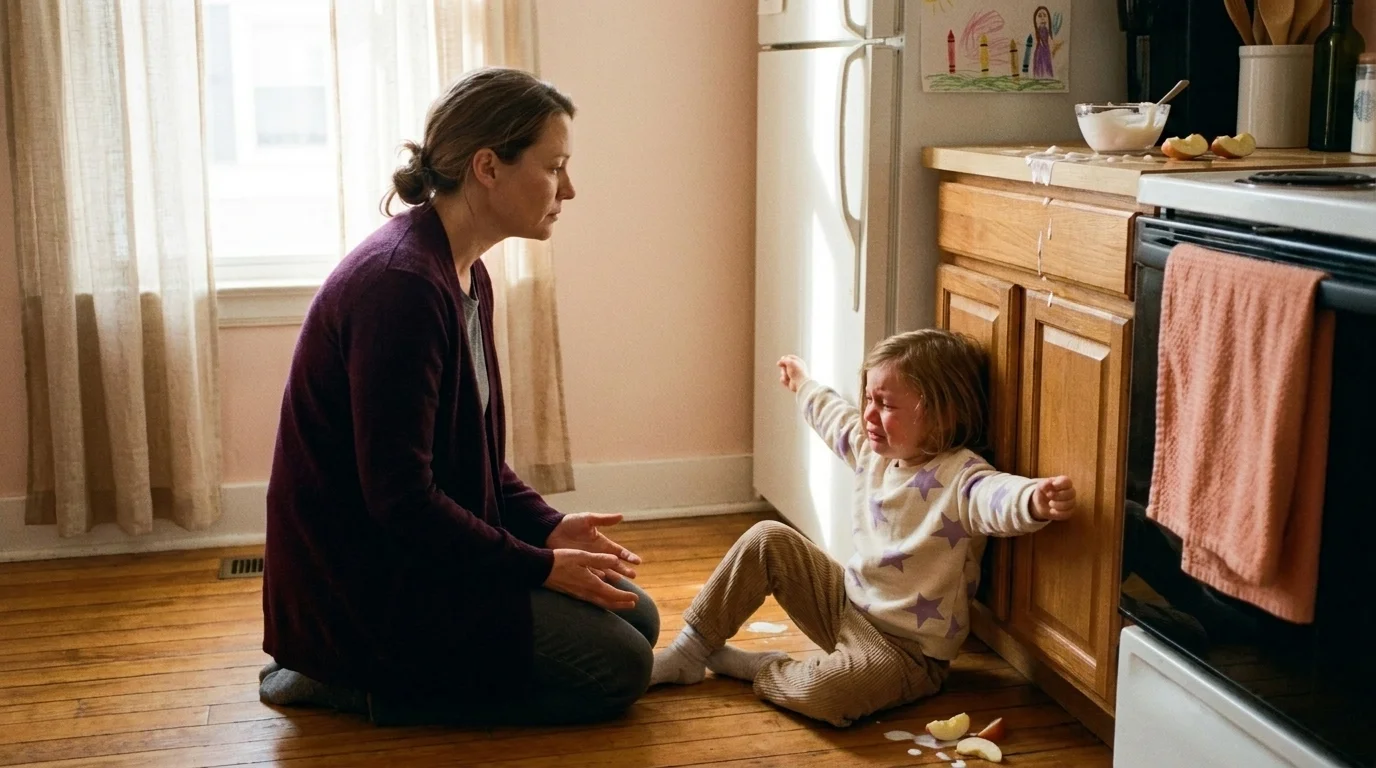
A friend of mine — call her Maya — told me last spring that gentle parenting wasn't working. Her four-year-old had thrown a yogurt at the kitchen wall. Maya knelt down, named the feelings ("you sound really frustrated, the spoon was hard"), held the limit ("yogurt stays in the bowl"), offered a repair ("can you help me wipe the wall?"), and watched her son look her in the eye and throw a second yogurt. By the third yogurt she was crying in the bathroom Googling "is gentle parenting actually a scam." She is a competent, thoughtful adult. She is not the problem.
The piece you're about to read is for her, and probably for some version of you. It's an honest look at gentle parenting in 2026 — what the only peer-reviewed study has actually found, why so many parents who try it report burnout, the comparison table that nobody else seems willing to draw clearly, and a set of age-stratified scripts that work in the kitchen at 6:47 PM rather than only on Instagram. I'm a researcher and a mother of two teens. I have raised two kids through the entire arc of this discourse and tried roughly half of it on my own children. The honest answer at the end of all that is: gentle parenting works and it is mostly a rebrand of something we already knew was best. The interesting question is what the rebrand got right, what it got wrong, and what to actually do.
What Gentle Parenting Actually Is (and Isn't)
The cultural moment for gentle parenting peaked in late 2022 and has been declining steadily since — search interest for the term itself is down roughly 62% from its peak, and "positive discipline" (its older sibling, the Jane Nelsen vocabulary) is down about 76% in the same window. That's not necessarily a sign the philosophy is failing. It's a sign that "what is this?" is no longer the question parents are typing into Google. The new question is "does this actually work?"
In July 2024, the first peer-reviewed empirical study of gentle parenting was published in PLOS One by Pezalla and Davidson at Macalester and Rollins — n=100 US parents of 2- to 7-year-olds. Before this paper, every "evidence-based gentle parenting" claim circulating online was citing general parenting-style research, not gentle parenting itself. Three findings from that paper are worth holding onto, because they reframe the entire conversation.
First: 49% of the parents in the sample self-identified as gentle parents. Whatever this thing is, it's roughly half of contemporary US parenting culture by self-report.
Second: gentle parents scored no statistically significant differently than non-gentle parents on Baumrind's validated parenting-style scales. Not on authoritative, not on authoritarian, not on indulgent, not on neglectful. The thing that has spent the last decade marketed as a paradigm shift is, when measured by the most-validated instrument in the field, mostly a vocabulary update on the parenting style child psychologists have recommended for fifty years (authoritative — high warmth, high structure). The American Academy of Pediatrics still recommends that style, and has not specifically endorsed gentle parenting.
Third — and this is the finding everyone glossed over — 59.2% of gentle parents described their approach as primarily about regulating their own emotions, not their child's behaviour. Read that again. The thing they reported doing is not, in their own words, child-directed at all. It is parent self-regulation. That is a useful description of what's actually happening in most "gentle parenting" households — and a clue to why so many parents end up so tired.
A more honest one-sentence definition than the ones currently on page 1 of Google: gentle parenting is authoritative parenting with an explicit emphasis on the parent's own emotional regulation. The warmth is real. The boundaries, in the version that works, are real. The novelty is mostly that the philosophy makes you the project alongside your child.
Gentle vs Permissive vs Authoritative: The Comparison Nobody Draws Clearly
The single most clarifying thing I can give you is this table. The most common criticism gentle parenting faces is that it collapses into permissive parenting in practice, and that confusion is genuine — even gentle parents disagree about where the line is. So:
| Dimension | Authoritarian | Authoritative (incl. "gentle") | Permissive |
|---|---|---|---|
| Warmth toward the child | Low | High | High |
| Limits and structure | High and rigid | High and consistent | Low; limits drift when child pushes |
| Tolerance for child distress | Low (suppress) | Moderate (acknowledge, hold limit) | Low (remove limit to end distress) |
| Use of explanation | Rare | Routine, age-appropriate | Frequent, often as negotiation |
| Consequences | Punitive, often arbitrary | Logical, predictable, calmly applied | Often skipped or rescinded |
| What happens when kid pushes | Punishment | Limit holds; feelings welcomed | Limit gives way |
The two columns to compare are middle and right. Authoritative parenting (gentle parenting's actual content, by the data) holds the limit and welcomes the feeling. Permissive parenting drops the limit because the feeling is loud. They look identical for the first thirty seconds of a tantrum and completely different at minute four. That distinction is the one that keeps people out of trouble.
What this means for Maya in the yogurt scene: kneeling down and naming the feeling was correct (warmth). Holding the limit ("yogurt stays in the bowl") was correct. The problem wasn't the script — it was that her son hadn't yet been taught that the limit holds when he tests it. The first yogurt was data; the second and third were experiments. The work is to be the same parent at yogurt three as at yogurt one, every time, until experimentation stops being interesting.
The Burnout Problem Nobody Warned You About
The most under-discussed finding in the 2024 PLOS One study is the part that happens to the parent. More than one-third of the gentle parents in the sample spontaneously expressed self-criticism, uncertainty, or burnout without being prompted by the researchers. Among those self-critical gentle parents, parenting efficacy was significantly lower than among gentle parents who were not self-critical. Parents who described their approach as gentle reported higher satisfaction than non-gentle parents (M=4.15 vs M=3.73), but no advantage on perceived efficacy.
Read together, those results describe a real pattern. Gentle parenting asks you to remain calm in the face of your child's worst hour, to never punish, to model the regulation you want — and it offers no graceful exit when you fail at any of those things. The philosophy doesn't have an off-day script. So when a parent loses her patience and yells, the gentle-parenting community offers either "repair after rupture" (which is correct) or a quiet implication that the rupture was avoidable (which, for most humans, is not). The accumulated effect over years is the self-critical exhaustion the study measured.
Three things have helped the parents I've watched go through this. First, give yourself the off-day script: when you yell, you say "I yelled. I was overwhelmed. I'm sorry. That was mine, not yours." Then you go back to whatever you were doing. The repair is the parenting; the perfectionism is not. Second, drop "always calm" as the standard. The standard is "calm enough, often enough, with sincere repair when not." Third, take the philosophy's own data seriously: 59.2% of self-identified gentle parents described their approach as primarily about their own self-regulation. If the project is making you a worse self-regulator, the project is failing on its own terms and you can recalibrate.
Emily Oster's review of the available evidence lands in basically the same place, more bluntly: there is no data demonstrating gentle parenting's superiority over alternatives, and there is also no data demonstrating any alternative's superiority over it. Her recommendation is the rare honest one in this space: roll your own. Pick the elements that are sustainable for you, prioritize consistency over philosophical purity, and stop apologizing.
Age-Stratified Scripts: 2, 4, 6, 9, 12
The thing that doesn't exist on page 1 of Google is a single page that gives you actual phrases to use at actual ages. So here it is. Each script set is what works in my own house and what I've watched work elsewhere. They're not magic; they're language defaults that hold limits while keeping warmth on.
When your 2-year-old hits, throws, or won't get in the car seat
Two-year-olds cannot regulate themselves. They co-regulate with you. The script is short and physical.
- Declare the condition: "Hands stay on bodies. I'll hold yours so they're safe."
- Offer a binary choice: "Walking feet to the car or carry-arms? You pick."
- Name and limit: "You're so frustrated. We're going home now. You can be sad about that."
- After: a hug, a name, a snack. They're not being manipulative; they have not yet developed the brain machinery for it.
When your 4-year-old throws yogurt (or hits, or spits)
This is where most parents lose the thread. Four-year-olds are testing — not maliciously, but genuinely — to discover whether the limit holds when they push it.
- The same as 2, but with one addition: "Throwing food means the food goes away." Said calmly, exactly once. Then the food goes away. No re-explaining. No re-negotiating.
- For the second yogurt: "That was your second one. We're done with yogurt for today." Limit held; feeling allowed.
- After everything else has happened: "That was hard. I love you. Want to help me wipe up?"
When your 6-year-old says "you're the worst mom ever"
Six is the age of moral universe-building. They are using language that doesn't match what they feel because their feelings are bigger than their vocabulary.
- "That sounds like big feelings. You can be mad at me. The rule is the same."
- "In our house we don't talk to people that way. You can say 'I'm so angry' instead."
- Don't argue the substance. Don't take it personally. Don't punish the language — redirect it and hold the limit you set.
When your 9-year-old won't get off the iPad
Now the limits start to look like operational policy, not bedtime stories. Nine-year-olds respond to predictability, not pleas.
- The when-then frame: "When the timer goes off, screens go in the kitchen. That's the rule, every day." Said once at the start, not relitigated each time.
- The natural-consequence frame: "If we don't end now we won't have time for the show before bed. Your call." Then mean it.
- Avoid the negotiation trap: "I'm not arguing about this. The answer is no. I love you. Talk to me about something else."
When your 12-year-old shuts the door
Tweens are matrescing in their own way — identity reorganizing fast. Most discipline at this age is not about behaviour management at all; it's about staying available without being smothering.
- Knock once, leave them, return later: "I'll be in the kitchen if you want to talk. No agenda."
- Don't punish the door. Punish the things that have actually-real consequences (broken trust, broken curfew, broken rule).
- Use the long game: "You don't have to talk now. We can talk tomorrow. I'm here either way."
- Hold the structural rules. Drop the cosmetic ones. Pick three battles.
The pattern across ages is the same one the table above describes: high warmth, predictable structure, calm hold on the limit, room for the feeling. The execution changes; the architecture doesn't.

What About Time-Outs?
A side-question I get often, because mainstream gentle-parenting orthodoxy treats time-outs as harmful: do they work, and are they okay?
The honest answer is that the time-out research has not been overturned by the gentle-parenting movement. Oster's review cites peer-reviewed evidence that brief, calm, non-shaming time-outs are effective behaviour-management tools, with no good evidence of harm. The research that gentle-parenting Instagram tends to cite as proving harm typically conflates time-outs with longer punitive isolation, which is genuinely a different intervention.
What I do, and what I'd call defensible: a 3- to 5-minute calm separation when a child is dysregulated to the point that they can't hear me. Not punitive language, not "go think about what you did," not isolation as punishment. More like: "You're too upset to talk right now. Take five minutes in your room. I'll come find you." Then I go find them, and we connect, and we don't relitigate. That is closer to a calm-down corner than to the time-out of 1995, but the underlying mechanism is the same and the outcome data is the same.
If you don't want to use time-outs at all, you don't have to — there are other tools. But you don't need to feel guilty if you do. The orthodoxy on this is not as settled as the most-shared posts suggest.
Sturdy Parenting: What Comes Next
The 2025 evolution of this conversation, if you've been reading parenting media at all, is "sturdy parenting" — a framework most associated with Dr. Becky Kennedy and her Good Inside platform. The pitch: same warmth as gentle parenting, firmer boundaries, less perfectionism. The cultural moment behind it is real — UK education sources reported over 5 million formal school complaints in 2024-2025 and several specialists publicly attributed the rise in classroom dysregulation to gentle parenting at home (which probably oversimplifies — institutional erosion has many causes — but the perception is now embedded). Sturdy parenting positions itself as the answer.
In substance, sturdy parenting and well-executed gentle parenting are largely the same thing. The cultural difference is the permission: sturdy parenting explicitly says "I'm the parent, this is the rule" and treats that as compatible with empathy rather than opposed to it. For parents who got stuck in the all-warmth-no-limits trap, that permission is genuinely useful.
If you've been doing gentle parenting and feeling like the wheels are coming off, sturdy parenting is mostly the same architecture with the limits-holding part bolded. You don't have to switch teams. You can just hold the limit.
The Realistic Range of Responses
Three things to take away, if you take any.
One: gentle parenting works in the version that holds limits, and is mostly a vocabulary update on authoritative parenting — which is what the AAP has recommended for decades. The 2024 PLOS One data backs this up; you don't have to take my word for it. If you've felt like you were doing gentle parenting wrong because it didn't change everything, you weren't doing it wrong. There wasn't as much to change as the marketing suggested.
Two: the burnout finding is real, and it's not a character flaw. If you have spent three years trying to remain calm in every conflict and arrived exhausted, the philosophy contributed to that. The exit ramp is the off-day script and the lower standard ("calm enough, often enough, with sincere repair when not") and dropping the implication that any rupture is avoidable.
Three: the work is structural, not philosophical. Hold the limit. Welcome the feeling. Use the script that fits the age. Repair when you fail. Pick three battles, not thirty. That is most of it. The rest is reading some Becky Kennedy and not much else.
Maya, by the way, recovered. She holds the yogurt limit now. Her son threw it twice more across the next month and stopped. He is six and doing fine. She is doing better than fine. The thing that fixed it wasn't a new philosophy. It was the same one, consistently applied. That is the entire trick.
Frequently Asked Questions
As of 2026, only one peer-reviewed empirical study exists — Pezalla & Davidson's 2024 PLOS One paper. It found gentle parents are statistically indistinguishable from authoritative parents on Baumrind's scales, but report higher satisfaction alongside higher rates of self-critique and burnout (over one-third of gentle parents in the sample).
Gentle parenting holds firm boundaries with warmth — saying no, holding limits, but without shaming or punishing. Permissive parenting drops the boundary because conflict feels worse than the consequence. The line is whether the limit holds when the child pushes back.
According to the 2024 PLOS One study, statistically yes — gentle parents scored no differently from authoritative parents on validated parenting-style scales. The brand differs (vocabulary, social-media culture); the practice mostly does not.
The 2024 Pezalla & Davidson study found over a third of gentle parents in their sample expressed unprompted self-criticism and burnout, and self-critical gentle parents had significantly lower parenting efficacy. The expectation of always remaining calm is the most-cited driver.
Try: (1) declare the condition — 'We hold hands in the parking lot.' (2) Offer a binary choice — 'Walking feet or carry-arms?' (3) Name the feeling, hold the limit — 'You wanted to keep playing. We're going home now.' Pick one, stay consistent.
Mainstream gentle-parenting orthodoxy says no, but Emily Oster's review of the research finds time-outs effective with no good evidence of harm. Many parents combine the two: a short, calm separation paired with re-connection afterward — not isolation as punishment.
Sturdy parenting (popularized by Dr. Becky Kennedy) is the 2025 evolution: same warmth, firmer boundaries. It explicitly addresses gentle parenting's weakest point — wavering on limits — by treating 'I'm the parent, this is the rule' as compatible with empathy, not opposed to it.