
Paternity Leave California


Updated July 2026.
Your first kid is due in October, you have a spreadsheet open, and somewhere in another browser tab is a California state webpage that has managed to make one of the more generous leave systems in the country read like a tax form. I price parental-leave policy for a living and I still had to read it twice. So let's run the paternity leave California numbers the way you'd actually want them run: in plain English, with real figures, current as of 2026.
Here is the reassuring version first. If you are an eligible new dad in California, you can take up to eight weeks paid at 70 to 90 percent of your wages — capped at $1,765 a week for 2026, up from $1,681 last year — plus up to twelve weeks where your employer is legally required to hold your job. Almost all the confusion around this comes from four programs people mix up: PFL is the pay, CFRA and FMLA are the job protection, and SDI is the fund the whole thing runs through. Untangle those four and the rest is arithmetic and paperwork. That is what the rest of this is: how long, how much (with the actual math), who qualifies, and how to file.

How Long Is Paternity Leave in California? (8 Paid vs 12 Protected)
The short answer, and the single thing most new dads get wrong: California gives you up to eight weeks paid and up to twelve weeks with your job protected, both within a year of your child arriving — and those are two different programs doing two different jobs.
The eight paid weeks come from Paid Family Leave, or PFL. That is the cheque. The twelve protected weeks come from the California Family Rights Act (CFRA), and in many cases the federal Family and Medical Leave Act (FMLA) sitting on top of it. That is the promise your employer will not give your desk away while you are gone. The numbers differ because the programs differ: one is a benefit the state pays you, the other is a labour protection your employer owes you.
They can — and usually should — run at the same time. Take eight weeks off to bond, and PFL pays you for those eight while CFRA protects the whole block, with the remaining four protected weeks available unpaid (or topped up with vacation, if you have it banked) should you want them. What trips people up is assuming "twelve weeks of leave" means twelve weeks of pay. It does not. Eight is the paid number. Twelve is the protected one. Keep those two clocks separate and half the confusion is already gone. If you want the wider context, this all sits inside the mechanics of parental leave planning.
How Much You'll Actually Get in 2026 (with a worked example)
This is the part the state page buries and the law firms skip, so here is the arithmetic. Paid Family Leave replaces 70 to 90 percent of your average weekly wage, from a floor of $50 up to a 2026 cap of $1,765 a week — up from $1,681 in 2025. The EDD works out that wage from your highest-earning quarter in a base period ending roughly 5 to 18 months before you file, which means a raise you got last month may not count yet. You can see the exact formula on the EDD's benefit-amount page.
Which percentage you land on depends on a line most people do not know exists. Earn at or below roughly $65,100 a year — technically 70 percent of the state's average weekly wage, which is $1,789 for 2026 and nudges up each year — and PFL replaces 90 percent of your pay. Earn above that line and the rate steps down to 70 percent, capped at the $1,765 maximum. That is the same design California uses across the board since SB 951 lifted the old 60-to-70 percent formula to 70-to-90 for claims filed from 2025 onward.
Here is what it looks like in dollars:
- Take home about $1,000 a week (roughly $52,000 a year). You are under the line, so PFL pays 90 percent — about $900 a week.
- Earn $1,500 a week (roughly $78,000 a year). Now you are over the line, so the rate is 70 percent — about $1,050 a week.
- Earn $3,000 a week and the formula says 70 percent, or $2,100 — but the 2026 cap holds your benefit at $1,765 a week. Above about $2,521 a week, every earner lands on that same capped number.
One honest caveat, because this is money and it is the law: these figures are current as of 2026 and the maximum resets every January. Confirm the number that applies to your claim on edd.ca.gov before you file, and treat this as general guidance, not legal or tax advice.
Who Qualifies — PFL Pay vs CFRA Job Protection
There are two eligibility tests here, not one, and they have almost nothing to do with each other. This is the second big source of confusion.
To get PFL pay, you need to have paid into State Disability Insurance — look for a "CASDI" line on a recent pay stub — earned at least $300 in your base period, and welcomed a new child by birth, adoption, or foster placement in the past 12 months. That is essentially the whole test. Worth saying plainly, because people worry about it: your immigration or citizenship status does not affect whether you qualify for PFL. It runs off what you paid into SDI, full stop.
To get CFRA job protection, the test is about tenure, not contributions: you need at least 12 months with your employer and at least 1,250 hours clocked in the year before your leave, and your employer needs five or more employees. Miss any one of those and CFRA does not apply — though you may still qualify for PFL pay, because, again, different program, different rules.
This is where the gap between the statute and the shop floor shows up. On paper the rules are clean. In practice, whether your leave goes smoothly often comes down to whether your company has an HR person who has processed a bonding claim before or one overworked generalist Googling it alongside you. Ask early, and ask in writing.
Self-Employed and DIEC Coverage
If you are self-employed or an independent contractor, you are not automatically in the system — but you can opt in. The EDD runs a program called Disability Insurance Elective Coverage (DIEC) that lets self-employed workers pay in and become eligible for PFL. The catch is that you have to enrol and pay premiums ahead of time, not after the baby arrives, so if this is you, set it up well before your due date and confirm the current terms directly with the EDD.
PFL vs CFRA vs FMLA vs SDI — The Four Programs, Untangled
Here is the whole thing on one page, which is something neither the state nor the law firms will give you:
| Program | What it gives you | How long | Who's covered | What it costs you |
|---|---|---|---|---|
| PFL — Paid Family Leave | Pay — 70–90% of wages while you bond | Up to 8 weeks | Anyone who paid into SDI with $300+ in base earnings | Nothing extra; funded by SDI payroll deductions |
| CFRA — Calif. Family Rights Act | Job protection — your role is held | Up to 12 weeks | 12+ months and 1,250 hours at an employer of 5+ | Unpaid on its own — pair it with PFL for the pay |
| FMLA — federal | Job protection — the federal version, runs alongside CFRA | Up to 12 weeks | 12+ months and 1,250 hours at an employer of 50+ | Unpaid on its own |
| SDI — State Disability Insurance | The fund PFL is paid from; also covers your own illness or pregnancy disability | Varies | Workers with CASDI deductions | A payroll deduction on every cheque |
Read the table this way: only PFL pays you. CFRA and FMLA are both job protection — CFRA is California's version and reaches smaller employers (five and up), FMLA is the federal one and kicks in at fifty and up, and where both apply they run at the same time rather than stacking into twenty-four weeks. SDI is not leave at all; it is the insurance fund your PFL benefit is paid out of, and it is also what covers you if you are the one physically unable to work — which, as a bonding dad, you are not.
One more distinction, because the forms use both words: bonding leave is time to be with a new child, and it is what this entire guide is about. Caregiving leave is PFL used to look after a seriously ill family member. Same program, same eight-week pot, different reason — for a new baby, you want the bonding claim.
How to Apply — Step by Step
The application is more manageable than the website makes it look. The form you want is the Claim for Paid Family Leave Benefits, DE 2501F, and you file it with the EDD either through SDI Online (faster) or on paper by mail. The EDD's claim-process page walks through both routes.
A few things that keep it smooth:
- File after the baby arrives, not before. A bonding claim needs the child to have actually joined the family, so you cannot file in advance — but you can set up your SDI Online account and gather your documents ahead of time, so you are not doing data entry on two hours of sleep.
- Have your details ready: your last day of work before leave, your employer's information, and proof of the child's arrival and your relationship — a birth certificate, or the adoption or foster-placement record.
- Do not sit on it. The EDD sets a filing deadline for PFL claims, so check the current window on its claim page before you lock in your dates.
And here is the genuinely good news, the detail almost no guide mentions: PFL bonding has no seven-day waiting period. State Disability Insurance makes you wait a week before benefits begin; bonding leave does not. Your paid weeks count from day one. It is a small mercy, and it is real.
Planning Two-Parent Leave — Stacking Your Weeks
If there are two parents in the picture, here is the fact worth building the whole plan around: each of you has your own leave. This is not a shared pot you split down the middle. Each parent can claim up to eight weeks of PFL and up to twelve weeks of CFRA protection in their own right — and yes, that holds even if you both work for the same employer. The EDD is explicit about it.
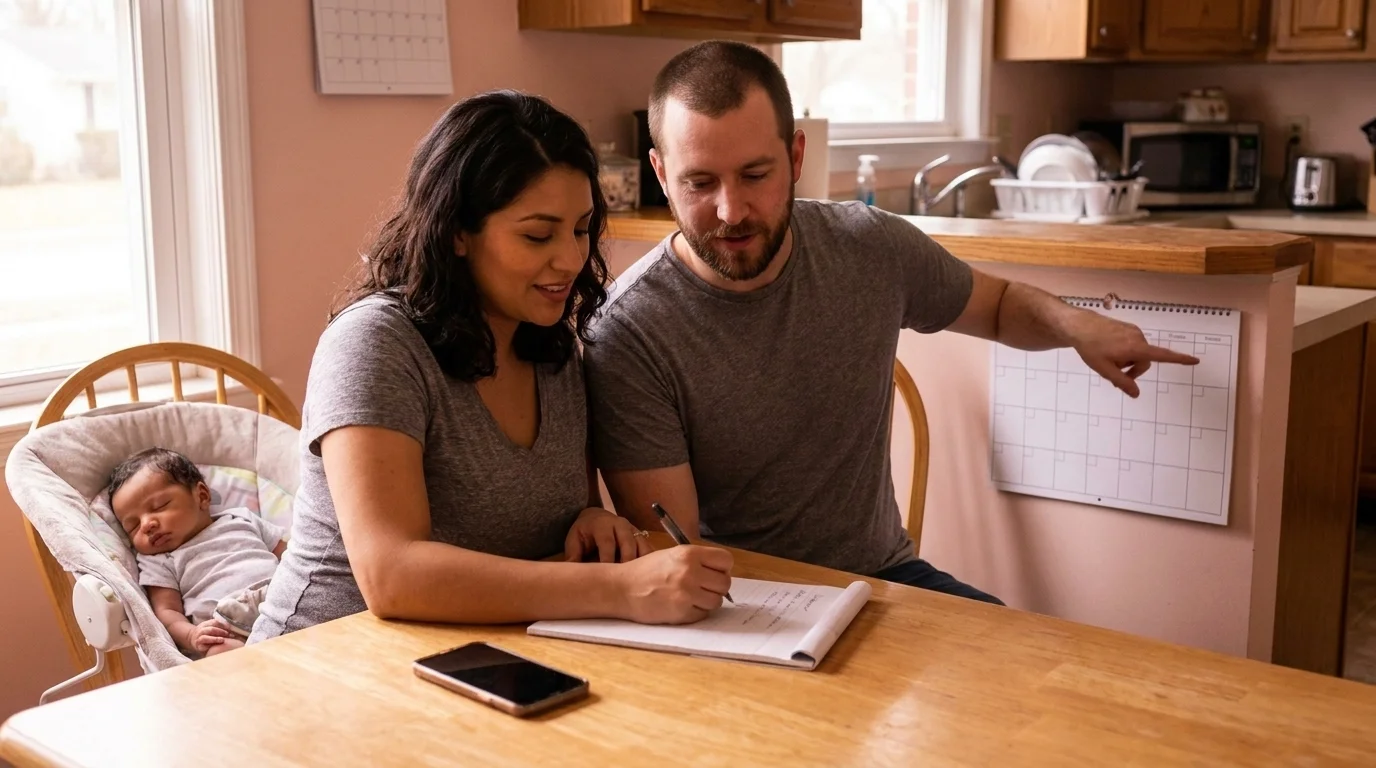
That opens up real strategy. The instinct is for both parents to take their leave at once, and the first stretch home together is genuinely valuable. But if the goal is to keep a parent home with the baby for as long as possible, staggering usually wins. One parent takes the first eight weeks; the other starts as the first is wrapping up. Done well, two eight-week entitlements can cover roughly the first four months with no bill for outside care in that window — which, for a lot of families, is one of the biggest line items there is, deferred.
There is no one right answer; it depends on both incomes, both employers, and who is in the middle of what at work. But run the two-parent version before anyone files. Couples routinely leave weeks of paid, protected time on the table simply because nobody told them the entitlements do not overlap. Then plan the far end of it too, because returning to work after leave is its own separate project.
The Short Version
For all the bureaucratic fog around it, paternity leave California is one of the better deals a new dad gets anywhere in the country — genuinely paid, genuinely protected, and far less complicated than the state's own webpage makes it feel. The whole thing comes down to four moves: confirm you qualify, estimate your pay using the 90-or-70 percent tiers, file the DE 2501F once your child arrives, and — if there are two of you — coordinate so you do not waste a single entitled week. The only real homework is timing, and the numbers shift a little each year, so pull up the current maximum on edd.ca.gov before you file and treat anything unusual about your situation as a question for the EDD or an employment lawyer, not for a blog. Then close the spreadsheet. You have a far more interesting deadline coming, and our parental leave guides will be here for the parts that come after.
Frequently Asked Questions
Yes — eligible fathers can receive up to 8 weeks of Paid Family Leave (PFL) at 70–90% of their wages (max $1,765/week in 2026) to bond with a new child, funded through SDI payroll deductions.
70% to 90% of your average weekly wage (from earnings 5–18 months before the claim), from a $50 minimum up to a $1,765/week maximum for 2026 — lower earners get 90%, higher earners 70%. Figures reset each January.
File a Claim for Paid Family Leave Benefits (DE 2501F) through SDI Online or by mail with the EDD, after your child arrives. There is no 7-day waiting period for bonding claims, so benefits start from day one.
Yes — each parent has their own entitlement (up to 8 weeks PFL and 12 weeks CFRA each), even if they work for the same employer; it is not a shared pool.