
Redefining Motherhood: Philosophical Perspectives on Maternal Identity and Fulfillment


The word I want to put on the table at the start of this essay is one that, until quite recently, almost no English-language parenting outlet was using. The word is matrescence. The American medical anthropologist Dana Raphael coined it in her 1973 book The Tender Gift: Breastfeeding to name the developmental transition women undergo when they become mothers — a transformation Raphael argued was as structurally significant as the one we already had a name for at the other end of childhood, adolescence (matrescence.com). The word sat largely unused, in clinical and anthropological literature, for the better part of forty years. In the last decade it has, abruptly, walked out of the literature and into ordinary conversation.
I had a copy of the New Yorker open on my kitchen table in 2017, the week the psychiatrist Alexandra Sacks published the op-ed in the New York Times that revived the term — "The Birth of a Mother" — and I remember reading it twice and finding, in its second paragraph, the sentence I had been trying to write for the four months since my eldest had been born. I will not paraphrase Sacks because Sacks should be read in her own register. I will say that the day I learned the word matrescence was the day I stopped feeling I had been failing at being myself and started feeling I had been, in a long and unspoken way, becoming someone else. The difference between those two framings is, on the most honest reading, the entire subject of this essay.
What matrescence is, and what it is not
The shortest useful definition, suitable for the search engine that probably brought you here: matrescence is the developmental transformation of becoming a mother. It is biological. It is neurological. It is psychological. It is social. It is, in its largest sense, philosophical — the rearrangement of the self that occurs when a particular human being takes on the lifelong responsibility for another particular human being who is, structurally, themselves. Like adolescence, matrescence is a normative life stage, not a disorder.
Three names are useful to know. Dana Raphael coined the term in 1973. Alexandra Sacks revived it in 2017 with an NYT op-ed and made it widely accessible in 2018 with a TED talk ("A new way to think about the transition to motherhood") that has, at this point, been watched more than four million times. Aurélie Athan, a perinatal psychologist at Columbia Teachers College, has been the academic curator of the concept for the past decade and formally re-defined it in 2025 to include women who become mothers through adoption, surrogacy, fostering, and stepparenting — a meaningful expansion from the original definition, which centred on biological birth (matrescence.com).
Lucy Jones's 2023 book Matrescence (Picador) is the literary high-water mark. It was longlisted for the Women's Prize for Non-Fiction. It is the book I have given to most of the friends who have asked me what it is like, in long honest terms, to become a mother. I would read it before reading the rest of this article. I will not be improving on it here.
The feminist philosophy that gave us the language
Matrescence is not a feminist concept in origin — Raphael's 1973 paper was anthropology, not advocacy. But the cultural conditions that allowed the word to migrate from anthropology to ordinary conversation are, in large part, feminist. Adrienne Rich's Of Woman Born (1976) made the case, more than half a century ago now, that motherhood was being lived as an institution and an experience simultaneously, and that the institution had been written by people who were not, themselves, mothers. Simone de Beauvoir's "on ne naît pas femme, on le devient" — one is not born, but becomes, a woman — applies almost verbatim to matrescence. One is not born, but becomes, a mother. The biology is necessary. The biology is not, on its own, sufficient.
What feminist philosophy gave to matrescence, in particular, was the willingness to take the rearrangement of a woman's self seriously as the subject of writing. Without that prior intellectual work, Sacks's 2017 op-ed would not have found the readership it found. Lucy Jones's 2023 book would have been classified as memoir rather than as the multidisciplinary synthesis it is. The work of the last fifty years has been to give motherhood the seriousness Rich predicted it had not yet been given, and the matrescence framework is, in a quiet way, one of the places that seriousness has landed.
I cite Rich the way I cite most of the writers I love — not to decorate but to think alongside. The sentence of hers I keep coming back to, in this context, is the one in which she writes that the institution of motherhood "alienates women from our bodies by incarcerating us in them." I take her to mean that the institution made motherhood a single, performed thing, and that the lived experience of becoming a mother — what we now call matrescence — was a different thing entirely, one that the institution had no working vocabulary for. Most of the women I have spoken to about this in the past decade would, I think, recognise the description.
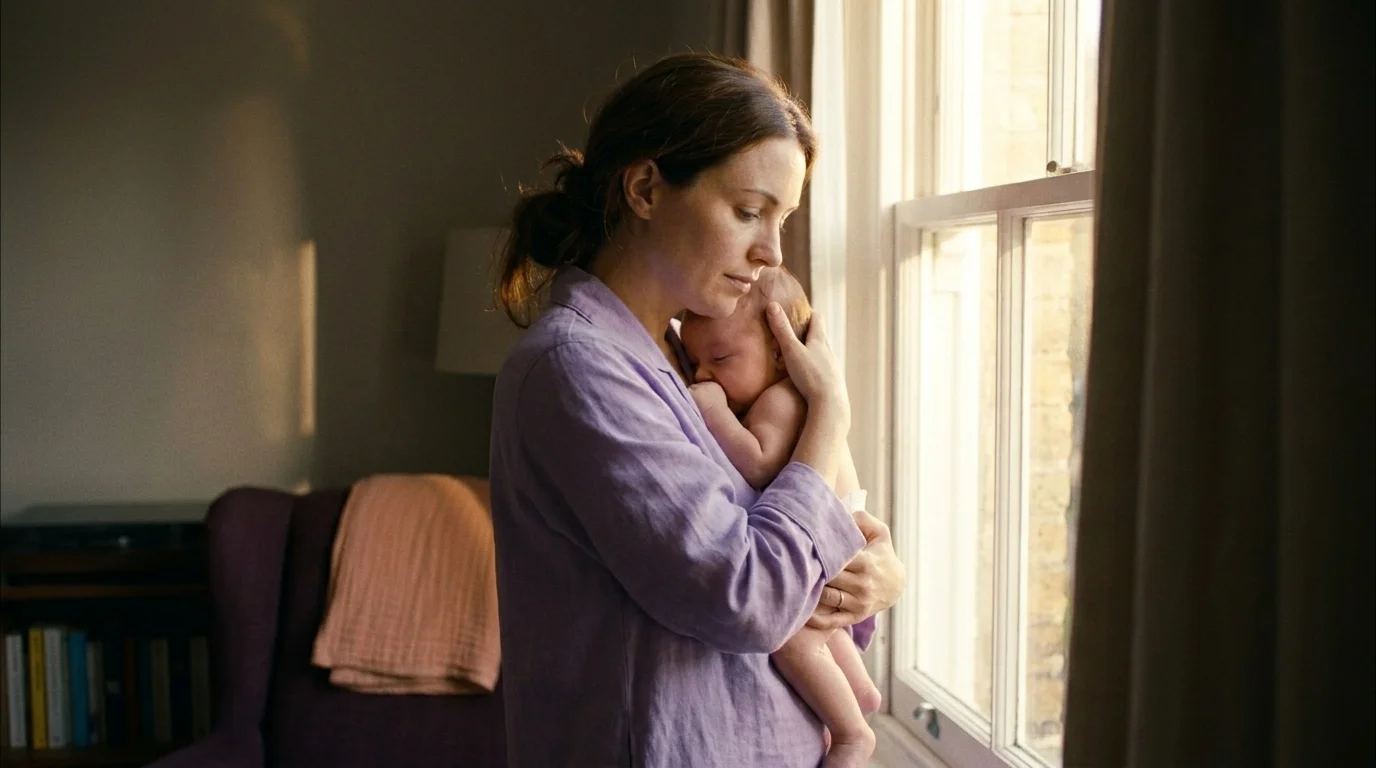
The fifth plane
The structural argument I find most useful for thinking about matrescence is the one I picked up from the developmental-education community. Christine Carrig, writing in Montessori Life in the winter of 2024, makes the case that matrescence parallels Maria Montessori's four planes of development — infancy, childhood, adolescence, adulthood — and constitutes a structural fifth plane in the human life course (AMS, Winter 2024). The parallel matters because the moves it makes are clinical and not metaphorical. Like adolescence, matrescence involves synaptic pruning, neuroplastic remodelling, heightened environmental sensitivity, and the re-formation of identity around a structurally new set of priorities. Like adolescence, matrescence is awkward, sometimes brutal, often funny, and recognisable from the outside as a stage rather than as a problem.
I would extend the argument the way the developmental literature is starting to extend it. Adolescence used to be regarded as a deviation from adulthood — a kind of failed-adult intermission — until enough work was done to make it visible as its own stage. Matrescence is, at this moment in the literature's history, where adolescence was sixty years ago. The work being done, by Athan and Sacks and Jones and the perinatal-psychiatry literature, is the work of making it visible. Once it is visible, the question stops being "why is she not who she was before" and becomes "what is she becoming, and what does she need to do that well".
The brain, and the durable rearrangement
The matrescence literature has, in the past five years, acquired a level of neuroscientific support that the older essayistic literature could not have anticipated. The 2023 Trends in Cognitive Sciences paper by Sacks and colleagues documents that the morphological changes the maternal brain undergoes persist for years and decades — that the brain of a multiparous woman in late midlife shows functional-connectivity patterns opposite to the patterns of normal age-related cognitive decline (Sacks et al., 2023). Motherhood, on a long-time horizon, may be neuroprotective. This is not what the old narrative — the one in which motherhood was a depletion — would have predicted.
Brain imaging studies have now reached the point where pregnancy itself is detectable as a structural change. Recent reviews of work by Hoekzema and others suggest imaging can determine with approximately 100% accuracy whether a woman has been pregnant between two scans, by reading the morphological signature alone. The biological event is not, on this evidence, a temporary disruption. It is the beginning of a durable rearrangement of the brain, the body, and — by the argument of every philosopher of the self I have read on the question — the person.
Maternal ambivalence is evidence, not failure
This is the part of the essay I most want to write carefully, because it is the part the existing essayistic literature has got most right and the popular literature has got most wrong.
The 2010s and 2020s produced a small canon of books that took maternal ambivalence as their subject. Orna Donath's Regretting Motherhood (2017) interviewed twenty-three Israeli women who, in the long honest form the form rarely permits, said that they loved their children and would, given the chance, not become mothers again. Rachel Cusk's A Life's Work (2001) is the older anchor — a literary account of the first year of motherhood that the British press, at the time, treated as if Cusk had said something obscene. Sheila Heti's Motherhood (2018) is the book about the deciding-not-to that is, in some ways, the philosophical hinge between the literature on choosing motherhood and the literature on refusing it.
The matrescence framework gives all three writers a name for what they were describing. Ambivalence about motherhood is not, in this framework, a moral failure or a sign of inadequacy. It is the felt friction of identity restructuring at a structural life stage. It is the texture of the work that is happening. The mother who feels ambivalent is not a worse mother than the mother who does not. She is, often, a mother who is closer to the surface of the work — and there is no version of the literature, going back to Rich, that can honestly tell her otherwise.
I would say one more thing, gently, here. The line between ambivalence and clinical depression is not a line that an essay can draw for the reader. Ambivalence is normative. Depression is treatable. Both are real, and the right person to help a reader tell the difference between them, when she needs to tell the difference, is a perinatal mental health provider, not me.
Losing yourself, and finding yourself
A great many of the women who arrive at this article through search engines arrive having typed the phrase losing yourself in motherhood. I have, in earlier years, typed it myself. The phrase describes a real experience — the part of matrescence in which the woman cannot recognise the person she used to be from inside the daily texture of who she is now — and it is one of the experiences the matrescence framework has done the most to dignify.
I would say two things to a reader who has arrived at this article through that search.
The first is that the losing-of-self is, as far as the literature can tell, not the destination. It is the middle. Matrescence is structurally an identity restructuring, and the period in which the old self appears to have evaporated and the new self has not yet arrived is the period most matrescence writers, including Jones and Sacks, locate near the beginning of the work. The work does not stop there. The new self arrives. She is not the old self, and she is not less than the old self.
The second thing is that the language of "losing" is not the only available language. Maggie Nelson, in The Argonauts, writes about becoming a mother as a process inside which she is also, at the same time, becoming something other than what she had been — and the way she writes about it does not reach for the language of loss. She reaches for the language of accretion. I find Nelson's framing more useful than the alternative, and I would invite the reader, on a difficult Tuesday afternoon, to try it.

Naming as intervention — what 2025 evidence shows
A piece of empirical evidence I want to put on the table, because it is the strongest single fact I can offer for why this essay exists at all.
In July 2025, a pilot study published in BMC's Maternal Health, Neonatology and Perinatology tested a six-week, seventy-five-minute-per-week Zoom-delivered matrescence education programme for new mothers (BMC pilot study, 2025). The sample size was small (n=18). The findings, even at that size, were strong. Self-compassion improved at p=0.0256. Posttraumatic Growth on the Personal Strength subscale improved at p=0.001. Mindfulness (Non-Reactivity) improved at p=0.01. Environmental mastery improved at p=0.04.
The intervention, in a phrase, was teaching new mothers the word matrescence and what it meant. The wellbeing outcomes the women showed after six weeks were measurable, statistically significant, and consistent across a battery of validated instruments. The literature has long argued, in its philosophical register, that language constitutes reality — that naming an experience changes the experience. The 2025 pilot study, in its clinical register, is the first peer-reviewed evidence that this is so for matrescence specifically. The naming, on the BMC evidence, is the intervention.
Matrescence is not postpartum depression
This is a clinical distinction I want to draw plainly, because the matrescence literature is just now arriving at it.
A 2025 commentary in PMC — "A critical need for the concept of matrescence in perinatal psychiatry" — supports incorporating matrescence into the diagnostic vocabulary perinatal psychiatrists use, while identifying three open problems with the current framework (PMC commentary, 2025). The problem most relevant to a lay reader is the first one: matrescence and postpartum depression are not the same thing, and conflating them does both concepts harm. Matrescence is a normative developmental stage that every mother undergoes; it is not, in itself, an illness. Postpartum depression is a clinical disorder, often treatable, that meets specific diagnostic criteria. Most matrescence challenges — exhaustion, identity-disorientation, ambivalence, the long middle of the night — are not pathology. Most postpartum depression is not "just" matrescence.
The reason the distinction matters in both directions is that medicalising matrescence makes a developmental stage into a problem to solve, and missing real postpartum depression leaves women without treatment they need. If you are reading this article from inside a difficult perinatal year and you are not sure which side of that line you are on, the right person to help you tell — and the only person, in honesty — is a perinatal mental health provider who knows you. Postpartum Support International (postpartum.net) is the right place to start when you do not yet know who to call.
A short word on patrescence
Matrescence has, predictably, prompted the question: what about fathers? The parallel term is patrescence, and the literature on it is younger, smaller, and emerging. Recent neuroimaging work is starting to document measurable structural changes in fathers' brains following the arrival of a child, though the changes appear smaller and less durable than the ones documented in mothers. The honest summary is that we know patrescence is real, we do not yet know how large it is, and the two stages are increasingly being treated as complementary life events rather than competing ones. I include the paragraph here partly because the question deserves an answer and partly because the absence of a working vocabulary for the men's stage is, structurally, one of the things the matrescence literature is now in a position to help fix.
The limits of the framework
I would feel I had not done this article honestly if I did not name what the matrescence framework, in its 2026 state, has not yet done. The 2025 PMC commentary names three of the open problems: the existing matrescence scales have not been validated across diverse populations; the framework is gender-exclusive in its current form (the literature on patrescence and on non-binary parents is sparse); and the literature has not yet produced a clean methodology for distinguishing normative matrescence challenges from psychiatric illness in clinical practice.
These are real limits and they are the limits of the framework, not of the experience. The experience is happening, regardless of how the literature catches up to it. The work the literature still has to do is the work of catching up. Most of the women I know who have read the matrescence literature in the past year have read it with the careful gratitude of someone reading the first draft of something that, in its final form, is going to be one of the most useful frameworks the field has produced.
A small note to close
Lucy Jones, near the end of Matrescence, writes that the word she was looking for, in the years of being a new mother, was not the word she had been given. She had been given mother, with its centuries of inherited content. The word she needed was the one that named the becoming, the work-in-progress, the woman who was already differently shaped from the woman she had been six months earlier and would be differently shaped again six months from now. The word she needed was matrescence. She found it after years of trying. She has, in the book she wrote about it, made finding it considerably easier for the rest of us.
I am, as I write the close of this essay, several years past the worst of my own matrescence and several years short of the part where I will need to do the work again differently as my children move toward leaving home. The word, by now, is a tool I keep in the kitchen. I would invite the reader to put it in hers.
Frequently Asked Questions
Matrescence is the developmental transformation of becoming a mother — a profound, prolonged identity shift involving biological, neurological, psychological, social, and philosophical change. The term was coined by anthropologist Dana Raphael in 1973 and revived in 2017 by psychiatrist Alexandra Sacks. Like adolescence, matrescence is a normative life stage, not a disorder.
Medical anthropologist Dana Raphael coined matrescence in her 1973 book The Tender Gift: Breastfeeding to name the transition women undergo when becoming mothers. The term was largely dormant until psychiatrist Alexandra Sacks revived it in a 2017 New York Times op-ed and a 2018 TED talk, and was formally re-defined and expanded in 2025 by perinatal psychologist Aurélie Athan.
Matrescence is a normative developmental stage — the psychological, neurological, and identity reorganisation that follows becoming a mother. Postpartum depression is a treatable clinical disorder. Conflating the two medicalises ordinary identity change and leaves real illness underdiagnosed. If you are unsure which side of the line you are on, a perinatal mental health provider is the right person to ask — Postpartum Support International (postpartum.net) is a good place to start.
Yes. The 2025 expansion of the framework by Aurélie Athan explicitly includes mothers who arrive at motherhood through adoption, surrogacy, fostering, or stepparenting. Matrescence is constituted by the developmental transformation, not by the biological event of birth.
Patrescence is the parallel developmental transition for fathers and non-birthing parents — emerging research suggests it involves measurable neural and identity changes, though it has been studied far less than matrescence. The two concepts are increasingly treated as complementary life stages rather than competing ones.
Yes — there is empirical evidence. A 2025 pilot study published in BMC's Maternal Health, Neonatology and Perinatology tested a six-week matrescence education programme for new mothers and found statistically significant gains in self-compassion (p=0.0256), posttraumatic growth (p=0.001 for Personal Strength), mindfulness (p=0.01), and environmental mastery (p=0.04). The intervention, in essence, was teaching mothers the word and what it meant.