
The Toys and Tech Revolution: How Parenthood Drives Innovation in Child-Friendly Technology


If your kid wants a STEM toy — or, more likely, if you want them to want one — you're walking into an aisle that has figured out exactly how to sell to you. "STEM" is now a marketing sticker as often as it's a real description, and the gap between the two is where parents waste money. So let's do this the useful way: what actually counts as one of these STEM toys, how to pick one that matches your kid's age, and the one question about smart toys that no retailer is going to answer for you.
First, the demand side, because it explains why the aisle looks the way it does. Parents drove this. In the Toy Association's 2025 survey, 60% of US parents said they actively seek toys that build STEAM-related skills, 58% prioritized toys that build essential life skills, and — the part I find most telling — 63% of Millennial parents said they weigh a toy's contribution to mental, emotional, and social health when buying (Licensing Magazine, 2025). That last number is the "whole child" shift: parents stopped treating STEM as academic flashcards and started treating it as one part of how a kid develops. The manufacturers noticed, and the market followed — STEM toys are growing at roughly an 8–9% annual clip, with the 8-to-12 age group making up about 41% of usage (Global Market Insights, 2025).
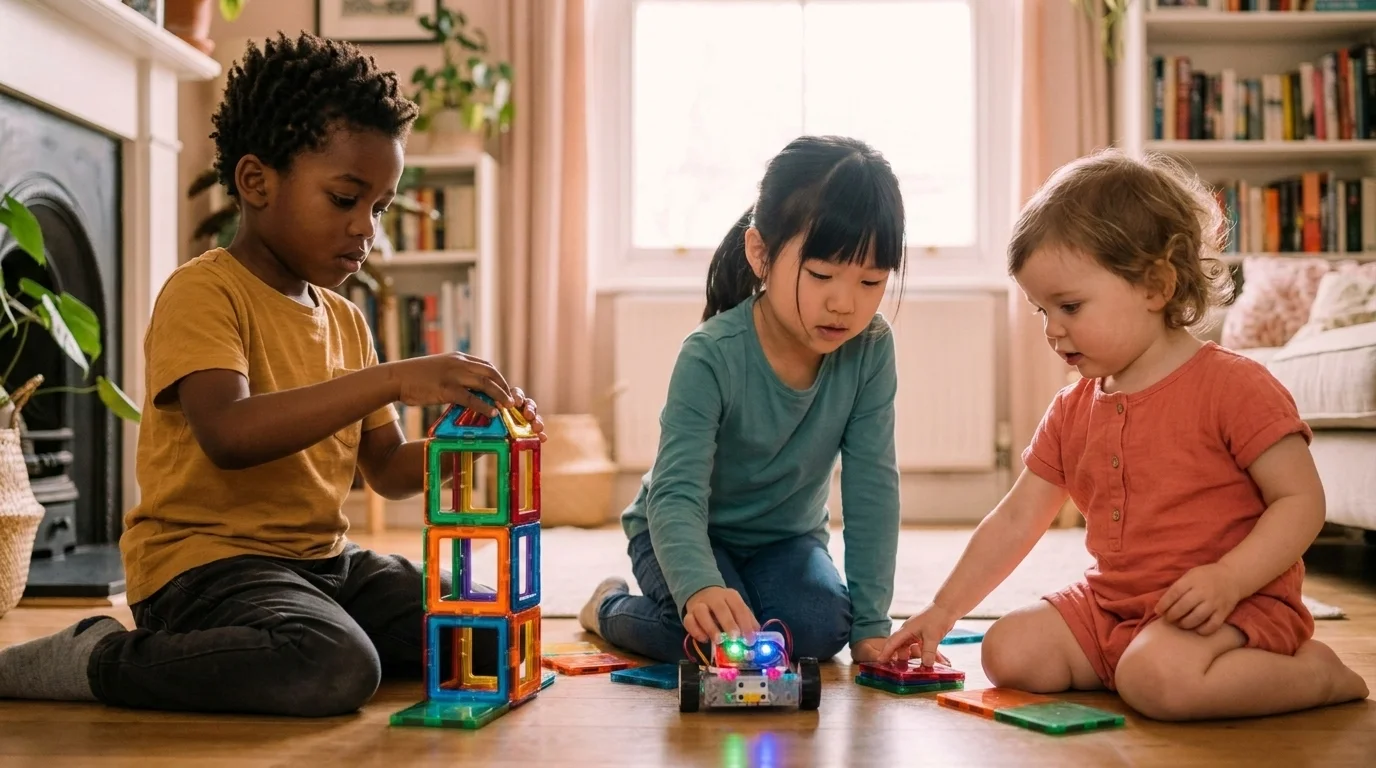
What actually makes a toy "STEM"
Here's the plain-English filter, because the label on the box is doing a lot of unearned work. A real STEM toy emphasizes problem-solving and open-ended play over passive entertainment. The test isn't whether it has a circuit board or an app — plenty of screen-glued toys have both. The test is whether the toy lets a kid experiment, fail, and find their own solution, rather than walking them down a single fixed path to a single right answer.
Three things separate STEM learning from STEM marketing:
- Open-ended, not one-outcome. A building set you can make a hundred things from teaches more than a kit that snaps into exactly one robot and then sits there.
- It grows with the child. Good STEM toys have a low floor and a high ceiling — a four-year-old and a seven-year-old can both play, at different depths.
- The kid does the thinking, not the toy. If the toy performs and the child watches, that's entertainment wearing a lab coat.
Hold that filter up to anything marketed as STEM and most of the aisle sorts itself out fast.
How to choose STEM toys by age
This is the part retailers scatter across a hundred product pages and never assemble for you. Match the toy to your child's developmental stage, not to a single "start age" — there are genuinely good STEM toys for every bracket.
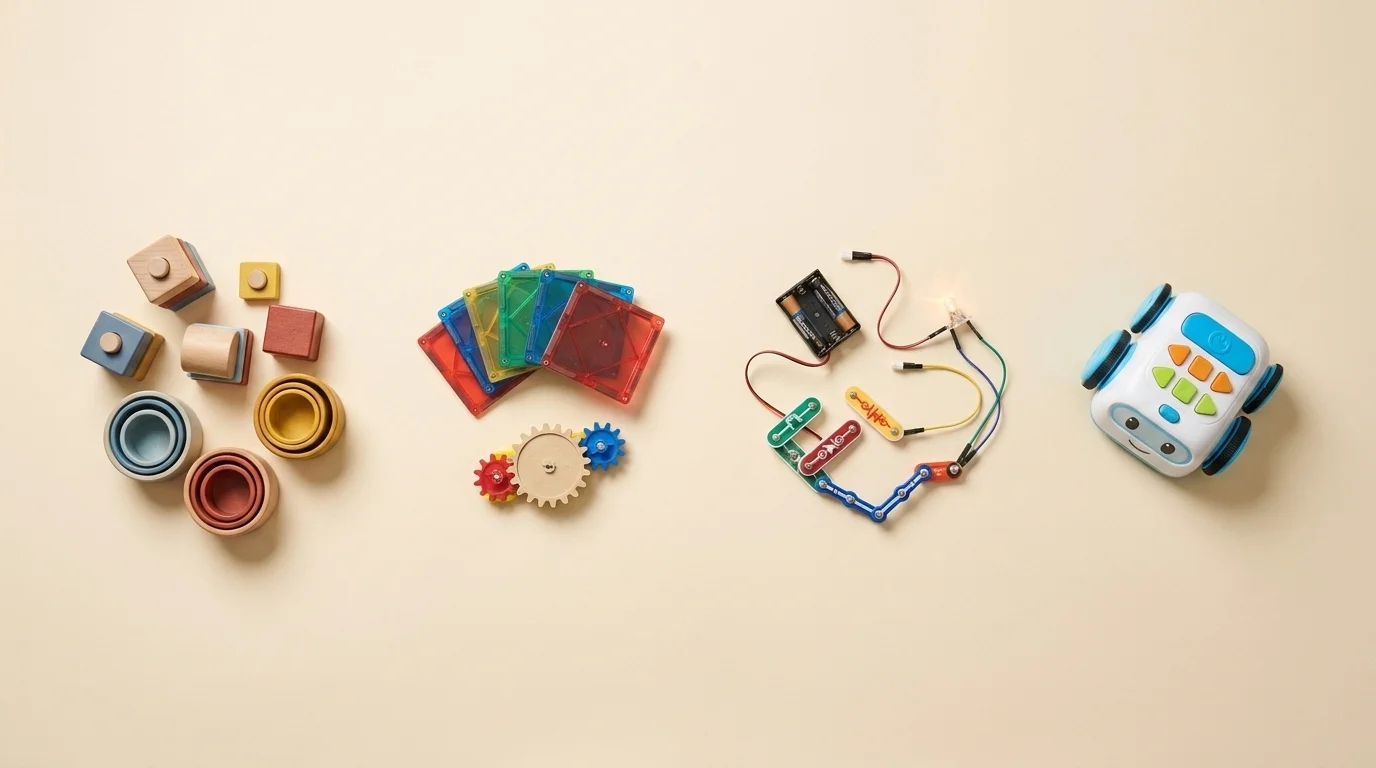
- Toddlers (under 3): Cause-and-effect toys, stacking and nesting sets, large building blocks. The non-negotiable here isn't educational — it's safety. Check every toy for small parts, which are a choking hazard for this age, and favor sturdy, non-toxic materials (AAP guidance, via Deeksha STEM). Skip anything with button batteries or magnets small enough to swallow.
- Ages 3–5: Magnetic tiles, simple gear sets, color-and-pattern logic games, beginner counting toys. Look for open-ended over instructional — this is the age where "make whatever you want" beats "follow the manual."
- Ages 6–8: Beginner robotics, simple circuit kits, snap-together electronics. This is where app-connected and programmable toys start to make sense. Look for ones that teach a concept (a circuit actually closing, a command actually running) rather than ones that just light up.
- Ages 9–12: Coding kits, electronics sets, more serious build-and-program robots. This bracket is the biggest slice of the market for a reason — kids this age can handle real challenge and stay with a multi-step project. Prioritize toys with a high ceiling they won't outgrow in a month.
The smart-toy privacy check no retailer mentions
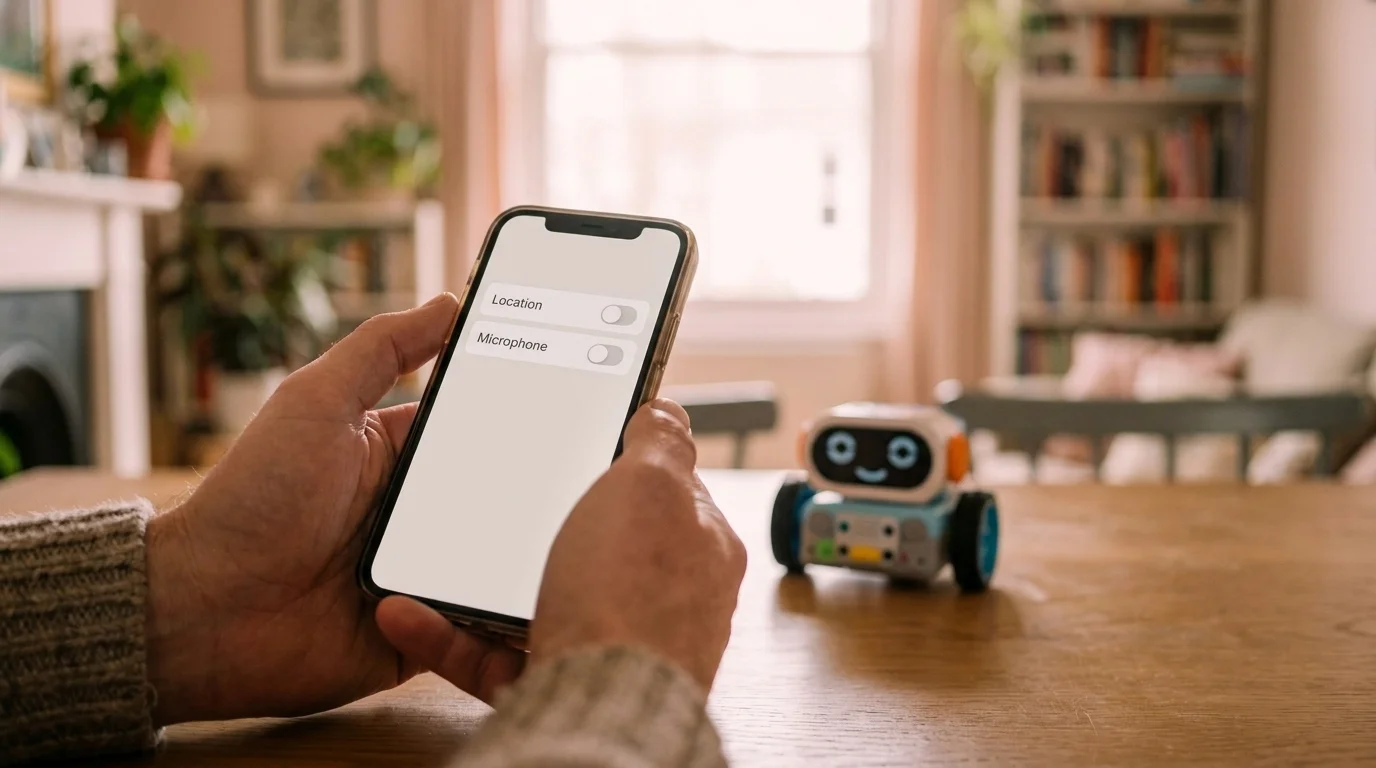
Now the question the box won't answer, and the one I'd want every parent to ask before buying anything that connects to an app. Let me separate the layers the way I always do: what the toy can collect, what actually happens in practice, and what you can realistically do about it.
What it can collect is broader than most parents assume. Connected toys aimed at kids fall under COPPA, the US children's-privacy law, and as of 2025 the rules explicitly cover persistent identifiers, precise geolocation, and biometric or voice data for child-directed services — including IoT smart toys — with requirements to minimize and delete what's collected (FTC COPPA FAQ).
What happens in practice is the part that should make you read the privacy policy. In September 2025, the FTC took action against robot-toy maker Apitor: its companion app bundled a third-party advertising SDK (JPush) that automatically collected children's precise geolocation without parental consent. The October 2025 order imposed a permanent injunction, a data-deletion mandate, and a $500,000 civil penalty (FTC, 2025). The toy itself looked like a friendly coding robot. The data behavior was hidden one layer down, in a component the toymaker pulled in from someone else — which is exactly why you can't tell from the packaging.
What you can do, before you buy:
- Read the app's permissions, not the toy's box. If a coding robot's app wants location, contacts, or always-on microphone access, ask why a building toy needs it.
- Check the privacy policy for third-party sharing. The Apitor problem wasn't the toy collecting data for itself — it was an embedded ad SDK doing it. Look for whether data goes to "third parties" or "advertising partners."
- Decide whether it needs to be connected at all. A lot of STEM toys teach exactly as well in their offline mode. If the app is optional, treat the offline version as the default and the app as something you opt into deliberately.
This isn't a reason to fear smart toys. It's a reason to treat a toy's data behavior as a buying criterion, the same way you'd check the age rating or the small-parts warning. The good products survive the check fine.
Where the innovation is actually heading
The frontier worth knowing about: AR/VR features, app-connected kits, and programmable robots are the named growth edge of the category, and institutional demand is rising fast — China's mandatory AI-education curriculum, requiring 8+ hours a year from September 2025, is pushing schools to buy coding and robotics kits at scale (Global Market Insights, 2025). "AI toys for kids" is the phrase you'll hear more of, but be clear-eyed: as a consumer category it's still emerging, not mainstream, and a lot of what's branded "AI" right now is a chatbot bolted onto a toy. Cover it with curiosity, not urgency. The fundamentals — open-ended, age-matched, privacy-checked — matter more than whether a toy claims to think.
The one thing to do before you buy
Pick up the toy you're considering and run the three-second filter: does it make the kid do the thinking, does it fit where they are right now, and — if it connects to anything — what does its app actually want access to? A toy that passes those three is worth your money whether or not it has "STEM" stamped on the front. A toy that fails them isn't, no matter how good the sticker looks. The marketing is designed for you. The play is for them — make sure that's what you're actually buying.
Frequently Asked Questions
There are STEM toys for every stage — cause-and-effect and large building blocks for toddlers, magnetic tiles and logic games for ages 3–5, beginner robotics and circuit kits for 6–8, and coding kits and electronics for 9–12. Match the toy to your child's developmental level rather than a single 'start age.'
A real STEM toy emphasizes problem-solving and open-ended play over passive entertainment. Look for toys that are open-ended (many outcomes, not one), grow with the child (low floor, high ceiling), and make the kid do the thinking rather than performing while the child watches.
They can be, but check first. Connected toys fall under COPPA, and in 2025 the FTC penalized toymaker Apitor $500,000 after its app collected children's precise location without consent via a third-party SDK. Before buying, review the app's permissions, the privacy policy's third-party sharing, and whether the toy works offline.
The good ones are — but the 'STEM' label is now a marketing sticker as often as a real description. A STEM toy is worth it when it passes a simple test: it makes the child do the thinking, fits their developmental stage, and (if connected) doesn't quietly over-collect data. Toys that fail that test aren't worth it no matter how they're branded.
STEM covers science, technology, engineering, and math; STEAM adds the arts. In practice for toy-buying the distinction matters less than the play pattern — both are valuable when the toy is open-ended and problem-solving rather than a single-outcome novelty. Surveys show most parents now value this broader, whole-child mix.