
Navigating Teenage Challenges: Supporting Adolescents Through Transitions


If you are raising teenagers in 2026, the macro picture is more complicated than the version your own parents were working with — and most of what is on the internet about parenting tips for teenagers was written before the picture changed. The CDC's 2023 Youth Risk Behavior Survey, released in August 2024, found that 40% of U.S. high-schoolers reported persistent feelings of sadness or hopelessness in the previous twelve months. That number is down from 42% in 2021 — the long-trend story is still that it climbed from 30% in 2013 — but it remains an extraordinary baseline. The disparities inside that average are the part the headlines underreport: 53% of female students versus 28% of male students; 65% of LGBTQ+ teens versus 31% of cisgender, heterosexual peers. If you are parenting a teen girl, a queer or trans teen, or a neurodivergent teen, the data is not the population average. It is something more specific you should know.
This article is a working playbook for raising teenagers under those conditions, written in the same register I'd use to brief a friend over coffee. It covers what neuroscience now says about why your teenager is the way they are (Laurence Steinberg's dual-systems model, in plain English), how to actually talk to teenagers without the conversation falling apart in the first sixty seconds, how to help them navigate peer pressure with autonomy rather than rule-by-rule prohibition, what the 2023 Surgeon General Advisory and the AAP's new universal screening guidance want every parent to know about the mental-health crisis, and — at the end — what Lisa Damour has been telling parents about the developmentally normal pulling-away that defines this stage. For the broader resilience framework across childhood, see the companion piece on cultivating resilience in children. What follows is teen-specific.
A note about what this article is and is not. I am a digital-safety researcher and a parent — not a pediatrician, psychologist, or psychiatrist. The clinical guidance below is reported from named institutional sources (CDC, AAP, USPSTF, HHS Surgeon General). When something in your house is acute, the right next calls are your pediatrician, the 988 Suicide and Crisis Lifeline by call or text at any hour, and — for LGBTQ+ teens specifically — The Trevor Project's 24-hour hotline. Those numbers are the YMYL floor of this article.
Steinberg's dual-systems model, in plain English
The single most useful sentence I can give you about the teen brain — and the one almost no parent-facing competitor on the first page of Google bothers to attribute properly — comes from Laurence Steinberg's dual-systems model of adolescent risk-taking, originally published in 2008 and reappraised by Steinberg and colleagues in 2016. The model is now the field's canonical answer to the "why is my teenager like this" question, and it is — once you have it — almost embarrassingly clarifying.
The teen brain develops in two unequal tracks. The socioemotional system — the part that processes rewards, peers, novelty, and emotional intensity — matures relatively quickly and peaks in mid-adolescence, around age 15. The cognitive control system — the prefrontal cortex, the brake, the part responsible for impulse control, planning, and consequence-weighing — matures slowly and linearly, into the mid-twenties. Adolescence, in Steinberg's framework, is literally the years inside that gap: the gas pedal is fully online, the brakes are not. Your teenager is not failing to be a small adult. They are functioning exactly as a human brain at this developmental stage is built to function.
The practical translation that has held up in every parenting conversation I've had in the last decade is that emotional intensity, peer responsiveness, present-bias, and occasional terrible decisions are not character flaws. They are neurodevelopment running on schedule. Knowing this changes how you respond at the moment in the kitchen when your fifteen-year-old has just decided that the wrong sentence said by you is the most important crisis of her life — because the right move in that moment is not to argue with the gas pedal, it is to wait, gently, for the brakes to come back online, which they do within minutes if no one keeps the argument running.

How to talk to teenagers (without losing them)
The communication advice the parenting internet keeps giving — "have open conversations," "be a good listener" — is true and useless. It is useless because it does not say the actual sentences. Below are five scripts that survive contact with a real teenager and that are grounded in what the dual-systems literature would predict.
The first script is the swap. Replace "Why did you do that?" with "Tell me more about that." The "why" question reads, to the teen brain in the moment, as an interrogation; the cognitive-control system goes offline and you get a defensive non-answer. "Tell me more" reads as curiosity; the same teen will often, given thirty seconds and no follow-up question, narrate the entire backstory. This costs nothing. Try it tomorrow.
The second script is the validation-before-solution rule. Almost every teenager who walks in the door with a hard story will reject the solution if you offer it before the validation. Try, as your default opening sentence: "That sounds really hard. Want my take, or just to vent?" The second clause is the part that does the work — it gives them the option, and you will be surprised how often they pick just to vent, which is the version where you get to know what actually happened.
The third script is the side-by-side rule. Difficult conversations work better when you are not looking at each other. The teen brain reads direct eye contact in a high-stakes moment as confrontational and the cognitive-control system, predictably, goes offline. Drive somewhere; do the dishes together; walk the dog. The most useful conversations I have had with my older child have happened in the front seat of a car at six o'clock on a Wednesday with neither of us looking at the other.
The fourth script is the 24-hour reset. If a conversation has tipped into argument, end it. "I want to think about this. Let's pick it back up tomorrow." Walk away even if you are right. Adolescents in an escalated emotional state are not making decisions with the prefrontal cortex; they are making decisions with the limbic system. The conversation that resolves nothing tonight will, very often, resolve cleanly the next morning if you have not, in the interval, said the irretrievable thing.
The fifth script is the five-minute check-in. Once a day, at a predictable time, for five minutes, you are available with nothing else in your hands and no agenda. "How are you doing?" Not "how was your day," which is a question with a script — the script is "fine" — but the slightly more open version. Most days you will get a few sentences. On the days that matter, you will get the real thing, and only because you have made the previous twenty-seven five-minute windows available without forcing it.
How to help teenagers navigate peer pressure
If there is one operational keyword for this article, it is teenage peer pressure, and the version of the conversation that works in our house is built on a single re-framing: peer pressure is not the enemy; coercive peer pressure is the enemy. The distinction matters because most parental advice on the topic collapses the two and ends up trying to insulate teens from their peer group entirely, which is, developmentally, both impossible and counterproductive.
Adolescents are wired — per Steinberg's model — to weight peer information more heavily than parental information. This is the same neural feature that gets blamed in the risky-behavior literature, and it is also the same neural feature that produces the deep friendships and identity-building that adolescence is for. The parental task is not to defeat the peer signal. It is to teach the kid to read it.
What this looks like in practice is teaching refusal scripts before they are needed, while the prefrontal cortex is online — which is, for most teens, before they are at the party. The two lines I have seen work most reliably are short and built on plausible deniability. "I told my mom I'd be home by 11 — let's not push it" borrows your authority to give the teen a face-saving exit. "I'm driving so I'm out" borrows the car. The point of both scripts is that they are easy to say in the moment when the cognitive-control system is being overrun. Practising them at the kitchen table on a Saturday morning, somewhat self-consciously, is the work.
The other re-frame that pays for itself, especially in middle-school: distinguish positive peer influence from negative. A teen surrounded by friends who study, take care of each other, and tell each other when something is a bad idea is benefitting from peer pressure in a structural way that no parent could substitute for. If your child's friends are not those people, the work is the slow one — broadening the friend pool, getting them into activities where the social mix is different — rather than the dramatic one. Banning the friend rarely works; rerouting the social environment, slowly, often does.
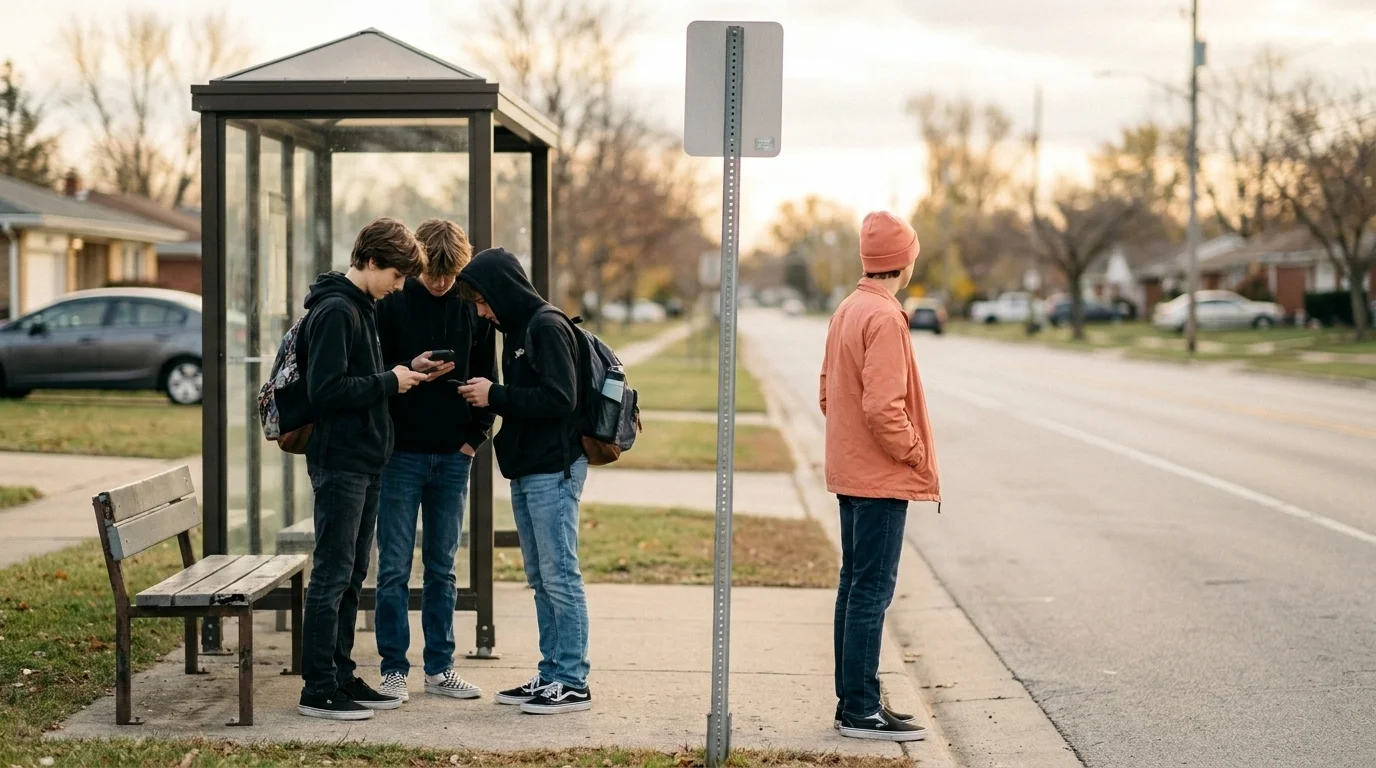
The teen mental-health crisis: what parents need to know in 2026
I want to write this section carefully, because the macro story has changed substantially since most of the parenting articles you have read were written, and the practical implication for parents has changed with it.
The data, in two paragraphs, named to the sources. The CDC's 2023 YRBS, released August 2024, found that 40% of U.S. high-schoolers reported persistent sadness or hopelessness in the previous twelve months (down from 42% in 2021); 20.4% seriously considered suicide; 9.5% attempted suicide. The gendered and identity-based disparities — 53% female / 28% male / 65% LGBTQ+ — appear in the CDC MMWR 2024 supplement. The U.S. Surgeon General has issued two relevant advisories: the 2021 Protecting Youth Mental Health advisory, which found that 60% of youth aged 12–17 with a major depressive episode receive no treatment; and the 2023 Social Media and Youth Mental Health Advisory, which found that teens scrolling social media more than three hours per day have approximately double the risk of depression and anxiety compared with lower-use peers. The 2021 American Academy of Pediatrics / American Academy of Child & Adolescent Psychiatry / Children's Hospital Association joint declaration of a National State of Emergency in Children's Mental Health has not been retired; it is still cited verbatim in 2025–2026 institutional materials.
The Haidt-vs-skeptics debate is the question parents are most often hearing about and least often getting the balanced version of. Jonathan Haidt's The Anxious Generation, published March 2024, argues that phone-based childhood + safety-ist parenting are the meta-cause behind the post-2012 mental-health curve, and the book has unambiguously moved policy — within twelve months of publication, 40 U.S. states had enacted some form of phone-in-school restriction. Counter-evidence from researchers at UC Irvine, Cambridge, and a 2025 PMC review argues the causal link is weaker than Haidt's framework asserts — that the post-2012 trend correlates with several macro-changes simultaneously and that pulling the social-media lever in isolation is unlikely to be sufficient. The Surgeon General's framing sits between the two: the 2023 advisory says social media is a substantial contributor that warrants serious caution, especially for younger adolescents, without claiming it is the single cause. The honest reading for parents, in 2026, is to treat the precaution as warranted (cap nighttime use, no phones in bedrooms, prefer messaging to algorithmic-feed apps for younger teens) without expecting that the cap on social media will resolve the picture.
What has changed in clinical practice — and what most parents are not yet aware of — is the formalisation of universal screening. The U.S. Preventive Services Task Force, reaffirmed by AAFP in 2024, now recommends anxiety screening for all children and adolescents ages 8–18 annually. The AAP's 2025 Pediatrics recommendation adds depression and suicide-risk screening at every well-visit from age 12. This is the operational answer to the "when do I bring it up with the pediatrician" question. It is now a default, not a special request. If your child's pediatrician is not doing the screen at the well-visit, you are within your rights — and your child's — to ask directly when it will start.
The clinical red flags worth bringing to a pediatrician outside the annual visit are: persistent sadness or irritability lasting more than two weeks; sleep or appetite changes; withdrawal from previously-enjoyed friends and activities; declining school performance; talk of being a burden; and any expression of self-harm or suicide. The thresholds are sensitive deliberately — the cost of an unnecessary visit is low; the cost of a missed crisis is not. In an acute moment, the 988 Suicide and Crisis Lifeline is available by call or text twenty-four hours a day. For LGBTQ+ teens specifically, The Trevor Project's 24-hour line is the parallel resource. Both are free. If your child is in immediate danger, dial 911.
A global context paragraph because the policy environment matters even for U.S.-based parents reading this. Australia's under-16 social media ban took effect December 10, 2025 — the world's first such law. By mid-January 2026, 4.7 million Australian teen accounts had been removed or restricted, with penalties of up to AU$50 million for platforms that fail to enforce. The Murdoch Children's Research Institute is running a multi-year study on whether the ban actually moves teen mental-health outcomes — the early data is not in. The 40-state U.S. school-phone-restriction wave is the closest American equivalent. The reasonable parental reading of all of this, in 2026, is that the policy lever is moving and the evidence base is not yet settled — which means the work, for now, is still at the kitchen table.
A note on resilience
Resilience is the part of the teen-parenting conversation that overlaps most heavily with what is true for younger children, so I'll keep this section short and direct you to the companion guide on cultivating resilience in children for the framework. The teen-specific application is that resilience in adolescence is built less by adult-led practice and more by what the developmental literature calls scaffolded autonomy — being allowed to attempt hard things, fail at them, and recover with the parent still in the room but not over-correcting. Evidence-based teen-specific resilience programs (school-based CBT-derived interventions, MTSS frameworks) are the operational version. The everyday version is letting your fifteen-year-old fight their own quarrel with the math teacher first, before you offer to write the email.
Identity, autonomy, and the parent-teen relationship
I want to close, before the practical tonight-action, on the conceptual framing Lisa Damour has been giving parents in Untangled (2016) and The Emotional Lives of Teenagers (2023). The thesis, compressed, is that pulling away from the parent is developmentally normal and not a sign that the relationship is failing. The pulling-away is the work the adolescent is doing — building a self that can function outside the family system, which is the whole point of adolescence. The parental task is not to prevent the pulling-away. It is to remain the trusted backstop they can return to.
In practice this means two things that are uncomfortable. First, the teenager who is quiet, in their room, on their phone, with the door closed is not necessarily in trouble; they are, very often, doing the developmental work of being alone with themselves for the first time. The metric is not how much they talk to you; it is whether, when something hard happens, you are the person they eventually come to. Second, the moments when they do come are unpredictable and short, and the cost of missing them is high. Be available when the moment comes — even at ten-fifty on a Sunday night, even when you are tired, even when the conversation looks like nothing. The five-minute check-in script earlier in this article is the practice that keeps the channel open for the rare moment that matters.

One concrete thing to try tonight
If you have read this far and want the smallest possible intervention with the highest practical payoff: pick a time tomorrow when you can be in the car with your teen for ten to fifteen minutes — to school, to practice, to the grocery store — and put your phone away. Don't open the conversation. Don't ask about school. Let the silence sit for the first five minutes if it needs to. Then, when something comes up, do the swap — "Tell me more about that" instead of "Why did you…?". That is most of the work. Repeat it tomorrow.
For the operational online-safety lane — the COPPA-13 conversation, sextortion red flags, the AAP's new 5 Cs screen-time framework, what to actually set up on the device — see the companion piece, Raising Responsible Digital Citizens. That guide is the rules; this one is the relationship. They are designed to be read together.
Frequently Asked Questions
The teen brain develops in two unequal tracks. The reward and emotion system matures by about age 15, while the prefrontal cortex — the "brakes" responsible for impulse control and judgment — keeps wiring into the mid-20s. This gap, described in Laurence Steinberg's dual-systems model, is the neurological reason teens feel everything intensely and sometimes act before thinking. It is normal development, not a discipline problem.
Lead with curiosity, not interrogation. Replace "Why did you do that?" with "Tell me more about that." Validate the emotion before solving the problem ("That sounds really hard. Want my take, or just to vent?"). Choose side-by-side moments — driving, dishes, walking the dog — over face-to-face confrontation, which the teen brain reads as threat. If a conversation escalates, use a 24-hour reset rule rather than pushing through to "win" the moment.
Teach refusal scripts before they're needed, and frame autonomy as something they earn through judgment rather than something parents withhold. Concrete refusal lines — "I told my mom I'd be home by 11" or "I'm driving so I'm out" — give teens a face-saving exit. Distinguish positive peer influence (real and developmentally protective) from coercive peer pressure (the target) so they can name the difference in real time.
Watch for changes lasting more than two weeks: sleep or appetite shifts, withdrawal from friends and activities they used to enjoy, declining school performance, persistent sadness or irritability, talk of being a burden, or any mention of self-harm or suicide. The American Academy of Pediatrics now recommends universal anxiety screening from age 8 and depression + suicide-risk screening from age 12 at every well-visit — ask your pediatrician about it directly if they don't bring it up first. In an acute moment, the 988 Suicide and Crisis Lifeline is available by call or text 24 hours a day; for LGBTQ+ teens specifically, The Trevor Project runs a parallel 24-hour line.
The honest answer in 2026 is: probably contributing, but the science is contested. The 2023 U.S. Surgeon General Social Media and Youth Mental Health Advisory found teens scrolling more than three hours a day have approximately double the risk of depression and anxiety. Jonathan Haidt's The Anxious Generation (2024) argues phone-based childhood is the central driver; researchers at UC Irvine, Cambridge, and a 2025 PMC review argue the causal evidence is weaker than that framing claims. Practical move: cap nighttime use, keep phones out of bedrooms, and watch what specific apps trigger mood drops.
Independence should expand with demonstrated judgment, not with the calendar. A 14-year-old can typically handle managing their own homework load, walking to local destinations, and short unsupervised periods at home. A 17-year-old should be making most decisions about their time, friendships, and money — with parents as consultants, not deciders. The shift across those years is from rule-setting to coaching: still involved, less directive.