Unveiling Ancestral Parenting Wisdom: Integrating Tradition into Modern Motherhood


My grandmother in Cork raised seven children in a terraced house with a single coal fire and the support of a street that had, in those years, the kind of density that meant a neighbour was usually nearer than a kettle. She would not have used the phrase "traditional parenting" — she would have used "raising the children" — but the practice she was inside is what most contemporary parenting writers mean when they reach for the word. I have been thinking about her, lately, because the household I am raising my own three children in is the structural opposite of the one she lived in, and because the gap between her arrangement and ours is, more than I had realised, the gap most modern mothers I know are quietly mourning.
This article is one parent's attempt to think honestly about what traditional parenting actually was — and is, in places where the lineage is unbroken — without either romanticising it or dismissing it. The aim is to name what travels well, and to be plain about what doesn't.
The "village" most of us never had
The single most useful piece of vocabulary I have learned in the last few years is the word alloparenting. It is the anthropologist's term for child-rearing shared among extended family, friends, and community members — and it is, as a 2023 NPR feature drawing on the Yale Human Relations Area Files documented, the historical norm rather than the historical exception (Yale HRAF). Researchers from University College London and Cambridge have argued that humans are "psychologically adapted to raise children cooperatively, not in isolation." The Hadza of Tanzania, the Ovambo of Namibia, the Pumé of Venezuela, the Woleai of Micronesia — the named cultures vary, but the structural pattern repeats. The isolated nuclear-mother model that most of us are now operating inside is, on the long anthropological view, a deviation.
I find this a more useful frame than the one parenting books generally start from, because it reframes what most modern mothers experience as a personal shortfall — exhaustion, isolation, the conviction that they should be able to do this themselves — as a structural reality. They cannot do this themselves, because humans were not designed to do this themselves. The Bump's 2026 parenting-trend coverage explicitly names "Radical Delegation" or "The Village Strategy" as a top adoption of the year (The Bump). The phrasing is new. The practice is, by some thousands of years, older than the writers covering it.
Traditional parenting across cultures
The first thing to say about traditional parenting is that it is not one thing. The competitor articles I read while writing this almost uniformly treat "traditional" as a Western mid-twentieth-century model — strict, gendered, hierarchical. That description fits one tradition among many. The four below are the ones I keep returning to because each one names a function the modern arrangement struggles to deliver.
The Aka and the Ngandu (Central African Republic). Anthropologists Barry Hewlett, Michael Lamb, and others have documented child-rearing among the Aka (a mobile forest-foraging band) and the Ngandu (settled farming villagers) in detail. Among the Aka, infants are held by someone — not always the mother — almost continuously for the first months of life, and a baby may be passed between several adults in a single hour. Among the Ngandu, the household is the unit, and older children, aunts, and grandmothers are inside the daily structure of caregiving. The function the practice serves, on Bornstein's framework — which I'll get to in a moment — is reliable adult attention without making any single adult the bottleneck.
Japan (amae). The Japanese psychiatrist Takeo Doi named amae in the 1970s — usually translated, imperfectly, as a kind of indulgent dependency. Japanese mothers traditionally permit very young children a great deal of physical closeness, frequent comfort-seeking, co-sleeping, and an unhurried separation. The reading that surprised me, as someone raised inside the Anglo-Irish "be a big boy" register, is that amae is understood to be the foundation of later self-regulation rather than its opposite. The child who has been secure can, in time, be self-possessed. The function is emotional security. The American Academy of Pediatrics' endorsement of "high warmth, high demands" — what pediatricians call authoritative parenting — is, structurally, a close cousin.
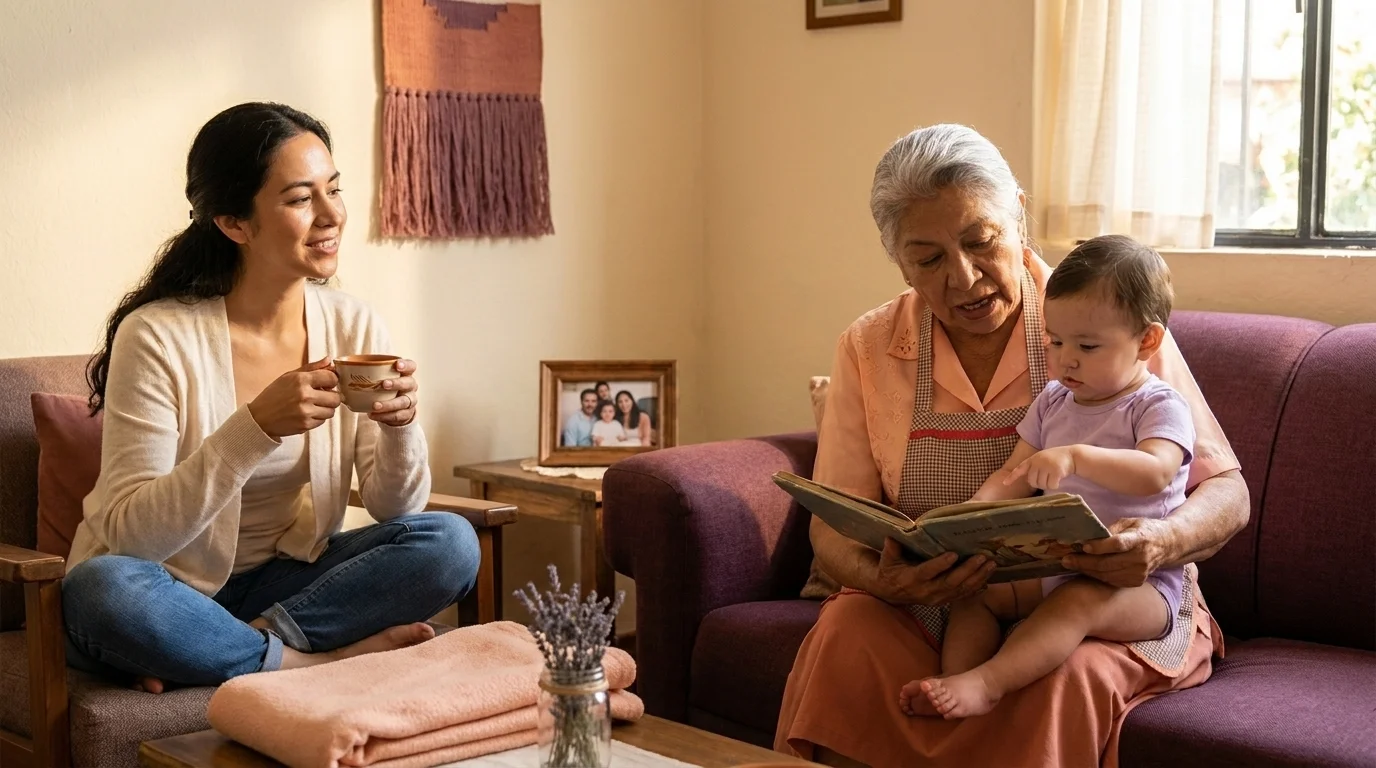
Latin America (the multigenerational household). In the Lebanese-Australian neighbourhood I lived in for the first three years of my eldest child's life, and in the Mexican-Australian family next door, the grandmother was not a visitor. She was a co-parent. Latin American multigenerational households — well-documented across Argentina, Mexico, Peru, and the diaspora — make the grandmother the second adult parents lean on, often by default. Rituals like the Quinceañera anchor identity around the extended family rather than around the nuclear pair. The function is dilution of load and the transmission of practical knowledge across generations.
Scandinavia (babywearing, co-sleeping, friluftsliv). The Norwegian word friluftsliv — "free-air living" — names a cultural conviction that children belong outside, in weather, for several hours of every day, from a very young age. Scandinavian traditions also lean toward babywearing, extended breastfeeding where the mother wishes it, and bedroom-sharing with infants. The function is closeness without crowding, and a robustness to ordinary discomfort that the indoor childhood my own children are mostly having does not produce by itself.
I want to be careful with how I list these. None of them is a recipe. Each of them is a long-evolved arrangement that does several jobs simultaneously, and the jobs are not the same in every household. The four named cultures above are the ones I happen to have read most carefully. There are many more.
Form, function, and the translation table
The intellectual frame that I keep finding the most useful for thinking about traditional parenting in a modern household is the one Marc Bornstein and colleagues set out in Parenting: Science and Practice in 2012 (NIH PMC3433059). Bornstein distinguishes between the form of a parenting practice (the specific behaviour) and the function the practice serves in its cultural context. The same form can mean different things in different cultures; different forms can serve the same function across cultures. Bornstein's five-culture comparison of mothers in Argentina, Belgium, Israel, Italy, and the United States found that mothers "differed in every domain assessed" yet showed "noteworthy attunement and specificity" between parental input and infant developmental domain — that is, the practice varied wildly, the underlying function was met everywhere it was looked for.
This is a more honest way to read traditional practices than asking "should I do this?" or "should I not?" The right question is: what function did this serve? Then: how do I serve that function in the household I actually live in?
| Traditional form | Function it served | A 2026-compatible form |
|---|---|---|
| Aka/Ngandu shared infant-holding across many adults | Continuous adult attention without single-bottleneck burden | Pre-arranged "village" of two-to-five trusted adults the baby is also handed to weekly |
Japanese amae (indulgent dependency, co-sleeping in infancy) |
Secure base for later self-regulation | High-warmth response to early distress; do not race toward independence |
| Latin American grandmother-as-co-parent | Knowledge transfer; dilution of parental load; identity anchor in extended kin | Standing Saturday-morning grandparent time; remote daily video routine for distant grandparents |
| Scandinavian friluftsliv (outdoor childhood) | Robustness, sensory range, low-tech downtime | Two hours outside on most days, regardless of weather; outdoor afternoons as the household default |
| Cork-style street-density of the 1950s | Casual unscheduled child-and-adult overlap | School-gate friendships, walkable park visits, weekly meals with the same two families |
| Oral storytelling at bedtime (most traditional cultures) | Pacing, attention, transmission of values without lecturing | Reading aloud past the age the child can read; "what happened today" rituals |
I would not present the table above as definitive. I would present it as the kind of thinking that, in my experience as a family mediator before I wrote full-time, most parents end up doing on their own once they have a vocabulary for what they are looking for.
Grandmother wisdom, the version that survives travel
A great deal of "grandmother wisdom" — the kind of phrase that ends up on a tea-towel — does not survive contact with my own life. Some of what my own grandmother in Cork knew was specific to her household and her decade. Some of it I would not want to inherit. But the parts that travel are sturdier than the slogans suggest. Three I keep returning to:
The first is that small children need predictable adults more than they need entertained adults. My grandmother did not run her seven children's afternoons. She let them run themselves, in proximity to her, while she did the work the house required. That arrangement is harder to reproduce in a household where one parent is on a screen and the children are inside, but the principle holds.
The second is that ritual saves you more than novelty does. The same meal at the same table at the same hour was, in her house, the structural fact around which everything else organised itself. I have come to think of bedtime, in my own house, the same way.
The third — and this one I had to be reminded of by my own wife — is that grandmothers are not optional infrastructure. The grandparents who are alive and present in our children's lives are a parenting resource on the scale of a school. The grandparents who are not — through distance, or through having died, as my own father did, before my eldest was old enough to remember him — are a structural loss it is fair to grieve and useful to compensate for in some other way. Saturday-morning video calls with the surviving grandparents in Cork are, in my house, what a kitchen full of neighbours used to be in hers.
What we leave behind
The harder part of this article. There are practices I have read about, in cultures I respect, that I would not adopt and would not recommend. I want to name them rather than pretend they aren't there.
Corporal punishment — slap, smack, switch — is part of the inherited form of many traditional households, including parts of my own grandparents' practice. The evidence that it produces durable harm to children's long-term emotional development is now strong enough that I would not bring it forward, regardless of how affectionately the inheritance is framed.
Rigid gender roles — the assumption that a mother is the default parent and a father is auxiliary, or that boys do not cry — were part of the script I was raised inside, and I have spent most of my adult life trying to step outside the parts of it that did me damage. They are part of the inheritance I would leave on the other side of the threshold.
Shame-based obedience — "children should be seen and not heard", the cold silence after a small infraction — produced, in my generation, a great many men who arrived at fatherhood without a working vocabulary for any of it. I write that sentence with the standing of a former social worker who watched some of them try to put the vocabulary together at fifty.
The principle is the one Bornstein's frame gives you: the function may have been worth keeping (order, regulation, respect) but the form is not. Find another form.
Traditional vs authoritarian: not the same thing
The fastest way to defend traditional parenting against its critics is to distinguish it from authoritarian parenting, with which it is regularly confused.
Authoritarian parenting, as developmental psychologists use the term, is high-demand and low-warmth — strict obedience without explanation, harsh discipline, emotional distance. The outcomes are documented and are not the ones most parents are aiming for.
What many traditional cultures actually practise is closer to the authoritative model: high demands paired with high warmth. The Japanese amae register, the Latin American carino, the Aka constancy — these are not cold. They are constrained and they are kind. The American Academy of Pediatrics, in its current parenting guidance referenced in The Bump's 2026 trend coverage, names authoritative parenting (high responsiveness, high demands) as the model associated with better emotional health, higher self-esteem, and stronger social skills than either permissive or authoritarian alternatives (The Bump).
The 2026 cultural turn away from both ultra-rigid and ultra-permissive extremes is, in this reading, less a new direction than a return to the actual structure of most traditional households outside the recent Anglo-American suburb.
A small note to close
What strikes me, having lived inside the modern arrangement for the entire active period of my parenting life, is that almost every piece of traditional practice my own grandmother would have recognised is doing one of two jobs: distributing the work of raising a child across more than one adult, or anchoring the household in a predictable rhythm. The forms are everywhere. The functions are the same.
My grandmother is dead. The terraced house in Cork has been sold. The street, when I last walked it, was full of cars I would not have known. The structural arrangement she relied on is not, in most modern lives, fully recoverable. The functions it served are. The practical work of contemporary motherhood is, more than anything else, the work of building those functions back from the materials available — friends, grandparents (alive and remembered), rituals, paid help when the budget allows it, the steady refusal to do the impossible thing alone.
I am, as my children would say, still working on it.
Frequently Asked Questions
Traditional parenting refers to child-rearing practices passed down through generations within a culture. It looks different around the world — West African Aka communities raise children cooperatively as a band; Japanese mothers emphasise 'amae' (a secure, indulgent dependency); Latin American households often centre grandmothers as co-parents; Scandinavian families lean into babywearing and outdoor childhood. The common thread is rooted, intergenerational, community-supported child-rearing — the opposite of the isolated nuclear-mother model dominant in much of recent Western media.
Yes — 'village strategy' is the 2026 trend term for what researchers have long called alloparenting: child-rearing shared among extended family, friends, and community members. Studies from University College London and Cambridge, summarised by the Yale Human Relations Area Files, show humans are psychologically adapted for cooperative parenting; the isolated nuclear-mother model is the historical outlier, not the norm.
Shared caregiving (a trusted village of family, friends, paid help), grandmother involvement (scheduled time and decision-input), bedtime and meal rituals, oral storytelling, and outdoor unstructured play translate cleanly. The key, on Marc Bornstein's form-vs-function framework, is to preserve the function the practice served (security, belonging, skill transfer) rather than copying its exact historical form.
Corporal punishment, shame-based obedience, rigid gender roles, and 'children should be seen and not heard' silencing are practices research has shown to harm long-term emotional development. Honouring heritage does not mean adopting everything inside it — choose what supports the child's wellbeing, leave the rest.
They overlap but are not the same. Authoritarian parenting is high-demand, low-warmth — strict obedience without explanation. Many traditional cultures combine high demands with very high warmth (Japanese amae, Latin American carino, Aka constancy) — closer to what pediatricians call authoritative parenting. The American Academy of Pediatrics endorses the warmth-plus-boundaries blend for better emotional and social outcomes.
2026 has seen parents step away from both ultra-rigid and ultra-permissive extremes. The Bump and other 2026 trend roundups name 'Radical Delegation' / 'Village Strategy' as a top adoption, with many parents looking to cultural inheritance for the warmth-plus-structure model the AAP also endorses.