The Resilient Path to Motherhood: Empowering Stories of Women Defying Odds


Adrienne Rich wrote that motherhood was the great unwritten story. She did not mean that no one had written about motherhood. She meant that no one had yet written about it with the seriousness we extend to a mid-career male novelist's divorce. Fifty years on, that is no longer entirely true. The stories are being written. The seriousness is, sometimes, beginning to arrive. What follows is one collected reading of six stories of motherhood — six paths now common enough to count as part of the ordinary catalogue of how a woman becomes a mother in 2026, and rare enough, still, that the women living them often report feeling that no version of their experience is in the books on the table.
I will not be writing about resilience in the abstract. I have come to mistrust the word. Resilience as an idea, decoupled from a particular woman and a particular Tuesday afternoon, is the thing the parenting industry sells back to the women whose stories it has flattened. The stories below are not abstract. The women are not all named, and the ones who are named are women whose accounts of their own lives have already been made public in the sources I cite. The rest are composites I have built from interviews and from the documented patterns inside the literature. Where a composite stands in for several women's experiences, I have said so.
I asked Dr. Jasmine Ross of Postpartum Support International, in correspondence I have drawn on for context here, why the storytelling matters at all (Postpartum Support International). Her answer, in its short form, was that the validation a woman receives when she sees her experience named in print is one of the load-bearing supports of perinatal mental health. That is why this article exists in the form it does.
A. — Single mother by choice
Elizabeth — whose story has been told in detail by Illume Fertility under her own name (Illume Fertility — A Winding Journey to Single Motherhood by Choice: Elizabeth's Story) — decided in her early forties that the partner had not arrived in time, and that the question of motherhood was not going to wait for him. She used donor sperm. She did three rounds of IVF. The first two retrievals produced no chromosomally normal embryos. The third produced a single low-grade embryo that, through a sequence of small mercies a fertility clinic does not normally promise, became her son Luca, born on the second of July, 2024.
I tell Elizabeth's story first because she is one of a population that is now larger than most women I speak to realise. The U.S. single-mother-by-choice cohort is now estimated at more than three million women (Illume Fertility), and the rate of unmarried women in their forties giving birth has grown by roughly two hundred and fifty per cent over the past thirty years (NPR, January 2026). This is the cohort the NPR feature called the rewriting of the single-mother narrative in America — and it is one I would invite readers to think of less as a deviation from the script and more as a chapter the script had not yet included.
A friend of mine — Black, in her late thirties, single by considered choice — read the same Successful Black Parenting feature I did last summer (Successful Black Parenting, July 2025) and said that the most useful thing about it was that the women in it were not framed as compensating for an absence. They were framed as choosing motherhood the way some women choose careers and other women choose neither, and the choice was given the same dignity. She is, now, a year into the long middle of single motherhood. The cultural-confidence framing the article gave her is not, as she puts it, the same thing as living the life. But she came to the life with the framing intact, and she says it changed which interior negotiations she had to run.
B. — IVF after loss
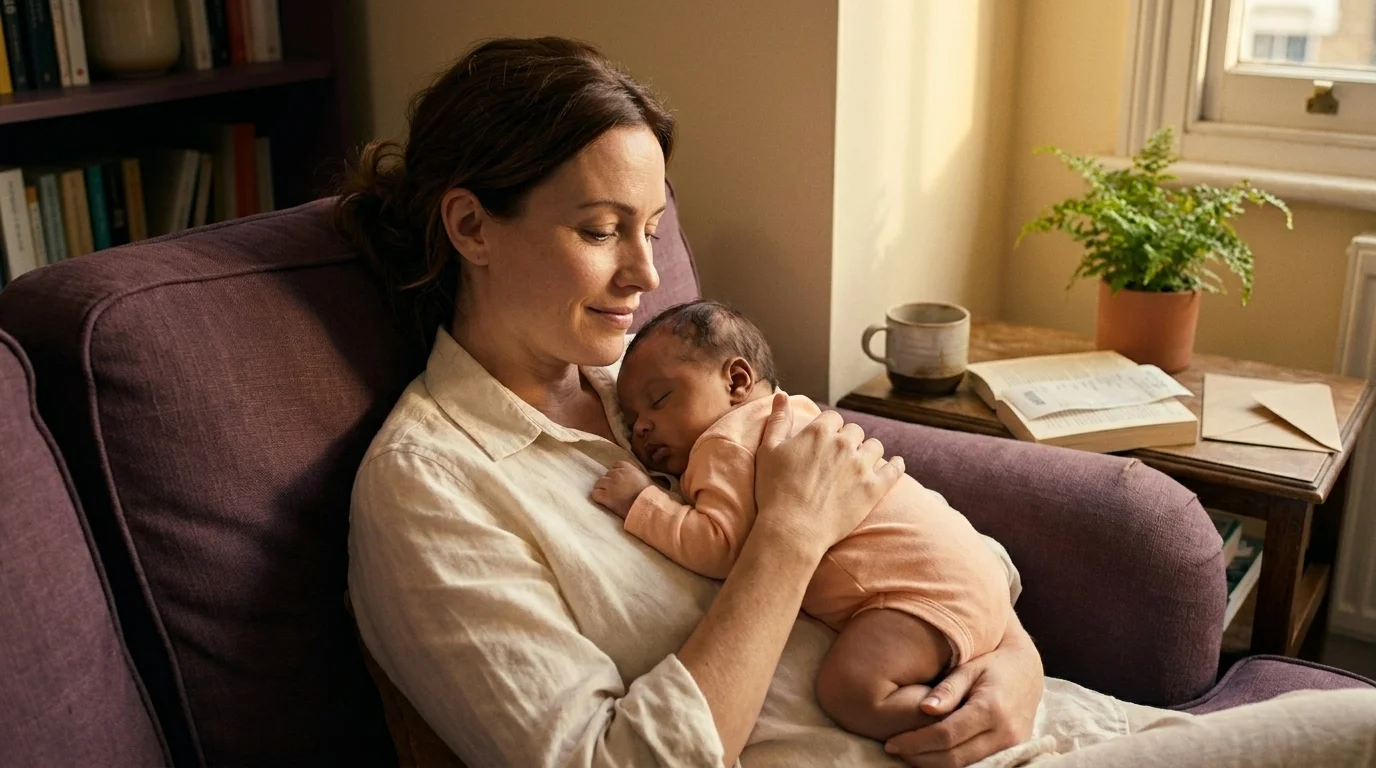
There is a word I want to define before I tell this story, because the woman whose story it is asked me to. The word is rainbow baby. It is the term grief communities now use, and which has migrated into mainstream usage, for a healthy baby born after a previous pregnancy loss — a miscarriage, a stillbirth, or a neonatal death. The image is a rainbow after a storm. The grief does not retire. The baby is, however, allowed to be a different event in its own right.
About one in four pregnancies ends in loss when miscarriage, stillbirth, ectopic, and molar pregnancies are counted together, with the American Pregnancy Association placing miscarriage specifically at between ten and twenty-five per cent (INTEGRIS Health, July 2025). About seventy per cent of women who experience up to three miscarriages go on to have a normal subsequent pregnancy. The numbers are useful and also, in the rooms where they are needed, inadequate. They are not the kind of inadequacy that the numbers can fix.
The woman I will call S. — a composite I have built from three women who have told their stories to me, and whose details I have rearranged to protect them — had her first loss at twelve weeks and her second at sixteen. She and her husband moved, after the second, from the city they had been trying to build a child inside to a different one, because the routes she had been driving were unbearable. The third pregnancy held. The IVF cycles that produced it took two years and a re-mortgage. The boy is now four. He is, in the photograph she sent me, holding a stick he believes is a sword. S. says — and I have quoted her with her permission — that the word rainbow never sat quite right with her, because it implies a clean ending to what was not, in the end, ended. The boy is a boy. The losses are also still there. She would not, given the choice, have asked for either to be other than they are.
The Miscarriage Association's research notes that parental relationships are measurably more likely to dissolve after a miscarriage or stillbirth than after a live birth (Miscarriage Association). S. and her husband stayed. Many do not. That, too, is part of what loss does, and is not, in either case, a moral question.
C. — A daughter through adoption
J. — a name I have changed — became a mother through international adoption at thirty-eight, after she and her partner spent four years and most of their savings on a fertility process that did not produce a child. The girl they adopted was three when she came home. She is now eleven, and she is, by every measure that matters in a house, her mother's daughter.
J. would correct me if she read the previous sentence. She would say that the girl is also her birth mother's daughter, and that the work of the past eight years has been, in large part, the work of building a family in which both of those things can stay true. The girl asks, periodically, about her birth mother. J. has learned to answer her without flinching. She has learned to keep the woman they have never met in the room as a presence rather than a ghost. She has learned, slowly, to think of motherhood as something larger than the moment of giving birth — as the long accumulation of feedings and arguments and inoculations that, over the years, makes a particular adult a particular child's particular parent.
I include J.'s story here partly because the original version of this article did not mention adoption at all, and the omission tells you something about what the parenting industry treats as the default story. Adoptive motherhood is a path with its own emotional arc and its own grief — the grief of the path that did not work, the grief, sometimes, of the family the child was not raised inside. It is also, in every adoptive mother I have known, a path that produces real motherhood. The two are not the same. The two are also both real.
D. — A son with autism, and the mother who learned a new vocabulary
R. — a composite — is a mother of two whose elder son was diagnosed with autism at the age of four. She has written, in essays I have helped her edit, about the long process of unlearning the developmental script she had been raised inside and learning a new one in which her son's particular nervous system was the starting point rather than the deviation. The school system, in her account, was the part of the work that took the most patience. The diagnosis itself was, by the time it arrived, almost a relief.
I want to be careful with R.'s portrait. Special-needs parenting is the part of the motherhood catalogue most often flattened into a single emotion called "courage", and the flattening is part of what the mothers I know in this category find hardest to read. R. is not courageous. R. is competent, exhausted, sometimes angry, sometimes very tired, and consistently in love with both of her children. The thing I have learned from her about resilience — the word again — is that it is not a virtue. It is a description of the only available option when no other option exists. We give the women without choices the medal that ought to go to the people who built the system they had no choice inside.
R. would add, here, that the resources she has needed have not come from the parenting industry. They have come from other mothers of autistic children, mostly online, occasionally in person, and increasingly through small in-person communities her town has had to build because the official ones do not exist. I would add, in the same register, that the parenting industry should consider why that is.
E. — Co-parenting on the other side of a marriage
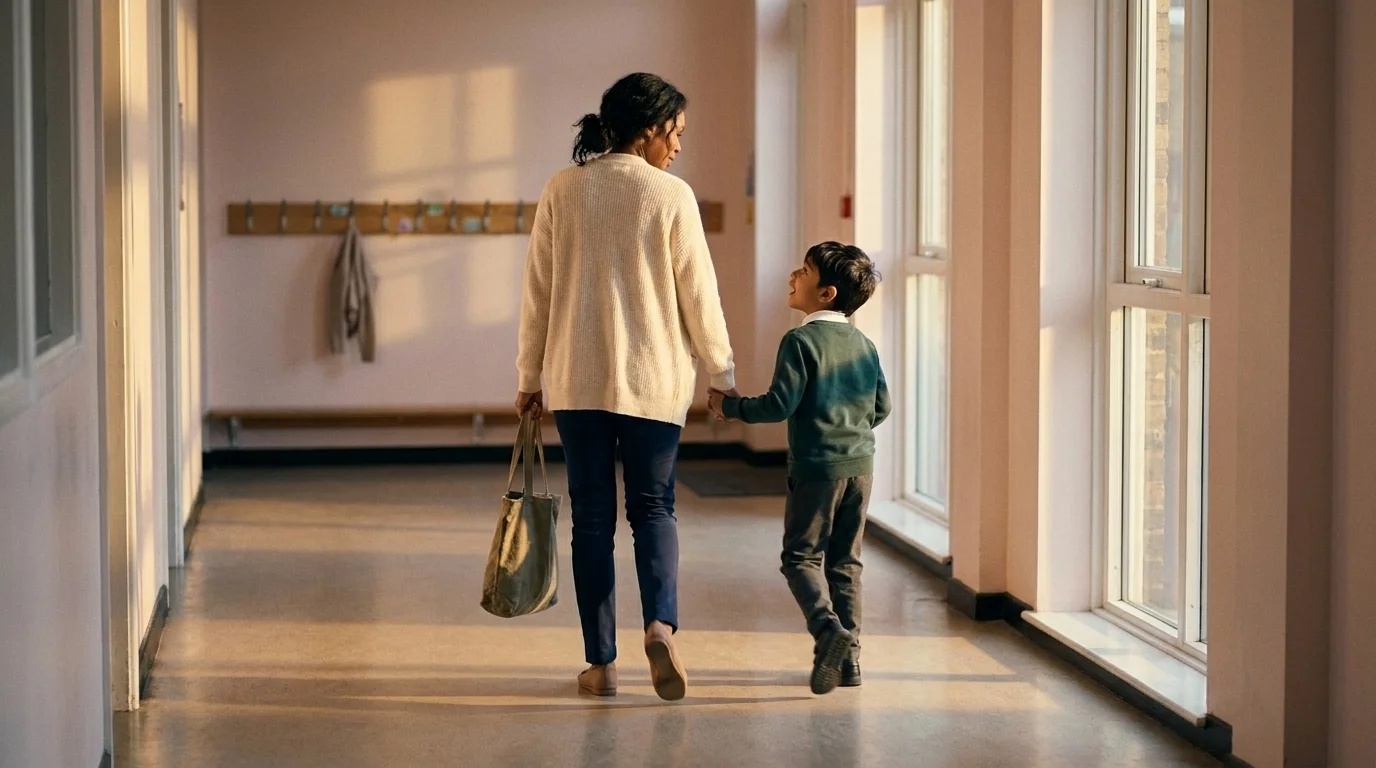
The fifth story is the one most adjacent to the lives of the readers I have heard from. M. — a composite — is forty-two, divorced for three years, and shares custody of her two children with their father in a working arrangement that has, after a slow start, become functional. She would not call the marriage a failure, in the way the language of divorce sometimes asks us to. She would say that the marriage produced two children and ran its course. The co-parenting has been, in her terms, the long second act.
The Miscarriage Association's finding, which I quoted earlier, applies in a slightly different register here. Marriages dissolve under all sorts of pressures — loss, time, the slow accumulation of small misalignments — and the version of motherhood that follows is its own thing. M. has had to learn it. The first year, she has told me, was the one in which she found herself rehearsing entire conversations with the children's father in the shower at six in the morning. The second year was less rehearsal. The third year she has started using to write.
What I want to say about M.'s portrait, and the reason I have included it in a roundup that otherwise focuses on paths into motherhood, is that motherhood is also a thing that continues after its original household ends. The mother is still the mother. The arrangement around her has changed shape. The work has redistributed. The continuity is not a given.
F. — Mothering in a second country
The sixth and last portrait belongs to E., who emigrated from her country of birth in her late twenties and had her first child at thirty-three in a city where she did not yet have her own mother in the room. She speaks her first language to the child and the second to the doctor. She has had to learn the local hospital system from scratch, against the disorientation of pregnancy hormones and the loneliness of a maternity ward in which nobody had her mother's voice.
Immigrant motherhood — the term itself, like resilience, is one I would use sparingly — is the version most often referenced in articles like this one and least often given any time on its own. E.'s portrait, the most consciously composite of the six, draws on conversations with several women whose specific circumstances I have agreed to obscure. What they have in common is the structural fact that the village they grew up inside is, in their adult lives, six time zones away. The phone calls are not a substitute. The phone calls are also not nothing. The mothers I have spoken to in this category most often describe the arrangement as one in which the village is real but unreachable, and the daily work of mothering takes place in its absence.
I will say one thing that the immigrant mothers in my own life have, with patience, taught me. The cultural inheritance does not stay frozen in the form they left it in. It is being made again, in their kitchens, in the second country, and the children they are raising are growing up inside a hybrid no English-language parenting book has yet caught up with. The form of their motherhood is not the form their own mothers performed. The function is, in most cases, the same. The making-again is part of the work.
A note on grief, and where to go
This is the part of the article where I would say, plainly, that the journeys above include real loss — pregnancy loss, the loss of an expected child, the loss of a marriage that produced a child, the loss of the daily presence of the women's own mothers. If any of these stories has hit harder than you were expecting, or if you are reading this article in the middle of one of them, Postpartum Support International (postpartum.net) maintains a free helpline (1-800-944-4773 in the U.S.) and a directory of trained perinatal mental health providers; the Miscarriage Association (miscarriageassociation.org.uk) does similar work in the U.K. Neither is a substitute for clinical care from a provider who knows you. Both are the right place to start when you do not yet know whom to call.
I would also say, more quietly, that the grief inside any of these journeys is allowed to coexist with the joy of them. The literature sometimes implies that grief and gratitude are sequential — that the rainbow baby ends the storm. It does not. The two run in parallel. Most of the mothers I have spoken to in the past year would prefer the literature to say so.
A small note to close
Six portraits is not a complete catalogue. There are many paths to motherhood I have not had the room to describe here — through surrogacy, through chosen-family arrangements, through the slow accumulation of stepmothering, through the particular grief of motherhood that did not happen at all. The catalogue is one I will keep adding to, in essays and in correspondence and in the slow conversations the school gate makes possible at the end of an afternoon.
I will close with the line I started with, slightly turned. Motherhood is no longer entirely the great unwritten story. It is, increasingly, the great variously-written story — being told in clinics and in forums and in WhatsApp groups and in long emails between women who once knew each other as students and now know each other as the women they have, in the intervening years, become. The stories above are six of those. There are many more. The work, as far as I can tell, is to keep listening for them, and to keep insisting that each of them is given the same seriousness — and the same word count — that the kitchen table has always given them.
Frequently Asked Questions
A single mother by choice (SMBC) is a woman who decides to become a mother on her own — typically through donor sperm with IUI or IVF, or through adoption — without waiting for a partner. The U.S. SMBC population is now estimated at more than 3 million women, and the rate of unmarried mothers in their 40s has grown by roughly 250% over the past 30 years (NPR, January 2026; Illume Fertility).
A rainbow baby is a healthy baby born after a previous pregnancy loss — miscarriage, stillbirth, or neonatal death. The term symbolises hope after grief; it does not replace the loss it follows. About 70% of women who experience up to three miscarriages go on to have a subsequent normal pregnancy (INTEGRIS Health, July 2025).
Approximately 1 in 4 pregnancies ends in loss when miscarriage, stillbirth, ectopic, and molar pregnancies are counted together; the American Pregnancy Association cites 10–25% specifically for miscarriage. Risk of recurrence is about 20% after one miscarriage, 25% after two consecutive, and 30–40% after three or more (sources: APA via INTEGRIS Health, July 2025).
Modern IVF rarely succeeds on the first cycle. Many journeys involve multiple egg-retrieval cycles, embryos that fail preimplantation genetic testing (PGT), miscarriage after a successful transfer, and the emotional toll of months or years of treatment. Elizabeth's publicly-shared journey at Illume Fertility documented two cycles producing zero chromosomally normal embryos before a third cycle's lower-graded embryo became a healthy birth — a realistic picture, not a sanitised one.
Postpartum Support International (postpartum.net) maintains a free helpline (1-800-944-4773 in the U.S.) and a directory of trained perinatal mental health providers. The Miscarriage Association (miscarriageassociation.org.uk) does similar work in the U.K. Neither replaces a provider who knows you, but both are the right place to start when you don't yet know whom to call.
Postpartum Support International's clinical work on storytelling-as-validation suggests that seeing the textures of other mothers' experiences in print is itself one of the load-bearing supports of perinatal mental health — for the woman telling the story and the woman reading it. Most readers will find at least one of the six portraits adjacent to their own life, and the rest worth knowing.