
A Mediterranean Mosaic: The Joys and Challenges of Italian Multigenerational Living for Modern Families


There is an Italian-Australian family up the road from us in Melbourne whose grandmother — Nonna, of course — lives in a converted granny flat behind the main house and is, by uncontested family consensus, the person who picks up the youngest from school and starts the dinner most weekdays. It is the kind of multigenerational living that has been Italy's quiet default for centuries. The arrangement is so ordinary in their part of the suburb that the only people for whom it is remarkable are the rest of us. What is being lived in that house, with its converted granny flat and its lunchtime calls across the back fence, is a version of multigenerational living that the United States is now improvising at scale, mostly without the inherited script, and that Italy has been quietly doing for centuries as the unmarked household default. According to the Pew Research Center's 2022 demographic study — still the canonical baseline — approximately 59.7 million Americans now live in multigenerational households, eighteen per cent of the population, a fourfold increase from the 14.5 million counted in 1971 (Pew Research, 2022). The National Association of Realtors reports that seventeen per cent of U.S. homes purchased in the most recent measurement year were bought for multigenerational households, at a median list price of $709,000 versus $429,900 for standard listings (NAR, 2025). The arrangement that looks unusual to most Anglo-American readers is, by the numbers, the arrangement an increasing share of Americans are now navigating, often without the cultural infrastructure to make it functional. That infrastructure — the part the magazine articles call La Famiglia and the part the data calls Italian household structure — is what the rest of this essay is about.
La Famiglia, more precisely
The phrase la famiglia is usually translated into English as "the family." That translation is correct in the way most translations are correct: it gets the noun right and misses what the word is doing. In the Italian sense the phrase is more usefully read as a social operating system — the deep allocation of household functions that the wider culture has worked out over centuries and that any given Italian family is running on top of, often without naming it. The functions the system allocates are not exotic. They are the same functions every household has to allocate. Who, day to day, looks after the small children. Who, in the long arc, looks after the old. Who pays for the adult child's first apartment, and on what terms. Who has the loud opinion at the kitchen table about whose work schedule needs to bend for whose. Who is responsible for the Sunday lunch. The Italian operating system answers these questions with a default that the post-war Anglo-American operating system, in most regions, eventually stopped answering with: the answer is, almost always, more than one household, more than one generation, more than one bedroom in the same building or on the same street.
Cultural Atlas, the cross-cultural reference compiled by SBS Australia, documents some of the structural particulars cleanly. Italians depart parental homes "at one of the highest ages in Europe." Parents commonly subsidize their adult children's housing, sometimes for decades, sometimes through co-ownership, sometimes simply by absorbing them back into the family home for years at a time. Residential eldercare facilities — nursing homes, in the U.S. sense — are, the Atlas notes, "avoided unless the family has no other option" and carry meaningful social stigma when used (Cultural Atlas (SBS), Italian Culture — Family). Eurostat's 2023 measurements quantify the residential pattern: roughly fifty per cent of Italians aged twenty-five to thirty-four still live with parents, and the figure rises to approximately seventy per cent for the wider eighteen-to-thirty-four bracket — the highest rates in Western Europe (Eurostat ilc_lvps08, 2023). These are not figures about young people who have failed to launch. They are figures about a different cultural answer to the question of when, and on what terms, the household ring expands or contracts.
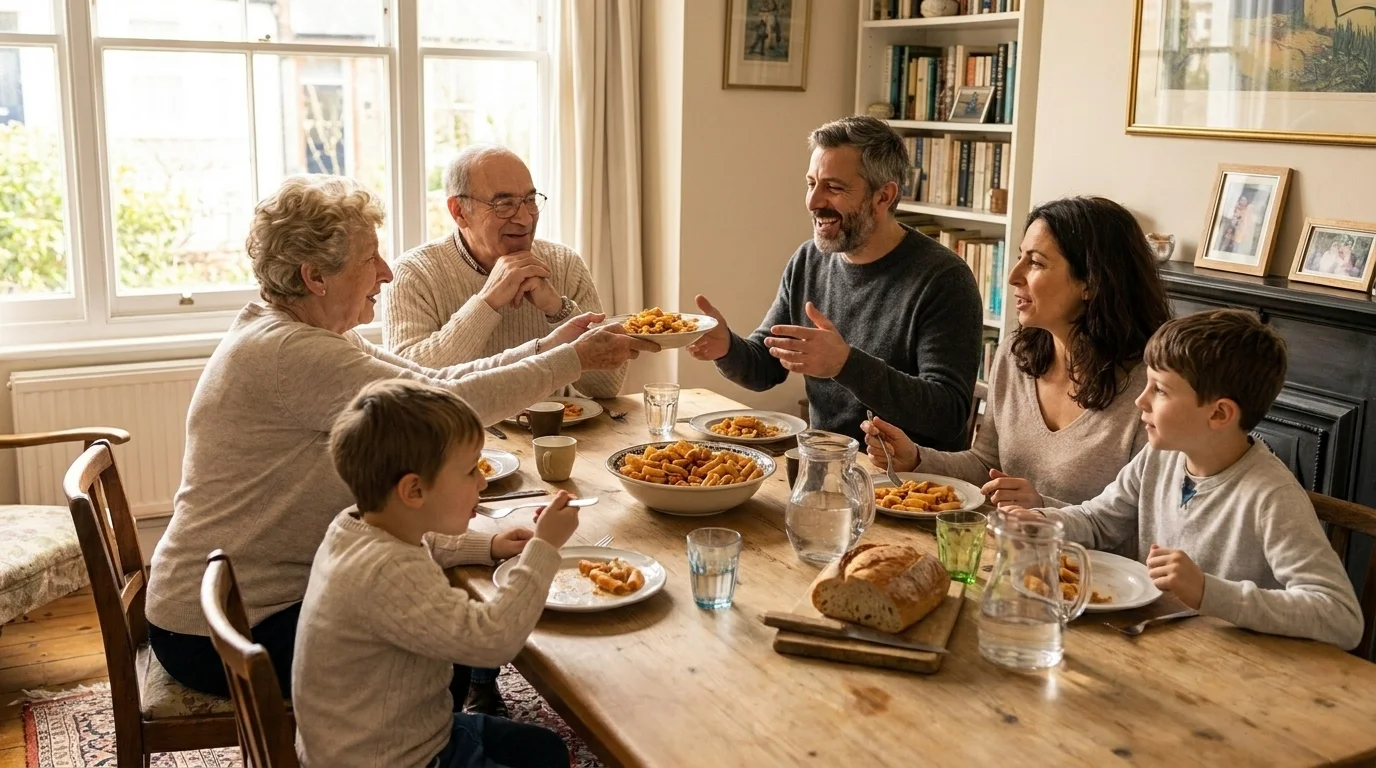
What the operating system delivers, when it is running well, is a redundancy of care that the nuclear-family model structurally cannot supply. The childcare layer is distributed — grandparents, aunts and uncles, older cousins, the neighbours who are functionally aunts and uncles — which is why the original "village" idea (which I wrote about, in this batch of essays, under the heading of alloparenting) maps cleanly onto the Italian case. The eldercare layer is also distributed, but in the inverse direction: the same adult children who are being subsidised through their twenties are also, two decades later, the people who absorb their ageing parents back into the household rather than transferring them to residential care. The financial layer is pooled in a way that the U.S. tax-and-benefit system does not particularly reward but the cultural expectation strongly does. The mealtime ritual — the daily lunch and the Sunday lunch — is the visible expression of the structural arrangement, the place where the operating system most easily reads as a single thing.
The honest version: the model under demographic strain
It would be dishonest to write about Italian multigenerational living without naming the fact that the structure is, in significant ways, currently under strain. Italy's ISTAT (the national statistics office) reports that the country's total fertility rate fell to 1.14 children per woman in 2025, with only 355,000 total births, and the average household size has now contracted to 2.2 members — down from 2.6 twenty years ago. Single-person households now make up 37.1% of all Italian households and are projected to reach approximately 41% by 2050. The population aged 65 and over stands at 14.8 million, or 25.1% of the population, and is projected to reach 34.6% by 2050 (ISTAT, Demographic Indicators — Year 2025).
These figures matter for the cultural reading. The traditional Italian household pattern — large, multigenerational, with several children per couple and a clear residential continuity across generations — is, statistically, increasingly the exception rather than the rule. What persists is the expectation of the pattern (the social pressure, the cultural script, the family-mealtime default) often without the demographic conditions that originally produced it. Southern Italian villages have been hollowing out for decades as young people migrate north or abroad, and the practical alloparenting layer that depended on having three generations in the same town is, in many places, no longer there to depend on. What Italian families are now living, in many regions, is the cultural memory of the operating system without the demographic substrate it ran on. This is part of why understanding the model — what it did, how it allocated functions, why those allocations held for so long — is more useful than romanticising it. The pattern is being rebuilt, in fragments, with smaller families, with adult children returning home for longer than anyone expected, with grandparents stepping into childcare that the Italian state, like the U.S. state, does not adequately fund.
I find this version more interesting than the romanticised one, partly because it is true and partly because it is closer to what the American household is also having to invent in real time. The U.S. is not exhibiting traditional multigenerational continuity; it is exhibiting the response to housing-price collapse, eldercare cost, and labour-market precarity that any culture exhibits under similar conditions. Italy got there first because the structural pressures arrived first. The cultural infrastructure Italy built around them is what an American household, mid-improvisation, can learn from.
What the cross-country picture looks like
The cross-country comparison is worth drawing once cleanly, because the SERP does not have it. The United States, at eighteen per cent multigenerational, is well above its mid-century low (seven per cent in 1971) but well below most of the world's historical norm. Inside the U.S., the figure varies considerably by ethnicity — Pew's 2022 data puts Asian, Black, and Hispanic American adults at 24%, 26%, and 26% respectively in multigenerational households, against 13% for white Americans (Pew Research, 2022) — which is itself a useful corrective to the framing of multigenerational living as a culturally exotic practice; many U.S. families already do it and have done so continuously through the period in which the mainstream nuclear-family script was being written elsewhere. Italy sits at roughly fifty per cent of adults aged 25–34 still living with parents (Eurostat 2023). Spain and Portugal sit broadly comparably with Italy. Northern European countries — Denmark, Sweden, the Netherlands — sit at the opposite end of the spectrum, with substantially earlier nest-leaving driven by housing-policy and welfare-state arrangements that subsidise young-adult independence rather than family co-residence. The variance is large, and it is not random: it tracks the welfare state, the housing market, and the inherited cultural expectation in roughly that order.
The eldercare side of the picture is the one I find most instructive right now. Pew's December 2025 short-read reports that 22% of U.S. adults aged 65 and over now live in multigenerational households, up from 17% in 1990, and the figure rises to 25% for those aged 85 and over, up from 18% over the same period (Pew Research, December 2025). The U.S. is, in other words, quietly trending toward the Italian eldercare-at-home default, mostly without the formal cultural permission to call it that and largely because the alternative — residential eldercare — has become financially out of reach for a meaningful share of American households. The structural convergence is real even when the cultural script is mismatched. Italy has the script. The U.S. is improvising one.
Pros, cons, and the daily friction
The version of multigenerational living that gets idealised in the magazine pieces and the version that gets argued about on Reddit are both real. The honest synthesis: the structural benefits are measurable and the structural frictions are real, and households that choose this arrangement have to engineer for the frictions deliberately if they want the benefits to stick.
On the benefits side, the Pew 2022 data shows multigenerational U.S. households have a measurably lower poverty rate (10%) than non-multigenerational households (12%), driven mostly by the pooled-income effect of multiple earners sharing housing and utilities costs. The childcare load is distributable in a way it is not in a two-bedroom apartment with two working parents and no nearby relatives. The eldercare load is bearable in a way it is not when an ageing parent is several states away. The cultural transmission — the grandchild who learns a language, a religion, or simply a particular family's way of doing a Sunday — happens by structural osmosis rather than by deliberate parental project. These are not small benefits.
On the friction side, the operating system requires daily renegotiation that the nuclear household structurally does not. Privacy lives in different places than it does in a two-adult household. Decision-making about a small child runs through more adults, with more standing opinions, and the protocols for whose opinion prevails are mostly informal and have to be re-negotiated as the child ages and as the participating adults' health and capacity shift. Money — who pays for what, how a co-ownership is structured, what happens to the inheritance question once one parent dies — is a permanent live conversation that two-adult households can mostly defer. Generational values gaps, which exist in every family, are unavoidably daily rather than periodic, because the people holding the different values are in the same kitchen at the same time. These are the negotiations the Italian operating system has, over centuries, developed quiet protocols for. They are protocols a U.S. household putting the arrangement together today has to invent.

What is portable
The closing observation is the one Sweden made me, years ago, when I was first writing about cross-cultural household patterns. Sweden has, by international standards, the most generous family-policy infrastructure in the world; and inside Swedish homes the distribution of childcare is still, on the data, closer to the long-running gendered pattern than the policy would predict. Policy is necessary and not sufficient. The script we inherited about who does what, who is trusted with what, whose schedule bends for whose, runs deeper than any legislation can reach.
The same point holds, in a different direction, for multigenerational living. The Italian model is not a set of legislation. It is a long-running cultural script that allocates the daily functions of a household across three generations and that has been refined, argued about, defended, lampooned, and adjusted across centuries inside the cultures that built it. What is portable from that script to a household elsewhere is not the pasta, the nonna stereotype, or the converted granny flat in particular. What is portable is the structural recognition: that a household with one or two adults in it and small children to raise was never, across most of human history, expected to do this on its own; that the daily work of childcare and eldercare and household economics is naturally distributed across more adults than the nuclear arrangement assumes; and that the cultural infrastructure of how to make that distribution work — the daily lunch, the long phone call, the agreement about whose Sunday becomes the household Sunday — has to be built, slowly, by the household that wants it. The American statistics say the U.S. is now building this in real time. The Italian statistics say even Italy is rebuilding it from a position of demographic constraint. The arrangement that looks unusual from a certain angle is, from a longer one, the default arrangement that the last fifty years made unusual. The Italian-Australian family up the road is not doing something exotic. They are running an older operating system, one their grandparents brought with them in a suitcase, and the rest of the street, in its own slower way, is starting to wish they had brought one too.
Frequently Asked Questions
La Famiglia is usually translated as 'the family,' but the more useful reading is that it names a social operating system — a deep cultural allocation of household functions across multiple generations. The system answers, by long-running default, questions about who provides childcare, who absorbs eldercare, who subsidises an adult child's first apartment, and how household economics are pooled. The phrase refers less to a sentiment about family than to the structural arrangement most Italian households have inherited and continue to run, even as the wider demographic conditions shift around it.
On the benefits side, Pew Research's 2022 data shows U.S. multigenerational households have a measurably lower poverty rate (10% vs 12%) than non-multigenerational ones, driven by pooled income and shared costs; childcare and eldercare loads are distributable in ways the nuclear household structurally cannot match; cultural transmission across generations happens by daily proximity rather than by deliberate project. On the friction side, privacy lives differently, decision-making about children runs through more adults, money becomes a permanent live conversation, and generational values gaps are daily rather than periodic. Households that engineer protocols for these frictions deliberately tend to keep the benefits.
Italy sits at roughly 50% of adults aged 25–34 still living with parents (Eurostat 2023), the highest in Western Europe; Spain and Portugal are broadly comparable. The United States is at approximately 18% of the population in multigenerational households as of Pew's 2022 measurement — about 59.7 million Americans, quadrupled from 1971. Within the U.S., the figure varies significantly by ethnicity: 24% for Asian Americans, 26% each for Black and Hispanic Americans, and 13% for white Americans. Northern European countries (Denmark, Sweden, Netherlands) sit at the opposite end of the spectrum, with much earlier nest-leaving driven by housing-policy and welfare arrangements.
Approximately 59.7 million, or 18% of the U.S. population, as of Pew Research's 2021 measurement — quadrupled from the 14.5 million counted in 1971. The pattern has accelerated through the 2020s as housing affordability has tightened: the National Association of Realtors reports 17% of recent U.S. home purchases were for multigenerational households, at a median list price of $709,000.
Grandparents — nonni — function as a structural layer of the household operating system rather than as occasional visitors. They commonly provide daily childcare for working adult children, both as cultural expectation and as a substitute for state childcare provision that does not adequately cover the gap. The reciprocal arrangement is the eldercare default: residential care facilities carry meaningful social stigma in Italy and are 'avoided unless the family has no other option' (Cultural Atlas, SBS), so adult children commonly absorb their ageing parents back into the household when health declines. The two flows — childcare downward in early adulthood, eldercare upward later — are the same arrangement seen from different ages.
Yes, and honestly. ISTAT's 2025 data shows Italy's fertility rate at 1.14 children per woman, only 355,000 total births, average household size now at 2.2 members, and single-person households at 37.1% of all households (projected to reach about 41% by 2050). Southern Italian villages have hollowed out as young people migrate north or abroad, leaving the traditional three-generation co-residence pattern under significant strain. What persists is the cultural expectation; what is contracting is the demographic substrate. Italian families are now rebuilding the arrangement in fragments — with smaller families, longer adult-child co-residence, and grandparental childcare filling a state-childcare gap rather than supplementing a thriving extended-family network.
Check Out These Related Articles

Navigating Parenthood Across Borders: The Impact of Migration on Family Dynamics
Illuminating Cultural Wisdom: Parenting Pearls from Indigenous Communities Around the Globe

Beyond Samba and Soccer: Unveiling the Rich Tapestry of Brazilian Family Life and Child Development Strategies