Beyond Samba and Soccer: Unveiling the Rich Tapestry of Brazilian Family Life and Child Development Strategies


A Brazilian-Australian friend of mine — Paulista by birth, Melbourne resident since her twenties, mother of two — said to me at the school gate last term that the part of raising her children in Australia she could not get used to was the relative quiet. She did not mean the absence of music, although that came up. The thing she missed was a structural feature of Brazilian family life, not an aesthetic one. She meant the absence of other adults in the daily logistics of a small child's life — godmothers, aunts, neighbours, the great-aunt on the third floor who would come down and take the toddler off her hands for an hour while she finished a phone call. The arrangement she had grown up inside, and that the Brazilian-Australian community in her part of Melbourne re-creates on the weekends with some effort and some success, has been one of the most heavily documented social patterns in Latin American family-systems research for decades. Brazilian familia — the word stretches well past the English "family" — is, like Italian famiglia in the essay alongside this one, a social operating system, not a sentiment. And the operating system is, on the contemporary IBGE data, in the middle of a significant structural shift that the older guides to Brazilian family life mostly miss.
The headline number is from the 2022 Brazilian Census, the first results of which were released in 2023 and 2024. For the first time on record, the "classic" Brazilian family — a couple plus their children — is now a minority of households at approximately 42 per cent (IBGE, 2022 Census). Female household heads now make up 48.8 per cent of Brazilian families, up from 22.2 per cent in 2000; male household heads have fallen from 77.8 per cent to 51.2 per cent over the same period. The share of household heads with a higher-education degree has nearly tripled, from 6.3 per cent in 2000 to 17.4 per cent in 2022. Brazil's total fertility rate has fallen to approximately 1.62 children per woman (World Bank / Macrotrends), with regional variation that matters: the North runs near 1.83, the Southeast near 1.48. Those four numbers together describe a country whose family structure looks meaningfully different from the one most English-language travel writing on Brazil is still describing.
What persists, and what is most worth understanding for a non-Brazilian reader, is the cultural infrastructure that has run on top of the demographic substrate for generations. The script has not died; it has been re-allocated across a different distribution of adults. And the script itself — the way Brazilian families assemble caregiving across kin, community, and the daily rhythms of a Brazilian neighbourhood — has more to teach a contemporary Anglo-American parent than the surface clichés usually convey.
Compadrio: the padrinho and the madrinha
The single most useful place to start, in my reading, is with the institution most Anglo readers do not know exists by name: compadrio, the Brazilian practice of ritual godparenthood. When a Brazilian child is baptised — or, in many secular families, when a child is born or formally welcomed — the parents formally invite trusted friends or relatives to become padrinho (godfather) and madrinha (godmother). The role is not ceremonial in the diminished sense the English word carries. The padrinho and madrinha are expected, by long-running cultural convention, to be a second axis of caregiving in the child's life — providing emotional support, mentorship, financial backup where needed, and, in the older patterns, the structural promise that the child would never be without an adult network if the biological parents were lost. Compadrio is one of the cleanest examples in any culture I have read about of formal alloparenting embedded inside Catholic ritual structure. It is also one of the parts of the cultural script that has continued to function inside Brazilian-Australian and Brazilian-American diaspora communities even as the more diffuse extended-family network thins.
The reason this matters for a non-Brazilian reader is that it makes visible something the nuclear-family template tends to hide: that a child's developmental environment benefits considerably from the structural presence of trusted adults who are not the biological parents, and that the Brazilian culture has, for centuries, formalised that presence by name. The Anglo-American practice of designating a godparent has, in most contemporary households I know, atrophied into a one-off christening role with no continuing function. The Brazilian version, which is what the padrinho and madrinha mean in the daily practice rather than in the ceremony, is one that contemporary Anglo households could, if they wanted to, deliberately rebuild.
Festival as developmental environment
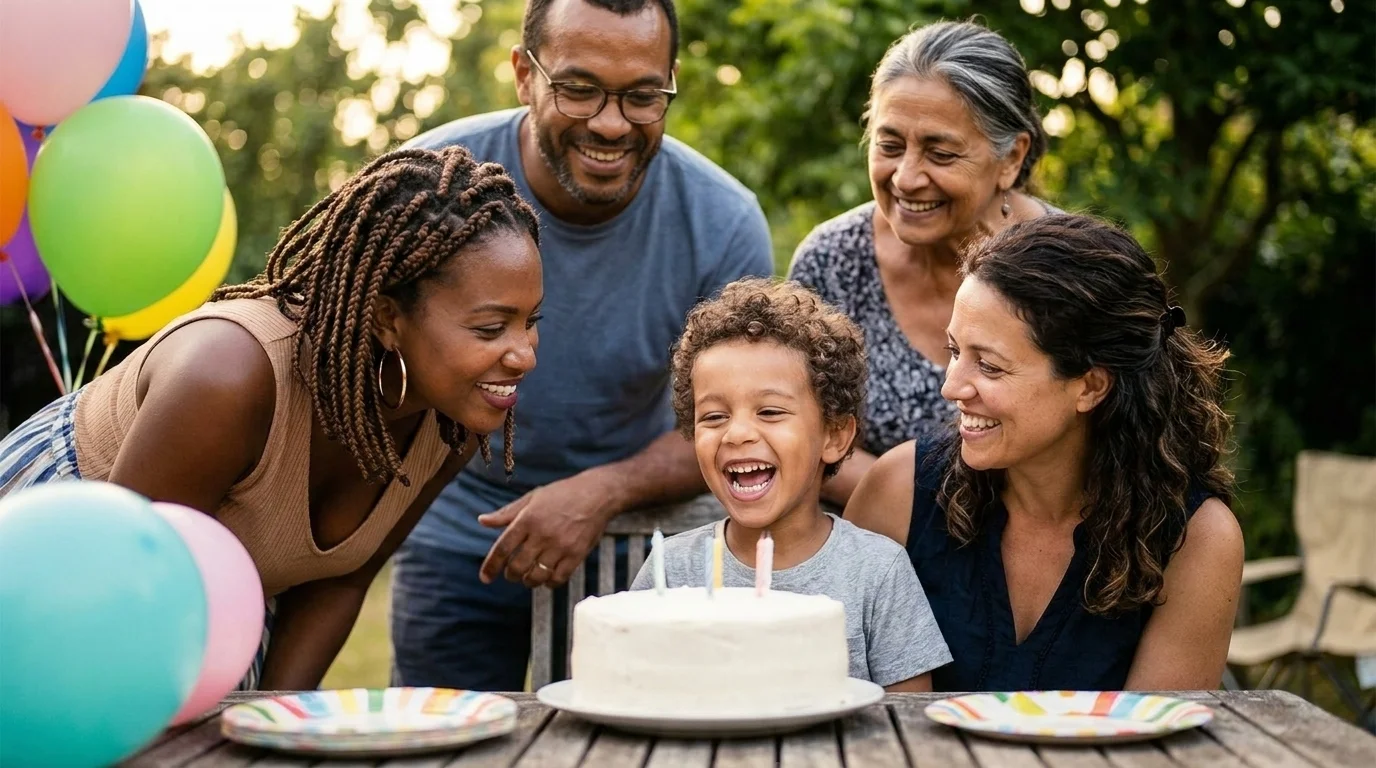
The festivals that travel writing usually presents as exotica — Carnaval, Festa Junina, the Iemanjá celebrations on the beaches of Salvador on February 2nd — function, inside a Brazilian household with young children, as a particular kind of developmental environment. The English-language writing about them tends to dwell on the spectacle. The lived-experience texture, in the Brazilian-Australian households I know in Melbourne, is closer to a regular set of points in the year when small children are folded into intergenerational public life, given a role inside a structured group activity, expected to manage the social complexity of a crowded plaza or a beach gathering or a school quadrilha, and supervised by an indistinct rotating cast of adults who treat the child's presence as both ordinary and welcome.
The developmental specifics are worth naming. Carnaval in its neighbourhood form (as distinct from the televised spectacle) is a structured group rhythm experience. Festa Junina — the June festivals — pair a controlled and visible adult-led ritual with the kind of cross-age peer interaction that contemporary developmental research treats as significant for social competence. Iemanjá day, where families bring flowers and small offerings to the sea, is a ritual contemplative practice many small children are inside before they are old enough to have words for it. Each of these is, in the lived practice, a setting in which a small child is asked to manage their behaviour inside a larger social complexity than the contemporary Anglo household typically asks them to navigate. The motor learning is real. The rhythm exposure is real. The cross-age social practice is real. So is the relationship to embodied tradition, in a way the older English-language treatments of "Brazilian carnival culture" rarely manage to communicate.
The other half of this is the embodied-learning layer that runs outside the festival calendar — capoeira as a structured movement-and-rhythm practice that many Brazilian children begin in primary school, futebol de várzea (the sandlot football of the local bairro) as cross-age physical and social practice, the beach culture in coastal cities that functions as both a daily recreation and a continuous low-grade swimming and ocean-competence curriculum from infancy. These are not exotic. They are simply the way many Brazilian households deliver developmental experiences that contemporary Anglo households tend to outsource to paid programs, where they do them at all.
The parenting style: what the research actually shows
The Anglo-American parenting discourse has, for the last forty years, treated authoritative parenting — high warmth combined with high structure — as the empirically supported gold standard, and permissive parenting (warmth without firm boundaries) as the lesser option. This is true on the dominant North American data. It is not always true on the cross-cultural data.
A 2020 cross-national study published in PubMed Central, sampling Spanish, Portuguese, and Brazilian adolescents, found that indulgent parenting — warmth and responsiveness without strict behavioural control — outperformed authoritative parenting on adolescent self-esteem in all three countries (PMC7177516, Parenting Styles, Internalization of Values and Self-Esteem). This finding has been replicated in Latin American and Southern European samples enough times now that the contemporary cross-cultural literature is comfortable describing the "best" parenting style as culturally contingent rather than universal. The mechanism, on the prevailing reading, is that the relational density of Brazilian (and broader Latin) family life — the carinho, the physical closeness, the extended kin network — does the structural work that authoritative-parenting strictness does in lower-density nuclear contexts. The warmth, in the Brazilian context, is doing more lifting than the strictness needs to.
A note on interpretation, the way I would put it in conversation. This is not a brief against structure; Brazilian families have plenty of structure, and the children inside them generally know where the lines are. What the finding suggests is that strictness as a deliberate parenting tool has less independent value when it is layered on top of an already-warm and already-relationally-dense household than it does in the leaner nuclear configuration where strictness is doing more of the relational work. The reframe matters for a non-Brazilian reader because it complicates the unexamined assumption that "warm but firm" is the universal answer. In context, warm and densely-connected may be a different answer that does the same job.
Gender, work, and what kids actually see
The IBGE 2022 number on female household heads — 48.8 per cent, up from 22.2 per cent in 2000 — is the kind of shift that reframes everything downstream of it. Roughly half of Brazilian children today are growing up in households where their mother, grandmother, or aunt is the named head; women now make up approximately 42 per cent of the paid Brazilian workforce, with that figure trending up rather than down (Cultural Atlas / SBS). The old machismo framing that English-language readers sometimes inherit from older treatments of Brazilian family life is, today, both still relevant in some regions and structurally on the back foot in most. The everyday picture in most urban Brazilian households is much closer to a dual-earner or female-led arrangement with significant continuing male presence in extended-family eldercare and weekend logistics than it is to the older patriarchal stereotype. What children see, mostly, is mothers and grandmothers running households and earning incomes, with fathers and grandfathers participating in childcare and eldercare at levels that are still uneven but are no longer, on the data, what they were a generation ago.
Multigenerational living, honestly
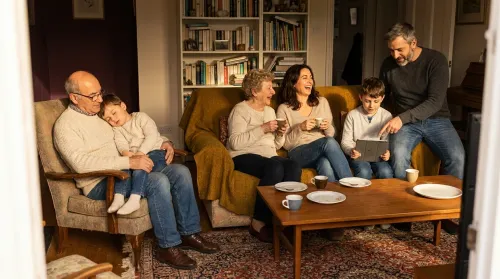
About thirty-two per cent of Brazilian homes now contain three or more generations under one roof, with four- and five-generation households emerging in significant numbers in the South and Southeast (Oxford Institute of Population Ageing). The Oxford Institute is, I think, right to frame this as crisis-driven — high housing costs, prolonged adult-child financial dependence, and the inadequacy of state eldercare provision have combined to make the multigenerational arrangement the practical answer for a third of Brazilian households whether or not it was their first choice. The developmental upside is real even when the driver is economic: built-in alloparenting, daily contact between small children and elderly relatives, distributed cognitive load on the working parents, embedded cross-generational language and value transmission. The honest reading is that the arrangement is both an economic strategy and a developmental asset. Both halves are true.
Brazilian-American families: what survives
The diaspora picture is the part of this conversation the older travel writing misses entirely. The Brazilian-Australian community I am most familiar with has its U.S. analogue in Brazilian-American families, concentrated geographically in Florida (about 23 per cent of U.S. Brazilians), Massachusetts (17 per cent), and California (9 per cent), with the Itamaraty (Brazilian Ministry of Foreign Affairs) estimating the U.S. Brazilian population at approximately 1.77 million against the American Community Survey's lower ~499,000 figure (Migration Policy Institute; Pew Research, 2023). Roughly half are college-educated. A 2024 study by Da Costa Silva Beall in the Journal of Multicultural Counseling and Development found that approximately 53 per cent of Brazilian immigrant parents in the United States named their own upbringing in Brazil as the single strongest influence on how they parent their children today — more influential than any U.S. parenting culture, any current pedagogical research, or any single parenting book they had read (Da Costa Silva Beall, 2024).
What the broader diaspora research consistently finds is that heritage Portuguese typically fades within three generations of immigration; what persists past three generations is food, holidays, physical affection norms, and the relational density of family gatherings. The carinho survives the language loss. The Festa Junina in the Massachusetts backyard survives the fluency loss. The structural pattern — the dense relational warmth, the multigenerational presence at the weekend gathering, the openness to children's participation in adult social life — persists past the surface markers of Brazilian-ness that the first immigrant generation works hardest to preserve.
Educação Infantil and the six learning rights
The Brazilian state's framework for early-childhood education — formally known as the Base Nacional Comum Curricular (BNCC), introduced in 2017 and updated through 2025 — is the policy I would point a curious non-Brazilian parent to, partly because the framework itself is unusually well-written and partly because it translates cleanly into a parenting checklist that any household can mirror at home. The BNCC's Educação Infantil section identifies six "learning rights" — direitos de aprendizagem — that any child between birth and age five is entitled to in any state-recognised early-learning setting: Conviver (to live alongside others), Brincar (to play), Participar (to take part in shared activity), Explorar (to explore), Expressar (to express), and Conhecer-se (to come to know oneself) (PMC, Early Childhood Education in Brazil). The framework is, in my read, one of the more elegant operationalisations of early-childhood pedagogy any country has produced, and the six rights map cleanly onto the daily activities a parent of any nationality can choose to weight in their household's everyday rhythm.
What is portable
The closing observation is the one I find myself returning to across this batch of cultural-comparison essays. The Brazilian model, like the Italian one and the alloparenting model I wrote about in the indigenous-parenting piece, is not a set of rituals to be lifted out of context. It is a structural arrangement that distributes the work of raising a child across more adults, more daily contexts, and more emotionally textured environments than the contemporary Anglo nuclear household assumes. What the recent data adds is that the structural arrangement is in active reorganisation inside Brazil itself — smaller households, more female heads, the multigenerational pattern persisting as both economic strategy and developmental asset. And what the cross-cultural research adds, more pointedly, is that the assumption that authoritative parenting is universally best is at least partly an artefact of having done the research in countries whose family structures had already thinned. Brazilian warmth, on the data, does work that Anglo-American parenting frameworks tend to assume strictness must do. That is not a claim that strictness does not matter. It is a claim that the relational density a household is operating inside does some of the work that any household has to do, and that a household with a less dense network has to be more deliberate about how the remaining work gets done. The Brazilian-Australian friend at the school gate is, in her own way, working on this every weekend. The rest of us are, in our own slower way, starting to wish we knew how.
Frequently Asked Questions
Brazilian families celebrate through named festivals like Carnaval, Festa Junina, and the Iemanjá rituals on February 2nd, plus regular neighbourhood (bairro) gatherings and the compadrio institution that formally enlarges the child's network of trusted adults. The developmental function is to fold small children into intergenerational public life from an early age — managing crowded social complexity under the loose supervision of a rotating cast of adults who treat the child's presence as both ordinary and welcome.
Brazilian outdoor life — beach culture, capoeira as structured movement-and-rhythm practice from primary school, futebol de várzea (sandlot football) as cross-age peer practice, ocean swimming from infancy in coastal regions — combines motor development, social competence across age groups, and a sustained relationship to embodied tradition. These are the developmental experiences contemporary Anglo households tend to outsource to paid programs; in many Brazilian households they remain part of the daily neighbourhood rhythm.
Samba, forró, frevo, and regional rhythms function as a shared emotional vocabulary inside Brazilian households — children are exposed from infancy and absorb rhythm, coordination, and an emotional register that the wider culture treats as ordinary household practice rather than as a specialised hobby. The contemporary developmental literature on rhythm exposure in early childhood supports what Brazilian families have done by default for generations: music as a daily medium, not an after-school enrichment.
The 2022 IBGE Census documented that the 'classic' Brazilian family — a couple plus their children — is now under 42 per cent of households, and female household heads have reached 48.8 per cent (up from 22.2 per cent in 2000). What persists is the cultural script of relational density and extended-kin involvement; what has shifted is who is at the centre of the script. The contemporary Brazilian family is more often female-led, smaller (fertility ~1.62), and more highly educated than it was a generation ago, while continuing to run on cultural infrastructure built for larger and denser configurations.
Educação Infantil is Brazil's early-childhood education stage (birth to age 5), and the BNCC (Base Nacional Comum Curricular) is the nationally binding curriculum framework introduced in 2017, with updates through 2025. The BNCC names six learning rights for every child in this stage: Conviver (to live alongside others), Brincar (to play), Participar (to take part in shared activity), Explorar (to explore), Expressar (to express), and Conhecer-se (to come to know oneself). The framework is one of the more elegant operationalisations of early-childhood pedagogy any country has produced, and the six rights translate cleanly into a daily checklist parents of any nationality can mirror.
Brazilian children grow up inside a structurally denser adult network than the contemporary nuclear template assumes. Compadrio (godparenthood), multigenerational households (~32% of Brazilian homes contain three or more generations), and the festival and neighbourhood culture together produce a distributed alloparenting environment. The developmental research consistently finds that broader networks of trusted adults are associated with stronger social competence, more language exposure, and more emotional regulation — outcomes the Brazilian arrangement delivers structurally rather than as a deliberate parental project.
Compadrio is the Brazilian practice of ritual kinship — parents formally invite trusted friends or relatives to become padrinho (godfather) and madrinha (godmother) to their child. These godparents are expected, by long-running cultural convention, to be a second axis of caregiving — providing emotional support, mentorship, financial backup where needed, and the structural promise that the child would never be without an adult network. Compadrio is one of the cleanest examples of formal alloparenting embedded inside Catholic ritual structure, and it continues to function inside Brazilian diaspora communities even as the more diffuse extended-family network thins.
Brazilian-American families — concentrated in Florida (about 23% of the U.S. Brazilian population), Massachusetts (17%), and California (9%), with roughly half college-educated — work hard to preserve language, food, and physical-affection norms. A 2024 study by Da Costa Silva Beall found that approximately 53% of Brazilian immigrant parents in the U.S. name their own upbringing in Brazil as the single strongest influence on how they parent. Heritage Portuguese typically fades within three generations; what persists past that point is food, holidays, the carinho (physical and verbal affection) register, and the relational density of family gatherings.
Check Out These Related Articles

Navigating Parenthood Across Borders: The Impact of Migration on Family Dynamics
Illuminating Cultural Wisdom: Parenting Pearls from Indigenous Communities Around the Globe
A Mediterranean Mosaic: The Joys and Challenges of Italian Multigenerational Living for Modern Families