
Generation Wise: Parenting Techniques from Baby Boomers to Millennials


Here is a thing that will save you a lot of arguments: parenting styles aren't a personality test, and they aren't a moral ranking. They're a description of two dials — how much warmth you give and how many limits you hold — and almost every generation has turned those dials in response to whatever its own parents got wrong. If you want to understand why your mother parented the way she did, why you parent the way you do, and why the twenty-six-year-old at daycare pickup is doing something that looks nothing like either of you, that's the frame. Not better or worse. Different dials, different decade, different reaction to the last guy.
And the most current finding worth knowing up front: parents today don't pick one style and commit. In a 2025 survey of 2,000 parents of young children, families reported blending an average of three styles, and 85% rejected a one-size-fits-all approach outright (Scripps News / Kiddie Academy, 2025). So treat what follows as a vocabulary, not a set of boxes you have to stand inside.
The four parenting styles, named
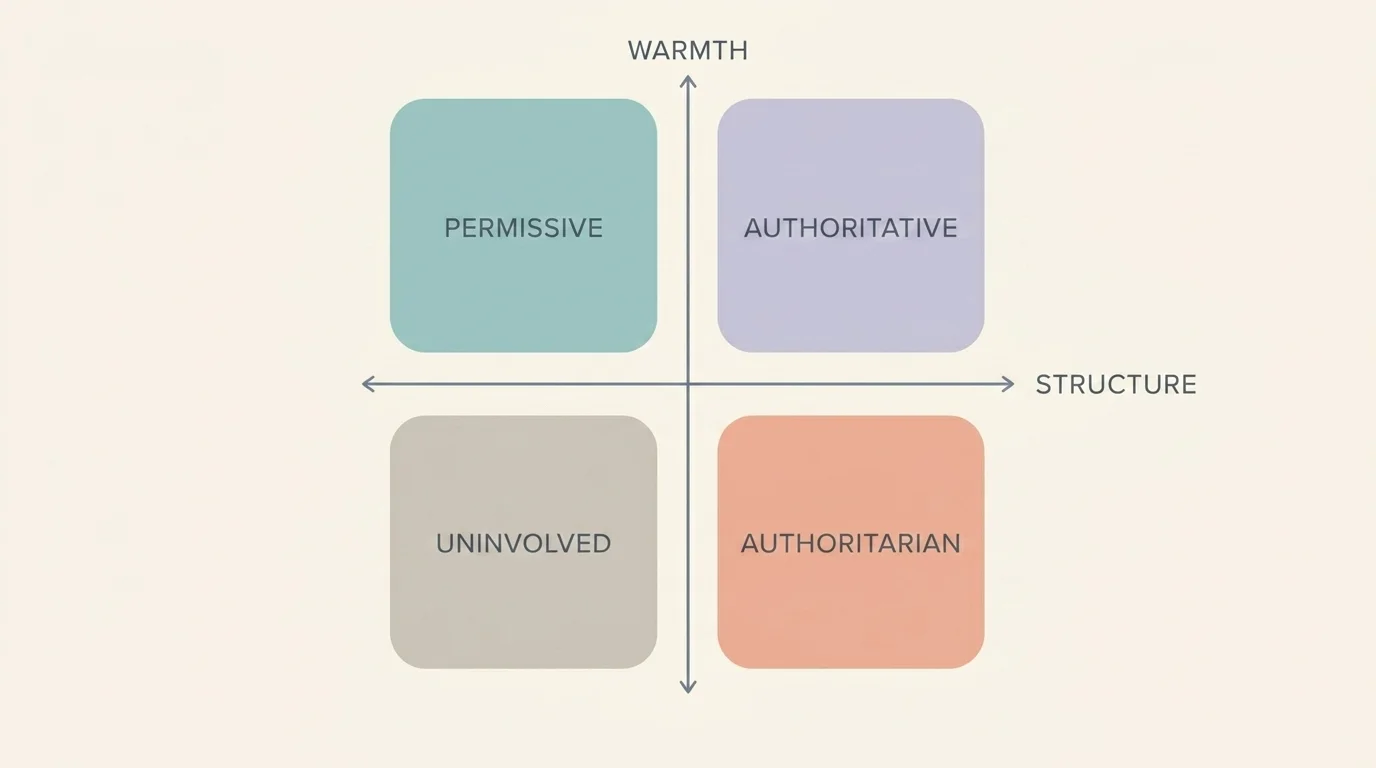
The framework everyone is implicitly using comes from psychologist Diana Baumrind, later rounded out to four by Maccoby and Martin. It maps two dimensions — demandingness (limits, structure, expectations) and responsiveness (warmth, attunement) — onto four styles (Psychology Notes HQ):
- Authoritative — high warmth and clear limits. Rules exist and so does negotiation. This is the one the research consistently links to the best child outcomes, and it's the one most parents say they're aiming for even when they don't use the word.
- Authoritarian — high control, low warmth. Obedience first, explanation optional. "Because I said so."
- Permissive — warm but few limits. Lots of affection, not much structure.
- Uninvolved — low on both dials. Neither the limits nor the warmth show up reliably.
The two that get confused are the two that sound alike: authoritative and authoritarian. They are near-opposites. One holds a boundary while staying warm; the other holds a boundary instead of warmth. Keep that distinction and the whole generational story below gets a lot clearer.
How each generation turned the dials
Baby Boomers: the authoritarian default
Boomers (born 1946–1964) were largely raised on, and largely practiced, an authoritarian model: structured schedules, clear hierarchy, respect for authority as a starting assumption rather than something earned. It suited a postwar era of relatively stable family structures and conformity to social norms. The warmth was often real; it just wasn't the organizing principle. Limits were.
Gen X: the latchkey swing toward permissive — and the helicopter correction
Gen X parents (born 1965–1980) grew up as the latchkey kids of dual-income, higher-divorce households, and many swung toward a more permissive, hands-off style in reaction — more autonomy, more open communication, fewer rigid rules. But Gen X is also the generation that produced helicopter parenting, the over-involved correction at the other extreme: scheduling every hour, hovering over every conflict, treating childhood as a project to be managed. Both moves are the same instinct — don't repeat what was done to me — pointed in opposite directions.
Millennials: gentle parenting, and what came after it
Millennials made gentle parenting the signature style of the era: high responsiveness, emotional validation, discipline reframed as connection rather than punishment. At its best it's authoritative with the warmth turned up. The catch — and this is the part most articles published before 2025 miss — is that the boundary-free version that spread online produced real parent burnout, and by 2026 the trend had already corrected toward what's now called hybrid or boundaried parenting: empathy plus clear limits, not empathy instead of them (Sustainable Parenting, 2026). If "gentle parenting" left you feeling like you'd traded authority for negotiation you never wanted, the correction is the point, not a failure.

Gen Z: the cycle-breakers
This is the cohort the older articles skip, and by 2026 there's enough data to write about them properly rather than guess. The oldest Gen Z are parents now, and what they intend is striking: in a 2025 survey of 1,500+ adults aged 18–28, 60% planned to parent authoritatively (versus the 34% who were raised that way), 28% planned gentle parenting (versus 7% raised that way), and only 3% planned a strict/traditional approach — down from the 39% who were raised on it (Chicco, 2025). That's the biggest single-generation swing in the whole timeline, and it's deliberate. Seventy percent said they want to give more emotional support than they received, and 64% plan to be more open about mental health.
What they actually do in practice has its own name: cycle-breaking — consciously refusing to repeat your own upbringing. Among Gen Z parents of young kids, 41% described themselves as cycle-breakers and 32% as gentle parents, with 43% saying gentle parenting "only works for some situations" (Scripps News / Kiddie Academy, 2025). It's worth noticing they're already more clear-eyed than the headlines: they're not adopting gentle parenting wholesale, they're keeping the warmth and reintroducing the limits.
Parenting styles by generation, at a glance
| Generation | Era of parenting | Dominant style | Core driver | Relationship to technology |
|---|---|---|---|---|
| Baby Boomers | 1960s–1980s | Authoritarian | Conformity, respect for authority | Largely pre-digital |
| Gen X | 1990s–2010s | Permissive / latchkey → helicopter | Autonomy, then the over-involved correction | Early adopters; first to negotiate screen time |
| Millennials | 2010s–present | Gentle → hybrid | Emotional attunement, then boundaried warmth | Digital-native parents, screen-time managers |
| Gen Z | 2020s–emerging | Authoritative-intended / cycle-breaking | Mental health, breaking inherited patterns | Most screen-cautious for their own kids |
This mapping — named style to named generation — is the part that's genuinely hard to find anywhere else. The style explainers define the four types in a vacuum; the generational pieces tell the story without the vocabulary. The interesting truth is in the overlay.
The technology dial, which moves faster than the others

Here's where I'll separate the layers, because "screens" is where every generation's parenting story now runs aground. What the devices technically enable, what the norms among kids actually are, and what a parent can realistically do about it are three different questions, and conflating them is how reasonable parents lose the argument.
The data shows the ground still shifting under everyone. Daily screen use among children under two rose from 24% to 35% between 2020 and 2025 (Pew Research, 2025) — and notably, 66% of parents aged 18–49 say they personally spend too much time on their own smartphones, versus 46% of older parents. The younger the parent, the more aware they are of modeling the behavior they're trying to limit. Gen Z parents are acting on it: they want their own kids to wait until about 15 to get social media, two years later than the ~13 they themselves started (Chicco, 2025).
Mental health is the other place the generations diverge sharply, and it's mostly a perception gap. Among parent-teen pairs, 55% of parents are extremely or very concerned about teen mental health while only 35% of teens are; 80% of parents say they're comfortable talking about it with their teen, but only 52% of teens agree the conversation is comfortable (Pew Research, 2025). If you've ever felt like your "how are you really doing" lands differently than you intended, that 80%-versus-52% gap is why. The willingness is there on both sides. The shared sense of ease is not.
What this actually means for you tonight
The clean story — each generation gets a little warmer and a little more flexible than the last — is too tidy to be true. What the 2025 data actually shows is convergence on pragmatism: parents blending about three styles and openly rejecting the idea that one approach fits every kid and every moment (Scripps News / Kiddie Academy, 2025). The authoritative middle — warmth and limits — keeps winning not because it's trendy but because the research has pointed there for fifty years, and every generation eventually reinvents it under a new name.
So the one concrete thing to try: instead of asking "what's my parenting style," ask which dial you're reaching for in the moment that's actually going badly. Are you short on warmth or short on limits? Most of us have a default we over-rely on under stress — the Boomer reflex toward control, the gentle-parenting reflex toward endless negotiation. Naming your own default is more useful than adopting a label, because the label you inherited is exactly the thing the next generation is, predictably, already trying to break.
Frequently Asked Questions
Based on Diana Baumrind's framework (completed by Maccoby and Martin), the four styles are authoritative (high warmth + clear limits), authoritarian (high control + low warmth), permissive (warm but few limits), and uninvolved (low on both). Authoritative is consistently linked to the best child outcomes.
They sound alike but are near-opposites. Authoritative parenting holds clear boundaries while staying warm and open to explanation. Authoritarian parenting prioritizes obedience and control over warmth — the classic 'because I said so' approach.
Surveys show Gen Z parents lean toward authoritative parenting (60% intend it, versus 34% raised that way) and 'cycle-breaking' — consciously not repeating their own upbringing. In practice, 41% describe themselves as cycle-breakers and 32% as gentle parents (Chicco 2025; Kiddie Academy 2025).
Cycle-breaking is the conscious decision not to repeat patterns from your own childhood. It's the emergent named style among Gen Z parents — 41% identify with it — and it typically keeps the warmth of gentle parenting while reintroducing clear limits.
It remains influential as the signature Millennial style, but the 2025–2026 trend is a shift toward 'hybrid' or boundaried parenting — empathy combined with clear limits — after reports of burnout from the boundary-free version. Among Gen Z parents, 43% say gentle parenting 'only works for some situations.'
Most don't pick just one. In a 2025 survey, parents reported blending an average of three styles, and 85% rejected a one-size-fits-all approach — adapting their balance of warmth and limits to the child and the situation rather than committing to a single label.