
Strengthening Family Bonds: Lessons from Parenting Experts


For the foundational case — what makes a family healthy and the underlying research framework — see the companion piece in this collection. This article is the actionable companion: the family bonding activities researchers actually measure, the conversation questions to print on the fridge, the experts worth listening to in 2026.
It was a Tuesday in early autumn, in the car on the school run, when my middle child — who is nine and not given to philosophical complaints — said, "We don't really do anything together as a family anymore." We had been to a barbecue at his cousin's house the weekend before, and a hike the Sunday before that, and he had been at both. What he meant, when I pushed gently, was that there was no thing that was ours — no small repeated act that he could point at and say, that's what my family does. The barbecue was someone else's. The hike was the dog's.
I drove the rest of the school run in silence, and most of the day in a kind of low-grade reckoning. He was right. The activities had been there. The thread between them had not.
This is an article for anyone who has had a version of that Tuesday. The good news is that the question — what should we actually do together? — has answers now in a way it didn't five years ago. Two 2025 peer-reviewed studies, plus a small set of working frameworks from named experts who are not selling you anything, have made the previously vibes-based topic of "family bonding" usefully specific. What follows is a researcher-and-father's read of what those studies and experts actually recommend. I have three children, two countries' worth of cousins, and a week that is roughly as chaotic as yours; everything below is filtered through that.
What Two 2025 Studies Found
The first peer-reviewed study to examine the type and time of family bonding activities — rather than treating "family time" as a single undifferentiated variable — was Kim's 2025 paper in Wiley's Children & Society. Looking at young children's social-emotional development, Kim found that two specific activities consistently emerged among the strongest predictors of healthy outcomes: reading together and storytelling. The volume of time mattered less than the consistency of the practice and the quality of attention during it.
The second is a 2025 MDPI systematic review titled (almost identically to this article) "Strengthening Family Bonds", which synthesized 41 studies on family-cohesion factors and interventions. The interventions that consistently worked across the literature were unfussy: device-free shared meals, cooperative games, regular outdoor time, and predictable family rituals. None of the interventions that worked involved expensive trips, elaborate productions, or perfectly Instagrammable evenings.
Take the two studies together and the conclusion is the kind of finding I find personally cheering: the boring stuff works. The reading aloud, the dinner without phones, the same tradition four years in a row. The thing my middle child was missing, on that Tuesday in the car, was not amplitude. It was repetition.
The 15–30 Minute Rule
The most useful single recommendation I've encountered in the recent evidence-based parenting literature is also the smallest. Multiple 2024–2025 sources — PM Pediatric Care's family-bonding synthesis, the Protect Families Protect Choices 2026 guide, and several pediatric medical-system summaries — converge on the same number: 15 to 30 minutes per day of focused, device-free family time.
Two things are surprising about that number. The first is how short it is. The second is that the consistency matters more than the duration: a household that protects 15 minutes daily outperforms one that does 90 minutes once a week, because what's being trained is predictability. The brain — yours and your child's — calms in the face of the predictable. A 15-minute ritual that happens every weekday at 5:45 PM is, neurologically, more useful than a Saturday-afternoon block that the calendar steals every third week.
Practical: pick the time slot you can actually defend. After-school snack. After-dinner walk. Before-bed reading. The slot is less important than the recurrence.
10 Family Bonding Activities, Backed by Research
A list, in roughly the order I'd commit to them in a real household. Each is supported by either the Kim 2025 paper, the MDPI 2025 review, or the converging recommendations of 2024–2025 pediatric and family-research sources.
- Read aloud, even past the age you think you should stop. The single most-evidenced bonding activity in the Kim 2025 study, and the most under-utilized at age-bands above seven. Read to the eight-year-old. Read to the eleven-year-old. The reading is the bonding. Take turns; let the kid pick the book; don't worry about whether they "should" be reading it themselves.
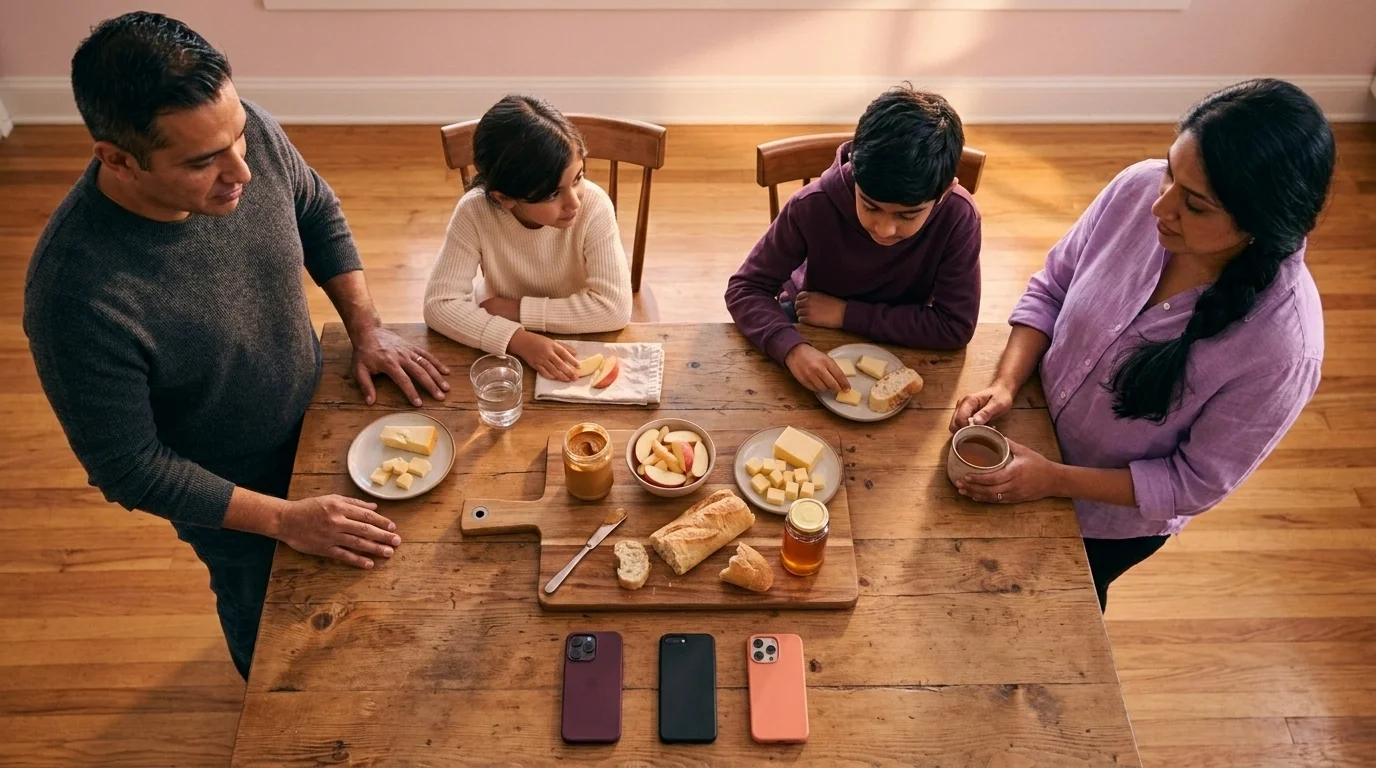
- Share a meal without phones. The MDPI review identifies device-free shared meals as one of the strongest cohesion interventions. The frequency that matters is roughly five-to-seven a week — fewer than three weakens the protective effect.
- Walk, somewhere, after dinner. Twenty minutes around the block, ideally after every dinner. The literature is robust on the bonding effect of side-by-side activity (vs. face-to-face), especially with tweens and teens, who often talk most easily when they are not being looked at.
- Cook one meal a week together, end to end. Not the parent making dinner with the child watching. Genuine collaborative cooking, picking the recipe, doing the chopping, plating it. The cooking is the conversation.
- Garden together, even on a balcony. Tomatoes work in two square feet of soil. Watching something grow that you tended is, in my experience and in the literature, an unusually durable memory.
- Volunteer, four times a year, somewhere. A food drive, a beach cleanup, a soup kitchen. The literature on prosocial-behaviour modeling is consistent: the children of parents who do volunteer work are more likely to grow into adults who do volunteer work. The four-times-a-year cadence is the threshold most research uses.
- Tell stories from before the kids were born. Where the parents met. The parents' parents. The grandparent who emigrated. The literature on intergenerational narrative coherence finds that the more children know about their family history, the more resilient they tend to be — measured, not vibes.
- Build something physical together. A bookshelf, a treehouse, a model, a Lego set the size of a coffee table. The Kim 2025 study found shared making was a strong predictor; the cooperative effort, even when imperfect, is the work.
- Have a weekly family meeting. Thirty minutes, fixed agenda, rotates who runs it. (The companion article in this collection has the agenda template; I won't repeat it here.) The meeting itself is the ritual, regardless of what's on it.
- Spend time outdoors, weekly. The MDPI review identifies regular outdoor time as a consistent cohesion factor. Bushwalk, beach, urban park, backyard. The mechanism appears to be lower distraction and higher proximity, but the practical fact is that families talk differently outside than they do inside.
What's notable about that list: nine of the ten cost nothing. None of them require special skills. They survive a pandemic, a financial bad year, a child who is going through a hard month. The literature on family bonding rewards what most family time has always rewarded — showing up, in a small repeated way, over years.
Cooperative vs Competitive Games
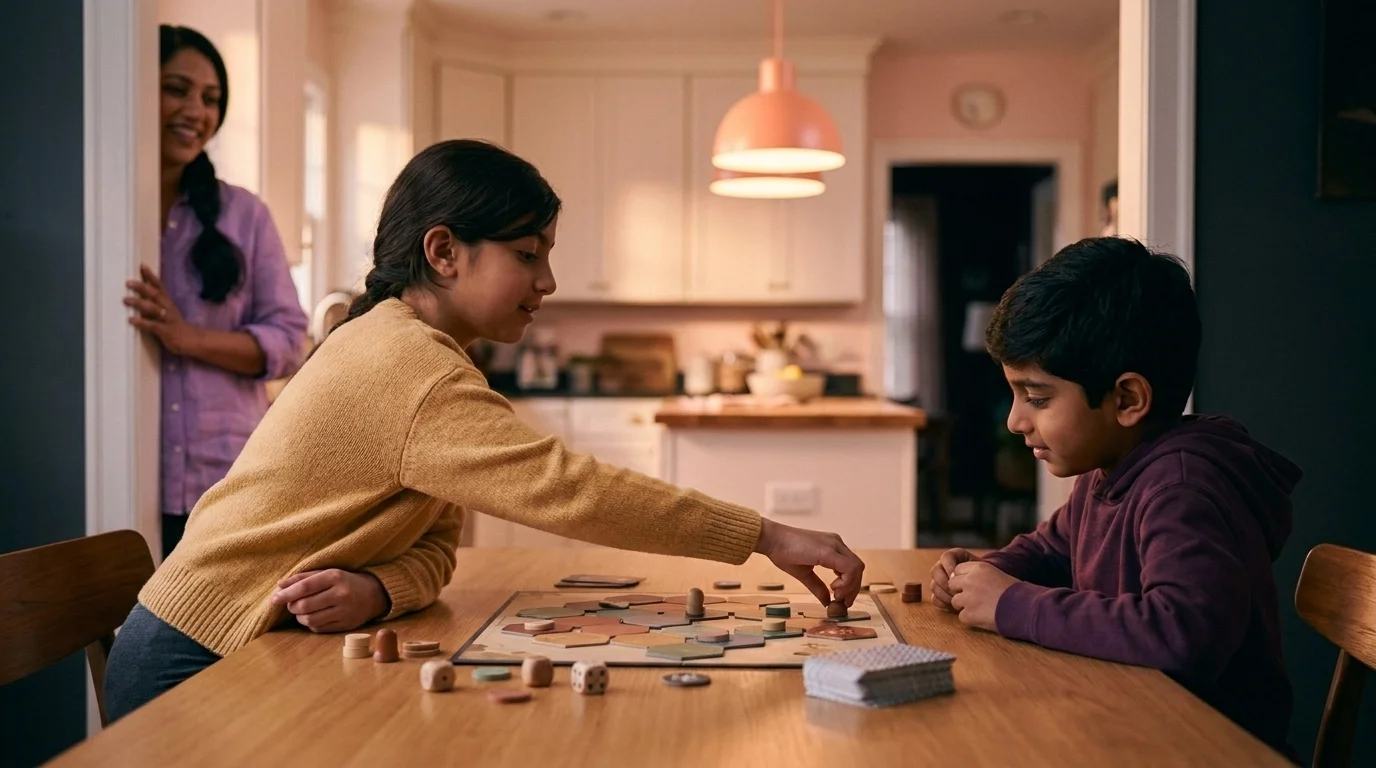
A small, specific point worth singling out because the evidence has been getting cleaner on it in the last two years. Multiple 2024–2025 family-bonding syntheses (including Chromaela's December 2025 review) now explicitly recommend cooperative games over competitive ones for bonding effect. The mechanism is intuitive once named: cooperative games train the family to function as a single unit working toward a shared goal; competitive games train siblings to compete with each other for parental approval.
This doesn't mean Monopoly is bad. It means that if your goal is bonding rather than entertainment, Pandemic, Forbidden Island, Mysterium, The Crew, and most cooperative card games will do more for your household's cohesion than Risk or Settlers of Catan. The kids care less about the distinction than the adults do. Try both; notice the dinner conversation afterward.
Teens: What Dr. Becky Kennedy and Lisa Damour Are Actually Saying
The teen years are where most of the family-bonding literature breaks down, because most of it was written for households with younger kids. Two named experts have done the most useful 2024–2025 work specifically on adolescent connection, and naming them in an article that promises "lessons from parenting experts" is the move I should have made the first time around.
Dr. Becky Kennedy, the clinical psychologist behind the Good Inside platform, has built her recent work around a frame she calls sturdy leadership. Her Mother.ly piece on teens and her December 2024 Tim Ferriss interview lay it out plainly: a teen needs a parent who shows up consistently, holds the parent role, and does not require the teen's emotional reciprocation in order to keep showing up. The framework directly addresses what most "teen rebellion" advice gets wrong — it's not that the teen has stopped wanting connection; it's that they've stopped wanting the same kind. Sturdy leadership is the parent who keeps offering, without performing hurt feelings when the offer isn't taken.
The three Becky Kennedy moves I've watched work in my own house and in others':
- Show up consistently, not perfectly. If you said you'd drive them to football practice on Tuesday, you are there on Tuesday — even when the previous Tuesday went badly.
- Don't take silence personally. The shut bedroom door is not a referendum on the relationship. It is a developmental phase you can be present through.
- Hold the parent role. You are not their friend. You can be warm, available, fun, and still the parent. The teen's job is to push at the role; your job is to keep being it.
Lisa Damour, clinical psychologist and author of Untangled and The Emotional Lives of Teenagers, is the other voice worth knowing. Her 2025 KEDM interview, "Are the kids alright?", pushes back constructively on the moral-panic framing of teen mental health: kids are, on the data, as resilient as ever, and many of the things parents read as crisis signs are developmental phase. That doesn't mean you ignore real warning signs (the previous article in this collection covers those red flags). It means the resilience case is also true.
Practical translation: if your teen is moody and shut-bedroom-door but eating, sleeping, going to school, and engaging in two activities they care about, you are not in crisis. You are in adolescence. Be sturdy. Don't panic. Don't perform calmness either — they can tell.
A small confession: I have a fifteen-year-old. My honest experience is that the sturdy-leader frame works about 70% of the time and that I forget it the other 30%. The 30% is where the repair conversations live. They count too.
Multigenerational Households in 2026
The multigenerational living section in the original article was generic. The data from the last two years says it shouldn't be.
Pew Research puts the share of Americans living in multigenerational households at 18% — roughly 59.7 million people, more than double the 1971 share. The fastest-growing demographic in this living arrangement is young adults aged 25–29, now at 31% multigenerational versus 9% historically. And the 2025 NAR data shows the driver is increasingly adult children moving back home: 21% of 2024 multigenerational homebuyers cited it, up from 11% in 2015 — nearly double in a decade.
That changes the bonding question. A household with a returning twenty-six-year-old and a primary-school sibling has different dynamics than one with grandparents in a granny flat. Three things I've watched work in households of both kinds:
- Explicit role conversations early. Who handles which child's pickups. Who's responsible for which household task. Who's not. Avoid implicit defaults; they curdle.
- Shared meals as the cohesion engine. Same finding as the nuclear-family research — the protective effect of regular meals together is roughly the same regardless of how many generations are at the table. Make them happen.
- Financial transparency, in the version that fits your culture. Per Pew, 40% of multigenerational adults cite financial reasons as a major driver of the arrangement. The thing that helps is naming it: who pays for what, who contributes what, what the unspoken expectations are. Otherwise the financial layer leaks into every other conversation.
A jurisdictional note: the legal and tax implications of multigenerational households vary by country and state — eligibility for caregiver benefits, dependant claims, and so on — and they're worth a thirty-minute consult with an accountant or settlement worker depending on where you live. None of which has anything to do with bonding directly. All of which has plenty to do with whether the household can stay regulated long enough for bonding to happen.
Sibling Bonds, with One Specific Recommendation
Sibling work was covered more substantively in the companion article in this collection, so I'll keep this brief and add only what I've watched matter most: regular individual time with each child, weekly, separately. Twenty minutes, planned, predictable. The reason: most sibling rivalry is, underneath, a competition for parental attention. When the attention is guaranteed in a separate slot each week, the rivalry softens noticeably within months. It's the small, repeated thing again. The cooperative-game finding above also applies: families that play cooperative games together tend to have softer sibling dynamics than families that mostly play competitive ones.
20 Family Bonding Questions
A sidebar I wish I'd had on the fridge for the last decade. Twenty conversation starters across four age bands. Save them, print them, ask one over dinner, and ignore the ones that fall flat.
Preschool (3–5). The questions are smaller; the answers are a window.
- What was your favourite small thing today?
- If our family were animals, what would each of us be?
- What's a song you love right now and why?
- Who made you laugh today?
- What do you want to dream about tonight?
School-age (6–10).
- What's something you're proud of this week that nobody noticed?
- If you could change one rule in our house, what would it be?
- What's the best thing about our family right now? The hardest?
- Who is somebody at school you'd like us to know better?
- What's a question you've been wondering about?
Tween (9–12). Gentle, but they can hold heavier ones than you'd think.
- What's one thing you wish I knew about your week?
- What do you wish was different about how we do things together?
- Who's somebody you admire right now and why?
- If you had a free day with no expectations, what would it look like?
- What's something hard that's been on your mind?
Teen (13–17). Use sparingly, and accept short answers.
- What's something you've been thinking about that you don't usually say out loud?
- What do you wish parents — generally, not just me — understood about your generation?
- What's the thing you'd like more of from me right now?
- What's a memory from when you were younger that means something to you?
- If we could travel anywhere together for two weeks, where would you want to go?
The rule that makes any of them work: ask, then listen without the urge to fix, advise, or relate-back-to-yourself. The teen ones in particular only work if the answer can be three words and the dinner moves on. That counts. The thread is being built one word at a time.
A Small Earned Observation
Six months on from that Tuesday in the car, the thing my middle child was missing has, mostly, been built. We have a Sunday-night family meeting now. We read aloud together, all five of us, three or four nights a week — a chapter of whatever the eldest picked, then a picture book the youngest chose. We walk after dinner most nights. None of those things was on the list of activities I would have come up with if asked, six months ago, what I should be doing differently as a parent. They are smaller than that. They are also, in my experience and in the literature, what families are actually built of.
The research is reassuring in this specific way: the work is already inside the reach of anyone reading this article. A 15-minute ritual you can defend. A book you read aloud. A meal without phones. A Sunday meeting. A walk. A few good questions on the fridge for the next time someone is willing to answer one. None of which guarantees any particular outcome in any particular family. All of which the evidence says is the right thing to be doing anyway.
The most-honest summary I can offer, after a decade of writing about modern fatherhood and three of my own children doing their level best to make a fool of any framework I try to apply: the families that bond are not the families that try the hardest. They are the families that do the smallest possible thing the most consistently for the longest. That is, in the end, both an enormous relief and a permanent assignment. Most weeks you are already doing it. The Tuesday-in-the-car wobble is part of the cycle, not a failure of it. Keep the small thing. The small thing is the answer.
Frequently Asked Questions
The 2025 MDPI systematic review of 41 studies on family cohesion identifies a small set of interventions that consistently work: device-free shared meals, regular outdoor time, structured family meetings, and 15-30 minutes of focused daily connection. The pattern across all of them is the same — predictable, low-distraction time matters more than amplitude. A weekly family meeting with a fixed agenda and rotating leadership outperforms ad-hoc 'we should talk more' resolutions because the structure removes the friction that otherwise blocks the conversation.
Dr. Becky Kennedy calls the answer 'sturdy leadership' — show up consistently, hold your role as parent, don't take refusal personally, and offer parallel-activity bonding (driving, cooking, walking) instead of forcing eye-contact conversation. Lisa Damour's 2025 work adds an important counter-framing: kids are as resilient as ever, and the silence isn't a crisis — it's a developmental phase you can be present through. Watch for the difference between phase and red-flag (sustained sleep, mood, or appetite changes; withdrawal beyond two weeks; expressions of hopelessness).
Pew Research data shows the traditional 'two parents plus biological kids' household is no longer statistically dominant in the US — cohabiting couples, single-parent households, blended families, and multigenerational households together outnumber it. Designing rituals, household rules, and language around the default template is just inaccurate. The four dimensions of family cohesion — bonding, adaptability, communication, support — are largely indifferent to family shape. What changes is how you set them up; building rituals that include each member's heritage, language, or family-of-origin patterns is the practical version of inclusion.
A 2025 Wiley peer-reviewed study (Kim) found reading and storytelling are among the strongest predictors of young children's social-emotional development. The 2025 MDPI systematic review on family cohesion identifies device-free shared meals, cooperative games, outdoor time, and family rituals as the most consistently effective interventions. The shared thread: regular, focused, low-distraction time — not elaborate trips.
Pediatric and family-research sources converge on 15-30 minutes per day of focused, device-free connection time. The number matters less than the consistency: daily 15 minutes outperforms weekly 2-hour blocks, because the goal is rituals the brain can rely on, not events.
Dr. Becky Kennedy calls the answer 'sturdy leadership' — show up consistently, hold your role as parent, don't take refusal personally, and offer parallel-activity bonding (driving, cooking, walking) instead of forcing eye-contact conversation. Lisa Damour adds: teens are as resilient as ever, the silence isn't a crisis — it's a developmental phase you can be present through.
Pew Research data shows 18% of Americans now live in multigenerational households, with adult children returning home being the fastest-growing driver (21% of 2024 multigen homebuyers, up from 11% in 2015). The proven cohesion strategies: explicit roles, shared meals, financial transparency, and one weekly all-generations activity. Avoid letting grandparents become permanent default childcare without a conversation about it.