
Pregnant Belly


There is a particular way a woman stands in front of a mirror somewhere around the fourth or fifth month — side-on, one hand flat against the small of her back, reading her own middle like a page she is not sure she understands. I did it with both of mine. Your pregnant belly is the one part of pregnancy you can actually watch happen, which is precisely why it becomes the thing you measure yourself against, usually against strangers on a screen who are no help at all. What follows is the guide I wish someone had handed me at that mirror: when the bump tends to arrive, how it changes across the weeks, why no two are the same size or shape, and what the words firm, soft, high, low, and is that a bump or just lunch actually mean. I have tied the whole progression to fundal height — the single centimetre measurement your provider records at nearly every visit from around twenty weeks — so that when you ask whether your belly is "on track," you have something steadier to ask it of than the internet. Everything here is grounded in medical sources and written for reassurance, not diagnosis. Wherever your belly is today, you are almost certainly more ordinary than you fear, and I mean that as the comfort it is.
When Do You Start Showing?
Most people begin to show in the second trimester, somewhere between twelve and sixteen weeks — though "most" is carrying a great deal of quiet weight in that sentence. The timeline is a range, not a date, and the range is wide on purpose.
If this is your first pregnancy, you will probably show later than you expect. Abdominal muscles that have not been stretched before hold the uterus in more tightly, so the bump stays private for longer, which is its own small frustration when you are ready to look pregnant and your body has not yet agreed. People carrying twins or more often show earlier — sometimes in the first trimester, before the calendar seems to permit it. And then there is everything else that moves the line: your height, your build, the particular way your uterus is sitting, whether you have been pregnant before. The WebMD guide to when women start showing lays out the same second-trimester window and the same caveats, and the caveats are the point. "Early" and "late" are both, overwhelmingly, just normal. I remember treating the absence of a bump as evidence of something, the way you do at three in the morning, and it was evidence of nothing except that bodies keep their own schedules. If you want the wider view of what is coming, our pregnancy guides walk through the rest of the changes alongside this one.
Pregnant Belly Stages, Week by Week — Tracked by Fundal Height
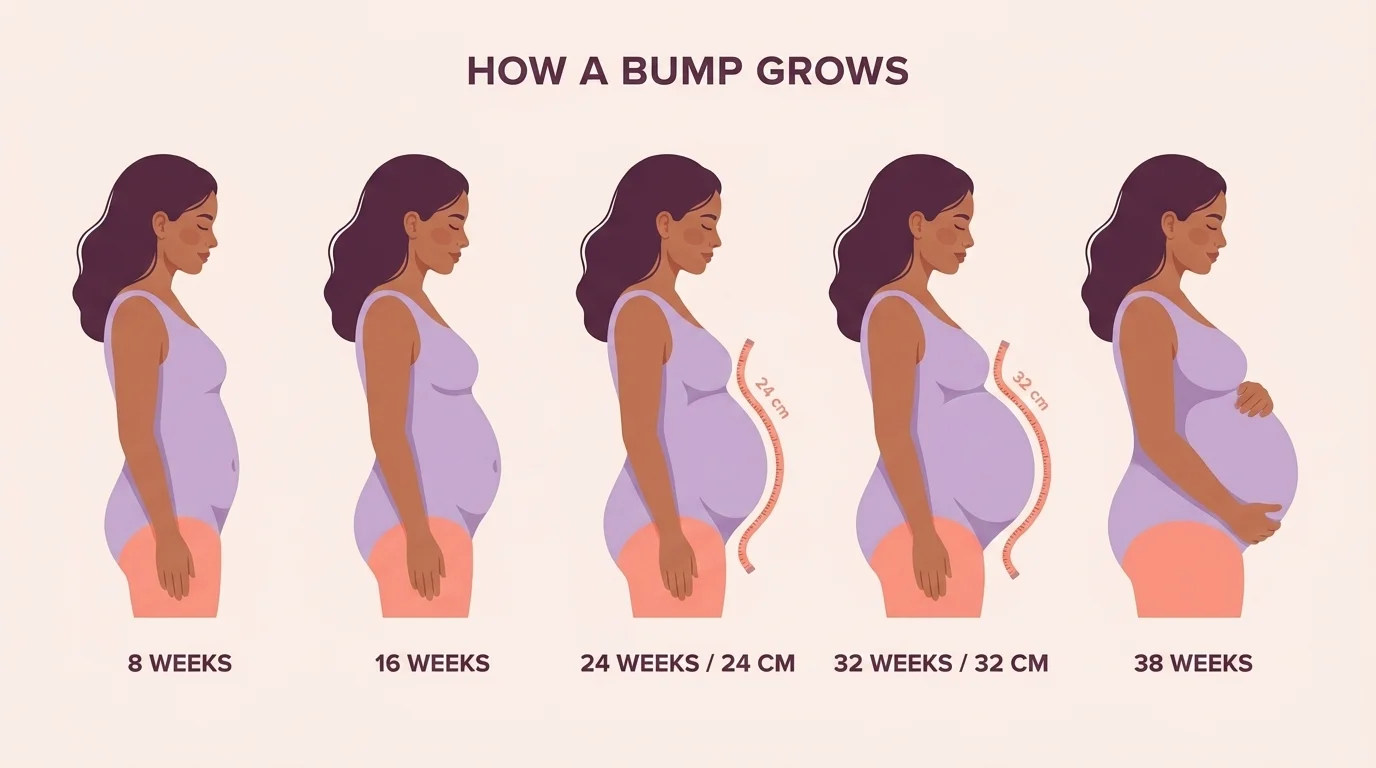
Here is the number almost no one hands you, and the one I wish I had understood sooner. Fundal height is the distance, in centimetres, from your pubic bone to the top of your uterus, and from about twenty weeks it should sit close to the number of weeks you are pregnant — within plus or minus two centimetres, according to Cleveland Clinic, and within about three centimetres after twenty-four weeks, per Mayo Clinic. It is the tape-measure reading your provider takes, more or less silently, at each visit. I find it steadying in a way the mirror never manages, because it is a measurement rather than a comparison. One caution before we walk the stages: fundal height is how your provider tracks your bump over time, not a figure to grade yourself against at home. A single reading outside the range is a reason for your provider to look more closely, not for you to lie awake. With that held firmly in mind, here is how the belly tends to move.
First Trimester (Weeks 1–13): Little to No Bump
For most of the first trimester there is not much to see, and what there is tends to be bloat and a general thickening rather than an actual bump. This is also before fundal height starts being tracked; that measurement only begins to mean anything from around twenty weeks. This is the stage of feeling enormously pregnant and looking, to everyone else, exactly as you did in October. The disorientation is real and it is temporary.
Second Trimester (Weeks 14–27): The Bump Appears
This is when the belly announces itself. Showing usually begins in that twelve-to-sixteen-week window, and by around twenty-four weeks the bump is unmistakably a bump — which is, not coincidentally, the milestone people tend to ask about. Around then your fundal height is roughly twenty-four centimetres, give or take a couple, which is the tidy near-equivalence that makes the whole measurement so quietly useful: the number your provider writes down and the number of weeks on your notes are, for a stretch of the middle months, nearly the same. It is the one part of pregnancy arithmetic that behaves.
Third Trimester (Weeks 28–40): Peak, Then Drop
The belly climbs to its highest point at around thirty-six weeks — Cleveland Clinic describes the fundus reaching the sternum at that stage — and then, disconcertingly, the measurement can go down. After thirty-six weeks fundal height can decrease because the baby drops into the pelvis, which is a descent, not a shrinkage; nothing is being lost, only rearranged for the exit. If no one warns you, a smaller number this late reads as alarm, when it is very often the opposite. The third trimester is mostly this: the body doing sensible things that feel, from inside, like plot twists. It is worth reading a little about what to expect as your body changes into the third trimester before you are in it.
Pregnant Belly Shapes: High, Low, Wide, D-Belly & B-Belly
Bellies come in shapes, and the shapes have acquired names, and the names have acquired folklore — most of it wrong. It is worth taking the vocabulary seriously and the folklore not at all, because a great deal of unnecessary worry lives in the gap between the two.
What Is a B-Belly?
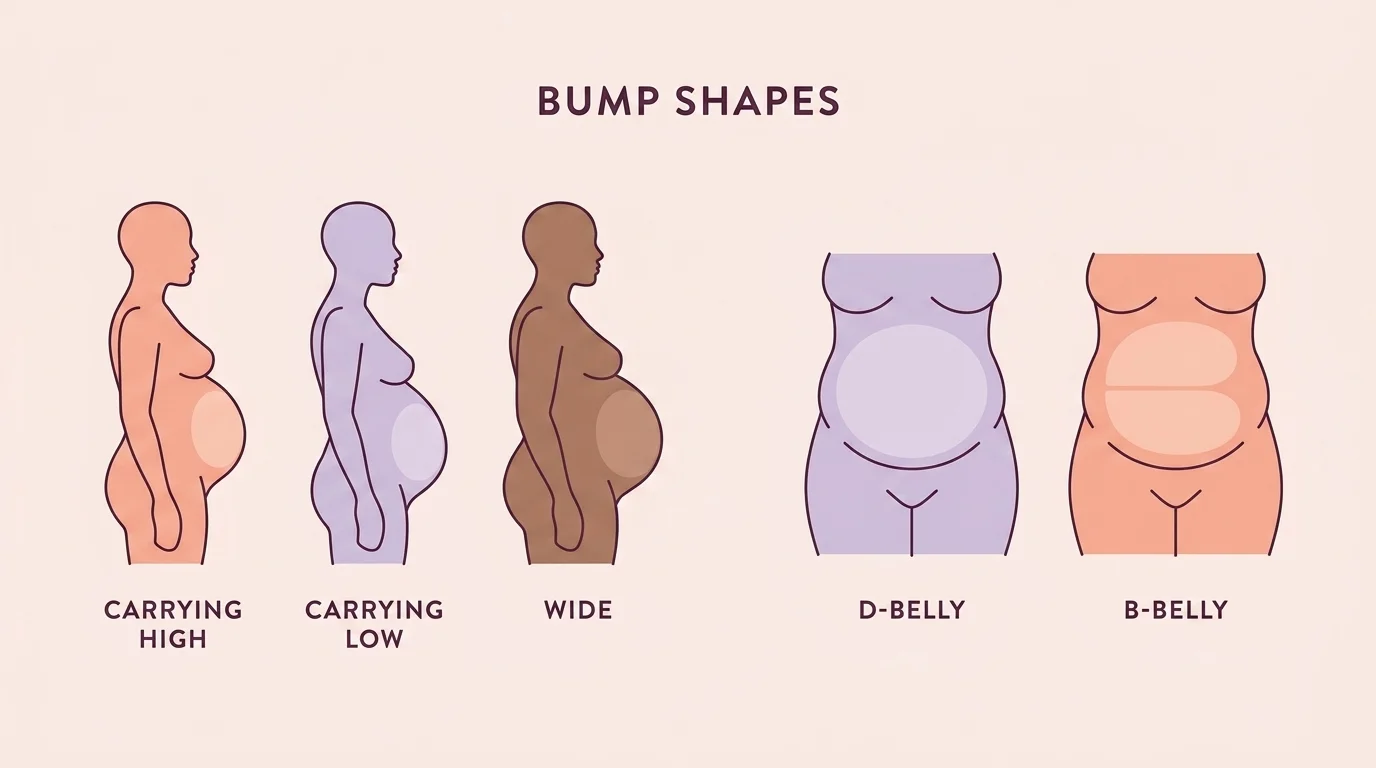
A B-belly is one with a crease or waistband across the middle, so that the bump looks split into a top half and a bottom half, rather like an uppercase letter B — the shape and the name both come from Healthline's explainer on the B-belly. It is common when there is more weight to carry, with diastasis recti (a separation of the abdominal muscles), with an apron belly, or after previous pregnancies. It is worth saying plainly, because the internet will not: a B-belly is a variation, not a problem. In Healthline's own words, "a B belly by itself should not raise alarm bells for your doctor." If you have one, you have a belly.
D-Belly vs. B-Belly
The counterpart is the D-belly — one smooth outward curve, the silhouette that magazine covers have quietly trained everyone to expect. The distinction matters mostly because so many people assume the D is the only correct outcome. It is not, and it is not even fixed: many B-bellies round into a D as the pregnancy goes on and the bump fills out. Shape is a stage as much as a category.
Carrying High, Low, or Wide
Whether you carry high, low, or wide is a matter of your body type, the strength and length of your core muscles, and where the baby happens to be lying — ordinary anatomy, all of it, and all of it normal. It changes between pregnancies and sometimes within one. There is no version of it that is doing anything wrong.
Belly Shape Doesn't Predict Baby's Sex
And now the folklore, said once and firmly so we can be rid of it. Belly shape does not predict your baby's sex. Healthline puts it flatly: "No peer-reviewed research has ever supported the idea that pregnancy belly shape predicts the baby's sex." Carrying high or low, neat or wide, tells you about your muscles and the baby's position and nothing whatsoever about whether there is a boy or a girl inside — the same point University of Utah Health makes in its round-up of pregnancy myths. Your aunt is allowed to guess. She is not allowed to be sourced. For more of the same, our early-pregnancy explainers take on the other myths one at a time.
Is a Pregnant Belly Supposed to Be Hard or Soft?
It can be either, and it changes hour to hour — occasional firmness, or a brief sharp twinge, is usually nothing to read into. The belly is not a single fixed texture; it is a surface being pushed on from the inside by something that keeps moving.
Some of the firmness has a name. Round ligament pain — the sharp, short pull low in the abdomen when you stand up too fast or turn over in bed — affects between ten and thirty per cent of pregnant people, according to Cleveland Clinic, and it tends to start in the second trimester, from around fourteen to twenty-seven weeks, when the uterus is growing fastest and the ligaments that anchor it are stretching to keep up. The tight, about-to-pop feeling is mostly that stretching — skin and ligaments accommodating a size they have not held before — along with the occasional painless tightenings people call Braxton-Hicks, which come and go without settling into any rhythm. Beyond that, ordinary things move the needle: the baby's position, a full bladder, gas, the time of day. None of that is cause for concern on its own. Persistent pain, or pain that arrives with other symptoms, is a different conversation, and it is the one I have kept until the end of this guide on purpose.
Pregnant Belly vs. Fat vs. Bloating: How to Tell the Difference
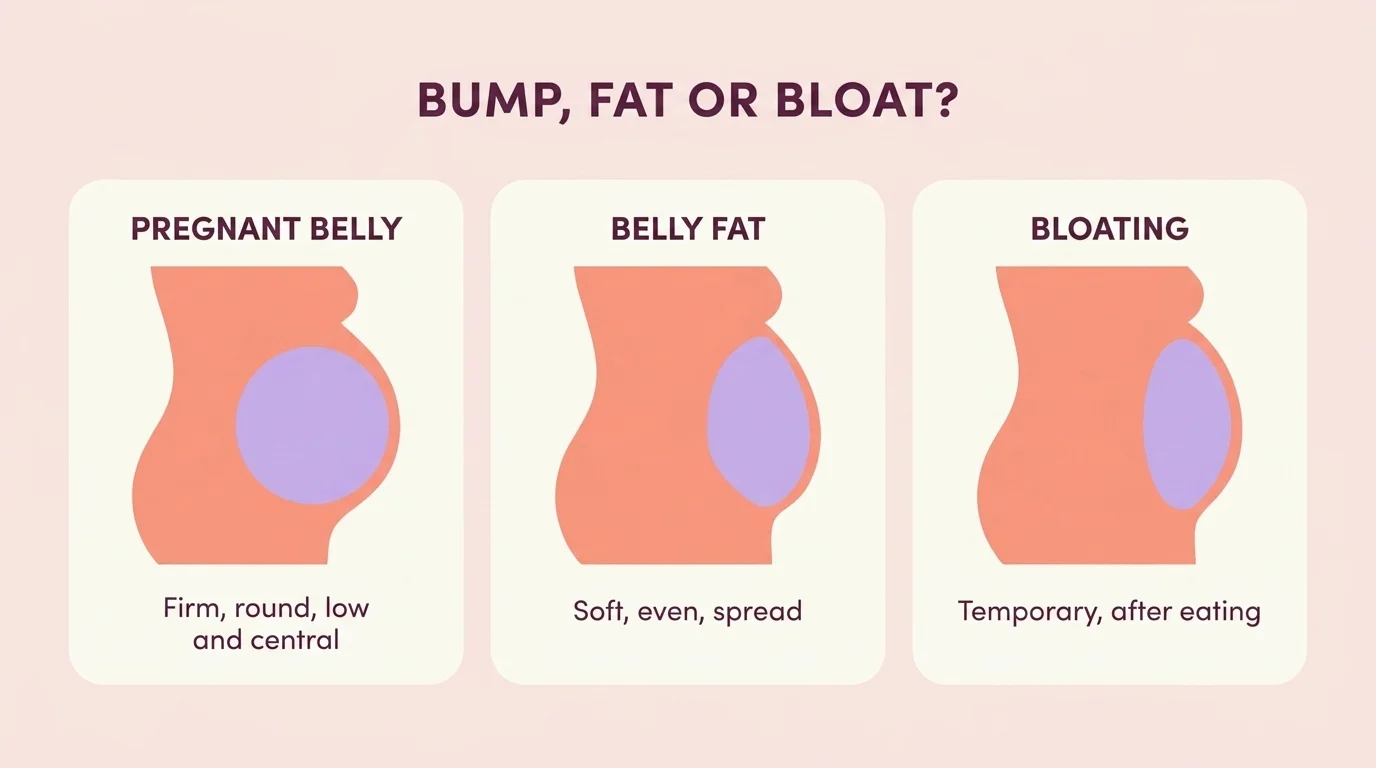
The honest short answer is that appearance alone cannot settle it, but there are reliable tendencies. A pregnant belly is firm, round, and centred low; belly fat is softer, more mobile, and spread more evenly across the body; bloating comes and goes.
Pregnant Belly vs. Belly Fat
A pregnant belly tends to feel firm and to sit round and low, in the lower abdomen; belly fat feels soft and a little jiggly and is distributed across the midsection rather than concentrated, a distinction Juniper and Healthline both draw. The tendencies are useful; they are not proof.
Bloating vs. a Baby Bump
Bloating is the great impersonator, but it has one tell: it is temporary. It tends to ease within about a day, often after you have eaten and digested, whereas a bump does not deflate overnight — it is not going anywhere. Healthline's guidance is refreshingly unromantic about the whole question, and so am I: the only thing that actually confirms a pregnancy is a pregnancy test. Everything before that is inference, and inference has a long history of being wrong at both extremes.
Other Belly Changes: Linea Nigra & Your Belly Button
Two smaller changes surprise almost everyone, so they are worth a sentence each of warning rather than a fright later.
The first is the linea nigra, the dark vertical line that appears down the centre of the belly. It develops in up to ninety per cent of pregnant people, Cleveland Clinic notes, usually becoming visible around twenty weeks, and it is the work of pregnancy hormones prompting more melanin along a seam that was always there but unpigmented. It is entirely harmless and it fades on its own, over several months to a year after birth. The second is the belly button, which the growing uterus tends to push forward until an innie flattens or turns frankly into an outie — a change Cleveland Clinic describes as ordinary and, like the line, one that usually reverses after the birth. Both are cosmetic, both are temporary, and both are the body doing exactly what it is supposed to.
When to Call Your Provider
Almost everything in this guide is a variation of normal, which is the whole reason to be clear about the small set of things that are not. Trust your instincts first: a quick call is always reasonable, and no provider worth having will mind you making it. Beyond that, Cleveland Clinic is specific about the signs worth acting on — belly pain that will not go away, and belly pain that arrives alongside bleeding, contractions, fever, or trouble walking. Those are not aches to interpret at the mirror; they are reasons to phone your OB-GYN or midwife and let a professional look. Nothing on this page is a diagnosis or a substitute for that call, and it was never meant to be. If you want a wider frame for looking after yourself through all of it, we have written about taking care of yourself through every stage as well.
What Your Belly Is Actually Telling You
A pregnant belly comes in every size, shape, and firmness, and the honest way to know yours is on track is not the bumps you scroll past at midnight but the fundal-height number your provider quietly records — the measurement that behaves, more or less, like the calendar. Normal is a much wider country than the mirror suggests, wide enough to hold high and low, B and D, firm and soft, early and late. The single thing worth interrupting all of that reassurance for is pain: constant, or arriving with bleeding, contractions, or fever. Keep following your body's changes rather than someone else's; our full pregnancy guides are here for the rest of the questions, and there is more to come after this one. The woman at the mirror, if I could reach her, is the one I would tell first — that the thing she is studying so anxiously is, almost certainly, just a body doing its oldest and least original work.
Frequently Asked Questions
A B-belly has a crease across the middle, so the bump looks split into a top and bottom half, like an uppercase "B" instead of one smooth "D" curve. It's normal — common with more weight to carry or with diastasis recti — and it often rounds into a D as the pregnancy goes on.
No. No peer-reviewed research supports the idea that carrying high, low, neat, or wide predicts a boy or a girl. Belly shape reflects your body type, your abdominal muscles, and the baby's position — not the baby's sex.
By around 24 weeks the bump is clearly visible, and your fundal height — the measurement from your pubic bone to the top of your uterus — is roughly 24 cm, give or take about 2 to 3 cm.
That tight, stretched feeling is usually the skin and round ligaments stretching to accommodate the growing uterus, along with the occasional painless tightenings some people call Braxton-Hicks. It's normal and temporary — but call your provider if the pain is constant or comes with bleeding or contractions.
Yes. As the uterus pushes forward, an innie belly button can flatten or turn into an outie. It usually returns to normal after birth.