
Embracing Imperfection: The Art of Realistic Parenting


It is eight o'clock on a Tuesday, the toddler is screaming about the wrong sippy cup, the seven-year-old's reading book is somewhere in the car, and I have just opened Instagram and seen — for no reason except the algorithm — a stranger's eleven-second video of her three children eating something green in matching linen overalls. The video is twenty-eight seconds. The shame is longer. The phrase the academic literature reaches for at this moment is the good enough parent — realistic parenting is what the search engines will call it, imperfect parenting is the slightly more honest version, but good enough is the one with seventy years of psychoanalytic spine behind it, and it is the closest thing the field has to a useful sentence at eight o'clock on a Tuesday.
What follows is an essay on what good enough actually means in practice, in 2026, in the small private rooms of the digital age. It covers where the myth of the perfect parent came from and why it accelerated in the last fifteen years, what Donald Winnicott meant when he coined the phrase in 1953 and how Ed Tronick later put a number on it, what the most recent research on mom guilt and parental burnout has settled, why the comparison trap on social media is empirically (not just anecdotally) costly, and what a small, sustainable repair-over-rupture practice looks like in a real kitchen. It is the companion piece to a separate article in this series on the operational rules and scripts for raising digital citizens. That one is about your children. This one is about you.
Adrienne Rich wrote in Of Woman Born in 1976 that motherhood is "the great unwritten story," and I think about that sentence more often than is probably healthy. She did not mean that no one had written about motherhood. She meant that no one had yet written about it with the seriousness we reserve for, say, a mid-career male novelist's divorce. Half a century later, the most expensive part of the unwritten story is the part the algorithm fills in for us.
Where the perfect-parent myth came from
The myth of the perfect parent has a fairly recent genealogy and it does us no favours to pretend it is older than it is. Pinterest opened to the public in 2010 and immediately created the aesthetic vocabulary — the styled lunch in a bento box, the chalkboard sign on the first day of school, the colour-coordinated playroom — that we then internalised as a baseline. Instagram, which became a parenting platform somewhere between 2013 and 2014, gave that aesthetic a face and a follower count, and made it possible for the first time in the history of motherhood to compare your own kitchen at five o'clock to the curated highlight reel of a stranger in a different time zone. TikTok parenting coaching arrived around 2020 and added a fourth layer — the implication that every difficult moment in the day has, somewhere on the platform, a thirty-second script you should already know.
None of these tools is wholly bad. The argument worth making is not against the technology; it is about what the cumulative effect of fifteen years of curated parenting content has done to the inside of an ordinary parent's head at eight on a Tuesday. The latest survey numbers, for what they are worth, are sobering: a 2,000-mother survey conducted by Little Sleepies found 91 per cent of mothers experience what the report calls "mom guilt," 72.5 per cent compare themselves to other mothers on social media (about a quarter of them often), and 58.5 per cent report feeling guilty about their parenting choices specifically because of social media posts from other parents. Motherly's reporting puts the figure at more than 70 per cent when the comparison is specifically to "momfluencers." Whatever the exact percentage, the order of magnitude is no longer in dispute. This is now structural. The Tuesday-night spiral is not an individual failure.
Winnicott's good enough mother (and the 30 per cent rule that finally puts a number on her)
The phrase the good enough mother comes from the British paediatrician and psychoanalyst Donald Winnicott, who used it in a 1953 paper and then repeatedly throughout his work. The essential claim, which is gentle, durable, and easy to mistake for a soft cliché, is that an ordinary, devoted mother who is good enough is exactly enough. Her imperfections are not a thing to be papered over; they are the necessary structure through which the child learns that the world is reliable but not magical, that needs are usually met but not instantaneously, and that the parent is a separate person rather than an extension of the child. The eventual gap between the mother's responsiveness and the child's wish is the place where the child's own selfhood is forced, by ordinary developmental pressure, to come into being. The mother who manages to be perfect — a hypothetical figure who, mercifully, does not exist — would, in Winnicott's logic, deprive her child of exactly this development.
For seventy years Winnicott's idea sat in a slightly literary register that made it suggestive but not measurable. In the last fifteen years the developmental psychologist Ed Tronick, whose famous Still-Face experiment is in every undergraduate textbook on attachment, did the empirical work that finally put a number on it. The Circle of Security International's reading of Tronick summarises the finding cleanly: in low-risk caregiver-infant pairs, parents are accurately attuned to the child's emotional signals only about 30 per cent of the time. The remaining 70 per cent is misattunement of one kind or another — missed cues, lagged responses, misread signals — and what produces secure attachment is not the avoidance of the 70 per cent, but the repair after rupture: the noticing, the coming back, the soft sentence said in the door of the bedroom afterwards. Thirty per cent. Read that number twice. It is the closest thing developmental psychology has given us to an antidote to Instagram.
The comparison trap, with the research that names it
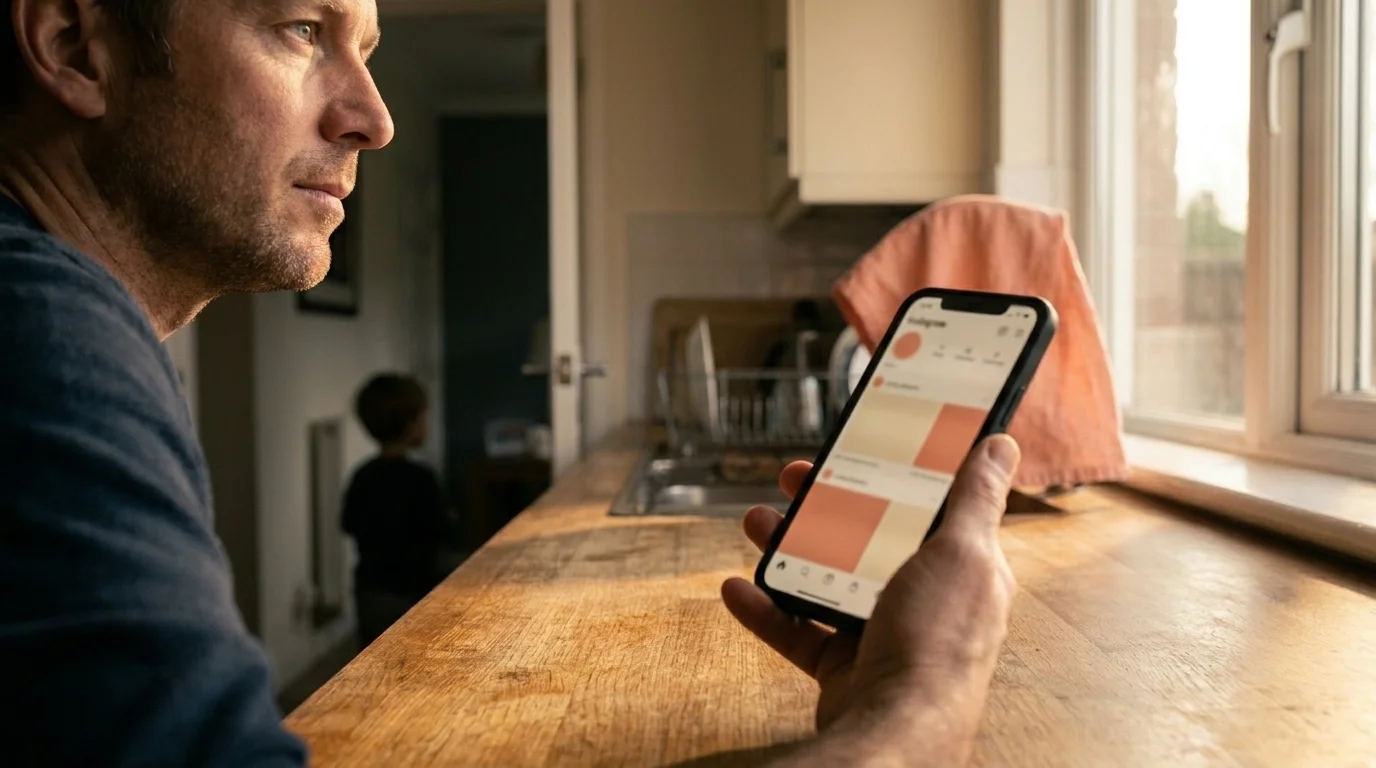
The research on what social media is doing to the inside of a parent's head has, in the last three years, hardened from anecdote into evidence. A 2022 study in Computers in Human Behavior on mothers' exposure to Instagram's "picture-perfect" motherhood found that highly curated content reliably increased envy, state anxiety, and inadequacy, while unfiltered or realistic content increased self-efficacy. A 2025 systematic review in Sage Journals of parenting influencers and a 2025 Frontiers in Communication paper on momfluencers shaping maternal identity converge on the same result. The mechanism is the curation, not the screen per se; the variable that moves the dial is whether the content you scroll past for fifteen minutes is real-shaped or performance-shaped.
The practical translation is not, in my experience, to use social media less. It is to re-curate the feed itself, on the grounds that the algorithm is, in a real sense, doing the comparing for you. The intervention that has worked best in our house has been small and unglamorous. Once a year I sit down and unfollow every account whose posts make me feel — in a way I can name — inadequate. (My test is short and physical: does my chest tighten?) And then I follow three or four accounts of parents whose houses look like mine — laundry on a chair, mismatched cushions, a slightly burnt thing on the counter, a child mid-tantrum. Within two weeks the feed begins to feel different, and so does the eight-o'clock Tuesday. None of this is willpower. None of it requires going off social media. It is a question of what the algorithm is allowed to feed you, which is a question you have more control over than the platforms would like.
A short word, while we are here, on the phrases. There are some sentences I have stopped saying out loud in our house, and the list is shorter and more specific than the toxic-parenting-phrases lists currently circulating on TikTok would suggest. Because I said so is one I rarely use, because it closes a door I almost always want to keep open. You're fine is another, because it overrides a small person's actual report of how they are. If you would just is another, because it almost never produces what comes after it. And the sentences I have started saying, in slow self-correction over a few years, are equally small. I noticed that was hard for you. That came out sharper than I meant it. Let me try that again. The third sentence is, in my experience, the single most useful one in the whole list, and it is the one Tronick's repair concept lives inside.
Mom guilt and parental burnout: the feeling and the syndrome
It is worth being precise about the difference between mom guilt, which is a high-frequency emotional state, and parental burnout, which is a clinically validated syndrome — because the two are often used interchangeably in popular writing and the conflation is unhelpful when one of them turns into the other.
The clinical construct is parental burnout, and the largest study of it I have read is the Roskam/Mikolajczak International Investigation of Parental Burnout (IIPB), which sampled 17,409 parents across 42 countries and was published in Affective Science in 2021. It validates three core dimensions of the syndrome: an exhaustion in the parental role that is qualitatively different from work tiredness, an emotional distancing from one's own children (this is the unsettling one to read in print, and the one that, if you recognise it, is the most diagnostic), and a sense of being an ineffective parent that bears no relationship to whether you are actually being one. Prevalence varies sharply by culture, with individualistic Western countries — the United States, the United Kingdom, Belgium, Poland — showing the highest rates. The same data, extended in a 2023 Springer paper, finds that the cultural variable of individualism predicts burnout more strongly than economic inequality or any individual or family characteristic. The version of the sentence worth holding on to, in plain English, is that our culture is making this harder than other cultures are, and the fact that it is hardest in the most individualistic countries means it is not, in the end, your private failing.
The mom-guilt cluster — high frequency, lower clinical severity, structurally produced — is one of the documented pathways into the burnout cluster, particularly when paired with perfectionism. A 2024 Ohio State University College of Nursing study found a correlation of r = 0.42 between perfectionist parenting expectations and parental burnout. That is not a small number in social-science terms. It tells us something a reader of Winnicott already half-knows: the parents who suffer most from burnout are not the parents who are doing the worst job; they are the parents who are trying hardest to do a job that has been culturally inflated into something no one can do. The 92 per cent of working parents who report burnout in the Maven Clinic data, the 80 per cent who report no organisational support, the roughly 71 per cent of family mental load that mothers in NPR-cited reporting are still carrying — these are the structural facts inside which any individual mother is trying to be enough.
A word, with appropriate seriousness, on the safety floor. Parental burnout in its severe form is associated with elevated risk of depression, suicidal ideation, and harm to children; if you recognise the three Roskam dimensions in yourself — particularly emotional distancing from your own children — the next call is your GP or a mental-health clinician, not another article. In the U.S., the 988 Suicide and Crisis Lifeline is available by call or text at any hour if the thoughts have gone darker than reading material can hold. This is not, in clinical terms, weakness; it is the move that the literature treats as resilience.

Work, parenting, self-care: an honest triage
The phrase work-life balance is one I have, with some reluctance, retired. I have replaced it with the less optimistic but more accurate triage, because what is actually happening in most households I know is a weekly redistribution of attention among three things that genuinely cannot all be fully met. The triage works approximately like this: on any given week, two of the three categories — paid work, parenting presence, your own minimum-viable self-care — can hold reasonably steady, and the third will give. The honest version of self-care, in this register, is not the bubble bath; it is the negotiation that decides which third gives, and the noticing when the third has given for three weeks in a row and one of the other two now needs to give instead.
What this looks like, in plain detail, is a Sunday-night conversation, sometimes alone and sometimes with a partner, that names — out loud — which week is coming and which of the three categories will be the one that breaks. Sometimes the answer is the paid work; the deadline can be re-negotiated, even if it costs something. Sometimes it is the parenting presence; the children survive a week of less-engaged dinners, especially if you tell them what the week is for. Sometimes it has to be the self-care, and the discipline then is short — a week, not a quarter, and a return to the practice the following Sunday. The fantasy is the balance. The practice is the rotation.
For working mothers reading this with a particular intensity, the operational version of the triage — the time-management rituals, the return-from-leave scripts, the mental-load conversation with a partner — sits in the companion piece on motherhood and career balance. What I am describing in this paragraph is the philosophical predecessor of that operational guide. They are designed to be read together.
Why repair, not perfection, is what the child remembers
The honest reason to invest in any of this — not the moral reason, and not the self-care-is-self-love reason — is the one the developmental literature is increasingly clear about. A 2026 longitudinal study in MDPI Children found that parental burnout in early childhood independently predicts toddler behaviour problems, controlling for maternal depression. The clinical translation is that burnout is the active ingredient, not just an artefact of comorbid mood disorder. The English translation is that the parent's nervous system is one of the inputs the child develops inside, and a parent who is in burnout is a parent who is not available to be that input — which the child registers, even when the child does not have the language for it.
What this means in practice is small, repeated, and almost embarrassing in its modesty. The Tronick research's most useful sentence is that what builds secure attachment is the repair, not the rupture-free record. The thing the child internalises is not the seven hundredth bedtime that went smoothly; it is the seven hundred and first, when you snapped at the missing pyjama trousers and then came back, two minutes later, and said I want to try that last bit again, and meant it. The repair is the practice. The repair is the message. The parent who never ruptures the relationship sends no message at all, because the child has no opportunity to learn that the relationship survives the rupture — which is the foundational developmental experience the literature can name.
This is the practical content of the good-enough parent in the digital age. It is not the curated bento box. It is not the matching linen overalls. It is the eight-o'clock Tuesday — the toddler still screaming about the cup, the reading book still in the car, the algorithm still scrolling — and you, the parent, putting the phone face-down on the worktop and saying, let me try that last bit again, and meaning it. The 30 per cent that Tronick measured is the bit you are doing right; the 70 per cent that you are not is, in Winnicott's language, the room in which the child gets to become a person; the repair, said quietly, said again, is the practice the research keeps pointing back to.
Adrienne Rich's "great unwritten story," half a century later, is still mostly unwritten. What the platforms have given us in the meantime is a great deal of curated commentary on the parts that photograph well. The honest version of motherhood — the long middle of it, the bits that do not photograph, the eight-o'clock Tuesdays — is still, mostly, the work of the parents living inside it. Being good enough at that work, in the way the research and Winnicott both meant the phrase, is the most a parent can reasonably do. It is also, the same body of work suggests, exactly enough.
A closing sentence
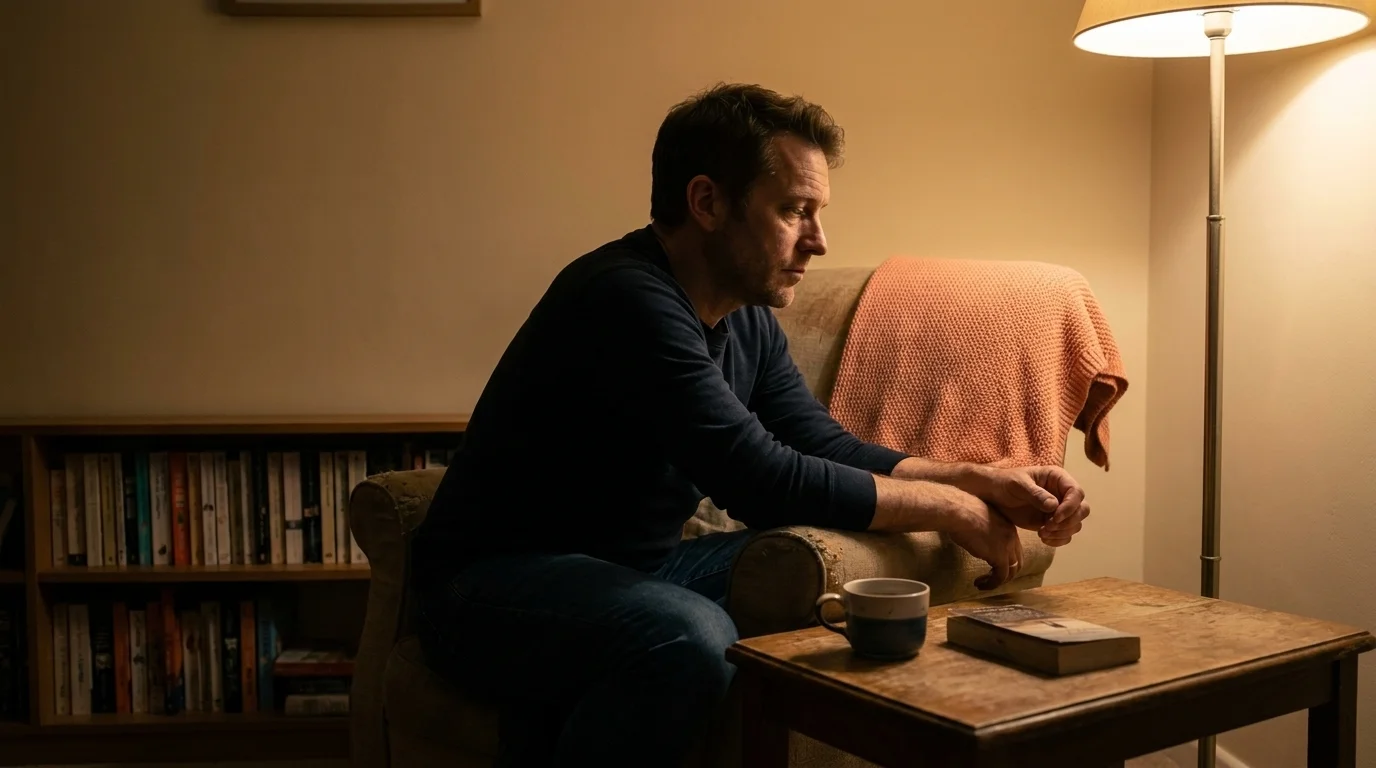
If you arrived at this article because the comparison spiral was acute tonight, the one concrete thing to try is the smallest: put the phone face-down somewhere you cannot see it, walk into the room where your child is, and say one true thing to them out loud. For the operational rules — what to actually set up on the devices, what to say to a fourteen-year-old about a sextortion message, when to file a CyberTipline report — see the companion guide on raising responsible digital citizens. That essay is the rules. This essay was the temperament for living with them.
Frequently Asked Questions
It's a concept from British paediatrician and psychoanalyst Donald Winnicott (1953): a parent who provides consistent warmth and care but does not aim for perfection — and the imperfection itself is what helps a child build resilience. Researcher Ed Tronick later put a number on it. In low-risk caregiver-infant pairs, parents are accurately attuned to their baby roughly 30% of the time; the remaining 70% is misattunement, and what builds secure attachment is the repair after rupture, not flawless attunement.
Mom guilt is a high-frequency emotional state — about 91% of mothers report it, and 72.5% report comparing themselves to other mothers on social media. Parental burnout is a clinically validated syndrome (Roskam et al., 42-country IIPB study in Affective Science, 2021) with three dimensions: exhaustion in the parental role, emotional distancing from your children, and a sense of parental ineffectiveness. Mom guilt is a feeling. Burnout is a syndrome. Sustained, untreated mom guilt — especially when paired with perfectionism (Ohio State 2024 found r = 0.42) — is one of the documented pathways into burnout.
Developmental researcher Ed Tronick found that in low-risk caregiver-infant pairs, parents are accurately in sync with their baby's emotional signals only about 30% of the time. The remaining 70% is misattunement — and what builds secure attachment isn't avoiding the 70%, it's repairing after it. The 30% is the empirical foundation of Winnicott's "good enough parent" idea, and it's the closest thing developmental psychology has given parents to an antidote to the curated Instagram feed.
They share an exhaustion dimension, but parental burnout is distinct. It includes emotional distancing from your own children (work burnout does not), a contrast with the parent you used to be, and direct family-level consequences. A 2026 longitudinal study in MDPI Children found parental burnout in early childhood independently predicts toddler behaviour problems — separately from maternal depression — meaning the burnout itself is the active ingredient, not an artefact of co-occurring mood disorder.
A 2022 study in Computers in Human Behavior found that curated "perfect-mother" content reliably drops your sense of parenting self-efficacy, while unfiltered content raises it. A 2025 Sage review and a 2025 Frontiers paper on momfluencers converge on the same finding. The intervention that works is not to use social media less; it is to re-curate the feed itself. Spend half an hour unfollowing every account whose posts make your chest tighten, then follow three or four accounts of parents whose houses look like yours. Within two weeks the feed begins to feel different, and so does the eight-o'clock-Tuesday spiral. The algorithm is doing the comparing for you; the lever is what you let it feed you.
Check Out These Related Articles

Motherhood

Decoding the Myth of the Natural Maternal Instinct: Insights and Realities
The Growing Trend of Fathers as Caregivers: Redefining Paternal Involvement in Child Rearing