
Embracing the Tapestry of Cultures: Motherhood and Parenting Across Borders


The shape of the comparison
This essay is, in the end, about parenting styles around the world, but it begins at a school gate in Bristol. At the school gate one wet Tuesday, two mothers I do not know are having a conversation about whether their five-year-olds are old enough to walk the half-mile home without an adult. The mothers reach different conclusions, in the polite, deflective way mothers reach different conclusions, and the children — neither of whom is mine — are collected by the appropriate adult on the appropriate timeline. The conversation stays with me longer than it should. The thing the mothers were really arguing about, neither of them saying it, was a question about what counts as a culturally normal level of independence at five.
A great deal of writing about parenting styles around the world treats this question as a tourism exercise. In Japan they let children ride the train alone. In Scandinavia they leave babies in prams outside cafés. In rural Mali, the toddler walks to the neighbour's compound on her own and the village functions as one long open door. All of those sentences are, broadly, true. They are also flattening. The wet Tuesday in Bristol is not less of a culture than any of those places. It is simply harder to see when you are inside it.
There is now reasonably good evidence that what we know in the English-language parenting press about parenting is mostly what we know about a very small slice of the world's parenting. The standard reference point on this is a 2022 review in Developmental Review (now hosted at PMC) that documents the field's WEIRD-sample bias plainly: 64% of participants in cross-cultural parenting research published in Developmental Psychology between 2003 and 2007 were US-based, and a 2015 audit found that cross-cultural samples accounted for less than 8% of the world's children (Cross-Cultural Similarities and Differences in Parenting). Most of the rules of thumb a Western parent absorbs from the parenting shelf are extrapolations from that 8%. This is worth holding in the mind before any sentence beginning in other cultures.
The frame that has been most useful to me in the last few years is Marc Bornstein's distinction between form and function, drawn from his eleven-country maternal-vocalization study across Argentina, Belgium, Brazil, Cameroon, France, Israel, Italy, Japan, Kenya, South Korea, and the United States. The function — a mother making a sound to a baby — is universal. The form the sound takes is local. A Cameroonian mother is doing the same human work as a French one when she vocalises to her infant; the work is recognisable across the eleven cultures, even when the surface differs. The same holds for soothing, teaching, protecting, weaning, sleep, food. The differences between cultures' parenting practices are mostly differences of form, not function. This is a more useful sentence to keep in one's pocket than the tourism kind.
It is also worth noting, before we begin, how culturally specific the things we treat as universal turn out to be. The same PMC review notes that a 24-country UNICEF analysis found country alone accounted for between 11 and 18 percent of the variance in whether parents used non-violent discipline at all — Albania reported that 49 percent of parents used exclusively non-violent methods, Mongolia reported zero — and that 63 countries had legally outlawed all forms of corporal punishment as of August 2021. Sweden was the first, in 1979. The United Kingdom and most of the United States have not. The map of what is normal in a household, on this single question, is redrawn entirely by jurisdiction.
What follows is a slow walk through five regions, none of them flat. I am writing in English, from England, with whatever astigmatism that implies. I have tried to name my sources where I have them. Where the practice is famous and the framing is mine, I have said so.

Japan: amae, and the train at five
The first time someone described amae to me — the Japanese concept that names the legitimate dependence one person can have on another — I felt something that had been mute in my own thinking turn around and speak. The English-language parenting press treats infant attachment seriously and adult attachment occasionally and the long quiet middle between the two as either a problem to be solved (attachment too intense, "enmeshed") or a phase to be moved beyond. Amae sits where the English vocabulary thins out. It is the assumption that one human being can let another carry them, in small ways, every day, without that carrying being either dysfunction or weakness. It runs from infant to mother but it does not stop there.
Japanese parenting, treated as a unit, has a certain literary mythology in the West — the child who rides the Tokyo subway alone at five, the eight-year-old running errands for her grandmother across town, the morning when the whole class cleans the school. The mythology is mostly true. It is also misread when it is treated as the result of an unusually disciplined childhood. The truer reading is that Japanese children move through the city with a low-level confidence because the city has been built and maintained — by adults — as an environment in which a child can be safely seen. The train station has a clerk. The shopkeeper knows the family. The other adults on the platform will, if pressed, intervene. The five-year-old's independence is, in a deep sense, alloparenting wearing a uniform. The child is supervised by the city.
Inside the home, the same logic shows up in the meal. Ichiju-sansai — one soup and three sides — is the modular structure most Japanese home dinners are built on, and what it teaches a child every evening is that a meal is composed rather than declared. A piece of fish or tofu, a small bowl of rice, a vegetable, soup, pickle. The child learns, without being told, that nourishment is balanced and that balance is an achievement of small careful choices, not a virtuous act. This is parenting transmitted through the texture of dinner, which is more or less how most parenting gets transmitted in any culture, if one is patient enough to look at it.
There is a reading of Japanese parenting that emphasises strictness; there is another that emphasises the famous Japanese permissiveness with very young children. Both are right at different ages. What an English parent can take from Japan, watching from across the wet Tuesday at the school gate, is the suggestion that independence is the work of the surrounding adults, not the child's lonely accomplishment. Whether that scales to a culture without ichiju-sansai or amae is a separate question. It is, at least, a question worth asking.
Related Article: Embracing Imperfection: The Art of Realistic Parenting
India: forty days of rest, and a house full of caregivers
Indian motherhood, in the registers I have encountered it — in essays, in friendships, in the long memoiristic conversations English-language mothers tend to have once they recognise each other as people who think — is organised around a different sequence than the British one. The first forty days after birth are, in many regions, formally a period of rest for the mother. The mother does not cook. The mother does not entertain. The mother lies in. Older women in the family — the mother's mother, the husband's mother, the aunt who has done this before — come to the house and run it. The new mother is fed, washed, oiled. The baby is held. The point of the forty days is recovery, not visibility.
The practice has names that vary by region — jaapa in parts of the north, the confinement period more generally — and it has a specific set of associated rituals: warm sesame-oil massage (malish) for both mother and infant, dietary regimens that favour warming foods and forbid cold ones, restrictions on outside visitors. A British or American mother reading this for the first time often feels two things at once: a tug of recognition that this is what postnatal recovery would actually look like if we treated childbirth as the physiological event it is, and a defensive wince at the patriarchal weight of being confined. Both reactions are accurate. The practice does carry the weight of the structures it grew up inside. It is also, materially, a system in which the new mother is not left alone in a flat with a baby and a kettle at three in the afternoon, which is the standard experience of a British or American postnatal mother in 2026.
The longer arc of Indian motherhood — into the years the child is small, then school-age — is shaped by the joint family more than by any single parenting style. A child grows up with grandparents in the house or near it, with aunts and uncles who are co-disciplinary figures, with cousins who function as siblings. Psychology Today's discussion of Indian parenting frames the same observation: independence in the Western sense is not the developmental goal; interdependence, a self that is fluently in relation to its kin, is (Parenting Across Cultures, Psychology Today). The "strictness" English-language press often projects on to Indian families is, in the households I have known, more accurately read as a density of relationship. There are more adults present. There are more eyes. There are also, very often, more hands.
What a Bristol mother can hold from this is not a practice to copy. The forty days require an extended family that most of us no longer have within walking distance. The longer arc requires a housing arrangement most of us cannot configure. What can travel, perhaps, is the question of whether postpartum recovery should be planned for as an event with named participants, rather than improvised around the absence of them.

Scandinavia: the pram outside, and the play-based seven
The most-circulated single image of Scandinavian parenting in the English-language press is the pram parked outside the café in winter, the baby inside it, the mother visible through the glass having her coffee. The image is real. Nordic parents have, for generations, considered cold-air sleep to be beneficial for infants — fresh air, deeper sleep, better appetite afterwards. The custom does not survive every translation; in colder British cities it tends to read as either negligence or showmanship, partly because in Britain we have not built the dense social infrastructure that makes a pram outside a café a low-risk proposition. (Someone is watching. Someone always says, if a stranger gets too close, that's not your pram.)
But the deeper logic of Scandinavian parenting is not the pram. It is the long postponement of formal academic schooling. Finnish children start formal school at seven, and the years before that are organised around play, outdoor time, and what the Norwegians call friluftsliv — life outdoors as a value in itself. Finland's well-known transformation from one of the lower-ranked OECD education systems in the 1970s to a top-ranked one by the 2000s happened despite, not because of, the late start (6 Parenting Styles from Other Countries, Care.com). What seems to matter is the assumption underneath the late start: that a child of three or four does not need to be schooled into reading at the cost of being a child.
The other anchor of Scandinavian parenting is hygge — the Danish word for the kind of low-key conviviality that turns a winter evening into a household practice. It is often softened, in English-language press, into a lifestyle category. Inside a household it is more functional than that: it is the structural practice of slowing the family's pace in the dark months, of choosing candle and book and slow soup over external activity, of letting children be bored at home until they invent something. The hygge winter is the play-based seven's parent. The two practices are continuous with each other.
I want to be honest that what makes Scandinavian parenting work, at scale, is paid parental leave, subsidised childcare, and a society with a low Gini coefficient. The PMC review notes that the United States is the only OECD high-income country without paid parental leave. The pram outside the café is not, in the end, a parenting choice. It is a parenting choice that has been resourced by a welfare state. A British mother who reads the lifestyle press and concludes that she should leave her own pram on the pavement is being told, accidentally, that she should imitate the leaf without growing the tree.
Sub-Saharan Africa: the carried infant, and alloparenting
Sarah Hrdy, in Mothers and Others, gave the word alloparenting its modern weight. The term names the human practice — by some measures, the human norm — of distributing infant and child care across many adults other than the biological mother. The mother carries the infant most of the time, and so does the aunt, and so do the grandmother and the older cousin and the neighbour and the older sibling. The infant is rarely set down. Skin-to-skin contact is high: in !Kung hunter-gatherer communities, ethnographers have documented approximately 90 percent infant skin-to-skin contact, against a Western norm of largely solitary infant sleeping (PMC8940605). The infant grows up registering the bodies of many caregivers as safe.
What the alloparenting frame upends, when read against the WEIRD parenting press, is the assumption that primary maternal attachment is the only attachment that protects. The literature on alloparenting suggests that infants distributed across multiple stable caregivers form multiple stable attachments and are no less secure for it — possibly more so. This is not an argument for nurseries staffed by strangers; the strength of alloparenting is known caregivers, knit into a fabric of long relationship. It is an argument against the model in which a single mother in a flat is treated, by both her own internal voice and the surrounding culture, as the necessary and sufficient source of an infant's emotional safety.
The political reading of this should be obvious. The countries with the most robust alloparenting networks tend to be ones in which a great deal of women's economic and political capacity has historically been suppressed; the carried infant is part of an arrangement that also includes constrained female mobility. The cultural form is not separable from the political form. What might travel — and this has been the project of various sociologists and policy writers since Hrdy — is the question of whether modern Western societies can engineer alloparenting deliberately, through paid parental leave, extended-family housing subsidies, co-op nurseries, and the unfashionable old practice of living near one's mother. Some can, and have. The British nuclear-family-in-a-postcode arrangement, with grandparents two trains away and no friends within pram-pushing distance, is a recent invention; it is not, as far as the species is concerned, the default.
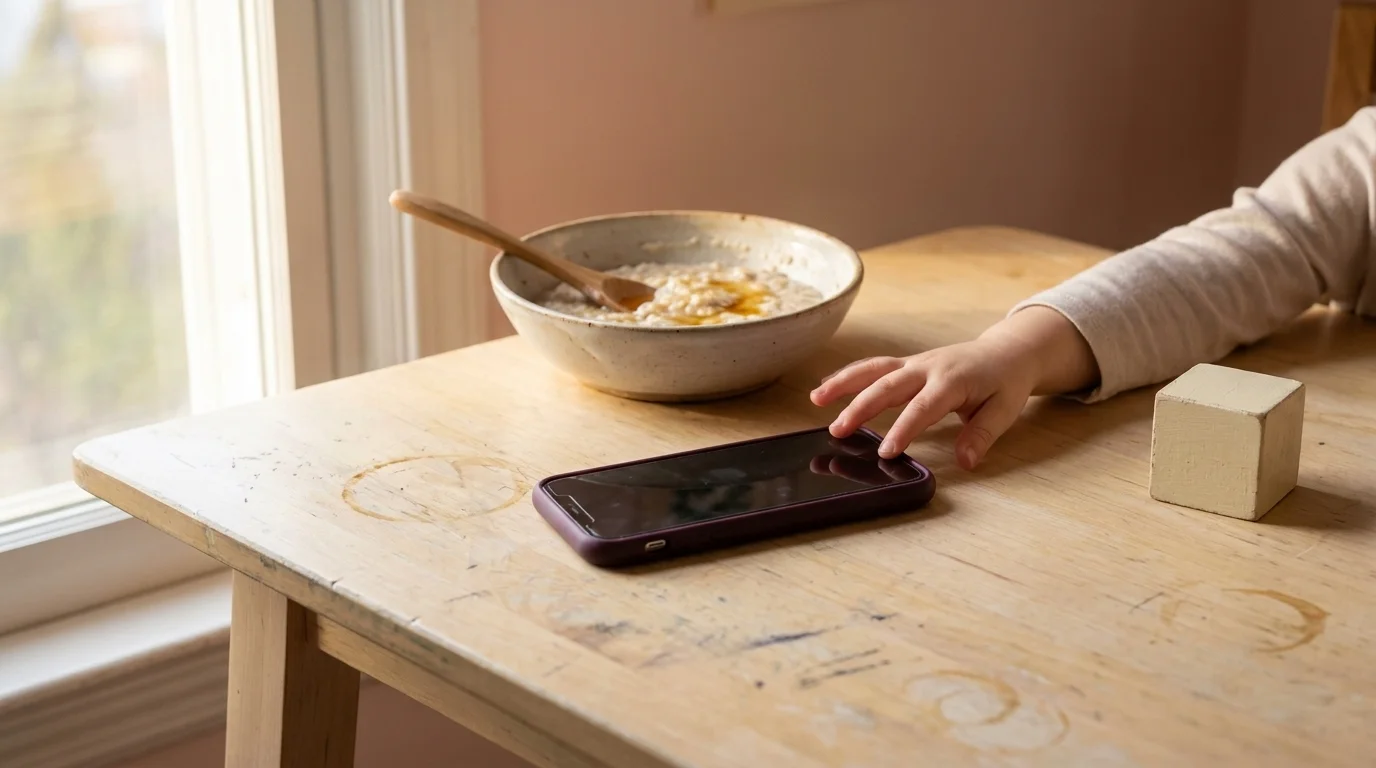
The screen, in every house
What every recent cross-cultural parenting review treats as the new variable in the equation — the variable for which we have, as yet, no settled cultural form — is the screen. A 2025 bibliometric analysis of the last five years of parenting research identifies digital parenting, emotion regulation, and parental stress as the three fastest-growing themes across the discipline (Bibliometric Analysis of Global Trends in Parenting). It is, plausibly, the first parenting question in human history that has arrived in every culture at roughly the same time, with the same hardware, and almost no inherited wisdom about how to handle it.
The cultural form has not had time to settle, and the comparative observation that turns up across regions is broadly consistent: parents everywhere are mostly improvising, mostly anxious, and mostly worried that other parents are getting it more right. The Japanese mother is not, contra the older stereotype, mysteriously immune to screen-time arguments. The Indian grandmother, asked, is generally the family member most concerned about the seven-year-old's relationship to YouTube. The Scandinavian play-based seven still wants the iPad. The cross-cultural parenting question of 2026 is, in one sense, simpler than the older questions: every culture is in the same negotiation with the same machine.
What changes, region by region, is not the worry. It is the social technology brought to bear on the worry. Japanese parents have school-mediated norms about device curfews. Indian joint families have grandparents who will, with no apology, take the phone away. Scandinavian schools have, at policy level, removed personal devices from the classroom. The British and American household tends to negotiate with the screen alone, which is the hardest position to negotiate from. Here, again, the form is local and the function is universal: every parent in every culture is trying to protect a child's attention from an attention-economy that does not have the child's interests at heart. The mothers at the wet Tuesday school gate, had they thought to ask each other, would have agreed on this faster than on anything else.
A sentence to close on
Denise Riley, who wrote about motherhood with a precision the English-language parenting press has mostly failed to inherit, observed that the mother's interior life is the part of the cultural conversation we keep losing track of. The parenting-styles-around-the-world genre, of which this essay is a partial and self-aware instance, can become a way of avoiding that interior — a way of staying tourism-distant from the question of what one is actually doing with one's own child on one's own wet Tuesday.
The use of the comparison, I think, is the opposite. To read across cultures is to be reminded that one's own arrangement — the nuclear family, the postcoded grandparents, the smartphone on the kitchen table, the half-mile walk from school that two mothers stood at the gate disagreeing about — is one arrangement among many possible ones. Some of the alternatives are better resourced. Some are worse. Most are differently resourced. None is the default the species was designed for, which means the choices the British or American mother is making in her own household are choices, not facts. The most useful thing the comparison gives back, in the end, is the freedom of having seen that one is choosing.
The mothers at the school gate would have collected their five-year-olds either way. What changes, if anything changes, is whether the next time they meet, the conversation can be a little less defensive about the choice — and a little more curious about why it felt, in the moment, like the only one available.
Frequently Asked Questions
No single style is universally best. Marc Bornstein's research across eleven countries — Argentina, Belgium, Brazil, Cameroon, France, Israel, Italy, Japan, Kenya, South Korea, and the United States — found that the same parental functions (comforting, teaching, protecting, feeding) take very different forms by culture while serving consistent functions. What matters is alignment with the surrounding cultural and material context, and resources to support the chosen form.
Japanese parenting tends to emphasise amae — the legitimate dependence one person can have on another — alongside group harmony and a low-key permissiveness with very young children that gradually becomes a quiet expectation of competence (Japanese five-year-olds famously run small errands and ride public transit alone). American parenting skews more individualistic, with greater emphasis on verbal self-expression, scheduled enrichment, and adult supervision well past the age at which Japanese cities expect a child to navigate independently. The Japanese arrangement is supported by infrastructure: dense neighbourhoods, watched train stations, and shopkeepers who know the family.
In many Indian regions the first forty days after birth are a formal recovery period for the mother — known as jaapa or the confinement period — during which she does not cook or entertain and older female relatives run the household. Warm sesame-oil massage (malish) is given to both mother and infant, dietary restrictions favour warming foods, and outside visitors are limited. The longer arc of Indian parenting is shaped by the joint family more than any single style: independence in the Western sense is not the developmental goal — interdependence, a self that is fluently in relation to its kin, is.
The biggest concept is alloparenting — a term the anthropologist Sarah Hrdy used in Mothers and Others to name shared caregiving by grandparents, aunts, older siblings, and known community members. The literature suggests infants distributed across multiple stable, known caregivers form multiple stable attachments and are no less secure for it. Modern Western adaptations include paid parental leave, co-op or extended-family daycare arrangements, multi-generational households, and the unfashionable old practice of living near one's mother. The cultural form is not separable from the political form — and the form is hard to import without importing some of the resourcing that grew it.
A 2022 review hosted at PubMed Central documents that 64% of participants in cross-cultural parenting research published in Developmental Psychology between 2003 and 2007 were US-based, and a 2015 audit found that cross-cultural samples represented less than 8% of the world's children. Most of the rules of thumb a Western parent absorbs from English-language parenting press are extrapolations from that small slice. Reading parenting practices across cultures is, in part, a corrective to a research base that has historically over-represented one kind of household.
A 2025 bibliometric analysis of recent parenting research identifies digital parenting, emotion regulation, and parental stress as the three fastest-growing themes across the discipline. The cultural form has not had time to settle, and the comparative observation across regions is consistent: parents everywhere are mostly improvising and mostly anxious. What changes by region is not the worry but the social technology brought to bear on it — Japanese school-mediated device curfews, Indian grandparents who will simply take the phone away, Scandinavian classroom-level device removal, against the British or American household that tends to negotiate with the screen alone.
Check Out These Related Articles
Motherhood

Decoding the Myth of the Natural Maternal Instinct: Insights and Realities
The Growing Trend of Fathers as Caregivers: Redefining Paternal Involvement in Child Rearing