
Cognitive Development in Early Childhood


The question arrives, most often, somewhere near eleven at night — after the child is finally down, after the dishes, when a parent is half-scrolling a phone: is my three-year-old on track? Cognitive development in early childhood is the machinery underneath that question: the rapid growth of thinking, memory, attention, language, and problem-solving that unfolds from birth through about age eight. It moves faster in these years than at any later point in a human life. A young child's brain forms more than a million new neural connections every second, and roughly 90 percent of brain growth happens by age five.
Here is the ground I want to cover, in order: what cognitive development actually is, what Piaget got right and what current research has since qualified, what the milestones look like under the recently updated CDC checklists, what all of it looks like at your own kitchen table, and how to support it without turning play into drills. One thing first, because it matters more than anything that follows: this is a guide to understanding, not a checklist to panic over. Milestones describe ranges, not a test a child passes or fails.
What Is Cognitive Development in Early Childhood?
Cognitive development in early childhood is the growth of the mental tools a child uses to make sense of the world — memory, attention, language, and problem-solving — from birth through roughly age eight. That is the one-sentence version, and it is worth holding onto, because the fuller picture has four moving parts that develop together rather than in a tidy line: memory (holding and retrieving information), attention (choosing what to focus on and staying with it), language (the words that let thought get organized), and symbolic thinking (the leap that lets a wooden block stand in for a phone).
The framing I'd ask you to keep is this: young children are not passive sponges soaking up facts. They are small, relentless meaning-makers — testing what happens when the cup goes over the edge of the highchair for the ninth time, revising the theory, testing again. Most of what looks like ordinary child development is exactly this: a child running experiments you didn't assign. Cognition is the strand of that story concerned with how they think, not just what they feel or how they move.
Piaget's Stages — and What Modern Research Adds
Jean Piaget's four stages remain the scaffolding almost every account of childhood thinking is built on: sensorimotor (birth–2), preoperational (2–7), concrete operational (7–11), and formal operational (11 and up). Early childhood lives in the first two, so those are the ones worth knowing well.
In the sensorimotor stage, the headline achievement is object permanence — the understanding that a toy still exists after it disappears under a blanket. In the preoperational stage, symbolic thinking blooms (a banana becomes a telephone) alongside what Piaget called egocentrism: the young child's difficulty holding a viewpoint other than their own.
Here is where I'd add the part most guides leave out. Piaget's stage boundaries have held up less cleanly than his reputation suggests. As the developmental review at Simply Psychology lays out, modern theory-of-mind research finds that children overcome egocentrism earlier and more gradually than his stages imply — on tasks tied to their real-world experience, even three-year-olds show flashes of genuine perspective-taking, and the ability arrives task by task rather than switching on all at once. This does not demote Piaget; it updates him. He gave us the map. The decades of research since have been redrawing the borders.
Related Article: Cultivating Resilience in Children: Building Emotional Strength
Cognitive Milestones by Age (2–6) — Under the 2022 CDC Checklists
Before the ages, the change almost no one is talking about. In 2022, a panel convened by the CDC and the American Academy of Pediatrics revised the "Learn the Signs. Act Early." milestone checklists for the first time since 2004, publishing the new criteria in Pediatrics. Two shifts matter for a parent. First, the checklists added 15- and 30-month checkpoints and stripped out vague qualifiers like "may," so each item now names a skill most children that age genuinely have. Second — and this is the substantive one — a milestone now marks the age by which about 75 percent of children reach a skill, not the old 50th-percentile mark. A 50-word vocabulary, for instance, moved from the 24-month list to the 30-month one.
Why does that matter? Because the deliberate intent was to end the "wait and see" reflex. If a milestone describes what most children can already do, a child who hasn't reached it is a clearer prompt to check in — not a reason to worry silently for another six months. It is a lower bar to act, not a higher bar to pass.
Age 2
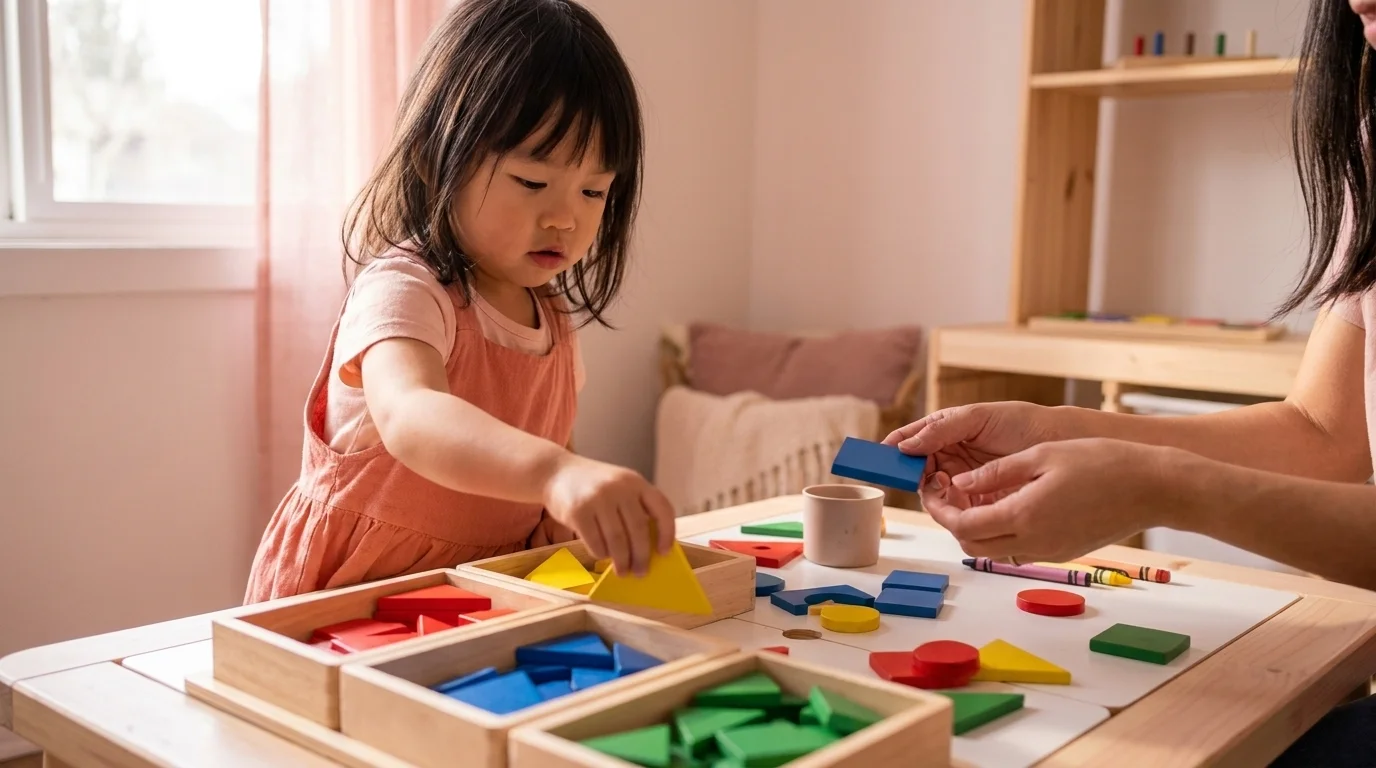
Around age two, many children find objects hidden under two or three covers, begin to sort shapes and colors, and play simple make-believe.
Related Article: Beyond Academics: Fostering Creativity in Children
Age 3
By three, a child often draws a circle when shown how, avoids a hot stove when warned, and can name the action in a picture — "running," "eating."
Age 4–5
Between four and five, many children name a few colors and numbers, understand the idea of counting, and begin to grasp time — yesterday, later, after nap.
What Cognitive Development Looks Like at Home (Real Examples)
Milestones are written in clinical shorthand, which is why they can feel abstract until you catch one happening. Here is what the same items look like at the kitchen table.
Finds objects hidden under two or three covers is your two-year-old lifting the couch cushion, then the blanket, then the laundry basket, hunting a ball you tucked away — memory working alongside the confidence that the ball still exists when she can't see it. Simple make-believe is the banana held to the ear as a phone, or the block driven across the floor with a "vroom." By three, naming the action in a picture is your child studying a photo and announcing "he's eating!" — a quiet triumph of language layered onto attention. And the four-year-old counting out five grapes, one finger to each, and landing on five, is early number sense doing its work.
None of this looks like studying. That is the point, and it is the part I most want parents to hear: the developmental work of early childhood is camouflaged as ordinary play. A child narrating a tea party for stuffed animals is running memory, sequencing, language, and social reasoning all at once. You are not missing a curriculum window. You are watching the curriculum.

Core Cognitive Skills & Executive Function
Underneath the milestones sit a handful of core skills that show up on nearly every "cognitive skills" list: attention, working memory, reasoning, language processing, and processing speed. Individually they are useful. Together, over the early years, they braid into something researchers call executive function — the mental control system that lets a person plan, hold instructions in mind, resist the first impulse, and juggle more than one task at a time.
The framing I find most honest comes from the Harvard Center on the Developing Child: children are not born with executive-function skills — they are born with the potential to develop them, and that potential is built through use. It is worth setting expectations honestly on the timeline, too. According to HealthyChildren.org, the American Academy of Pediatrics' parent site, it is not until around age three that children can reliably categorize, reason, and problem-solve — and even then they stay better at recognition than recall, which is why a three-year-old can point to the right answer long before they can produce it on demand. These skills are the foundation school will later stand on, which is exactly why they are worth protecting from being rushed.
Why Cognitive Development Matters
The stakes are easy to state and easy to overstate, so let me do both carefully. The early years are a stretch of genuine biological intensity: more than a million neural connections form every second, and roughly 90 percent of brain growth is complete by age five. Early language exposure tracks with vocabulary, too — children who are talked to frequently know about 300 more words by age two than children who are not.
Here is the caveat I never skip: those last two things travel together, and that is not the same as one causing the other. Talking to your child almost certainly helps; it also tends to come bundled with everything else a language-rich home provides, and untangling the single lever from the bundle is more than the data can do. The honest read is that responsive interaction matters — not that any one number is a dial you turn. And the frame that follows is a window, not a deadline. These years are unusually fertile, which is an invitation to show up, not a countdown to race against.
Activities to Support Cognitive Development (Ages 3–5)
The good news for tired parents is that a great deal of what helps costs nothing and looks like play. The mechanism underneath it has a name — the Harvard Center on the Developing Child calls it serve and return: a child does or says something, an adult responds in kind, and the back-and-forth itself is what wires the circuitry. You are not delivering content. You are keeping a rally going.
A handful of low-prep options for the 3–5 range:
- Pretend play with real narration — follow her story ("the bear is going to the doctor?") instead of steering it.
- Sorting and matching games — socks by color, coins by size, toys by "things that roll."
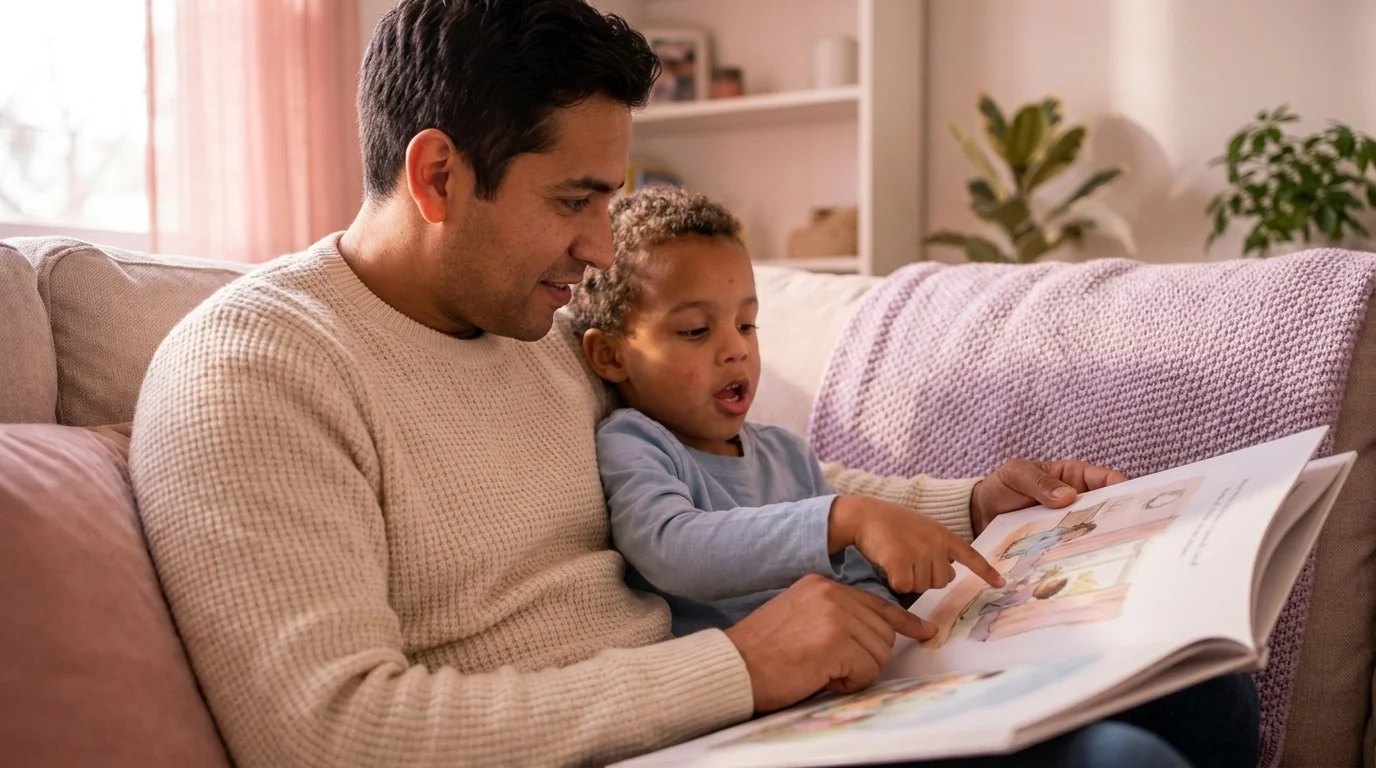
- Reading together, then off-book — pause and ask what happens next before you turn the page.
- Open-ended questions — "why do you think the ice melted?" beats "what color is this?"
- Cooking with a job — counting scoops, naming the steps in order.
- Simple memory and hiding games — the old cup-and-ball, or "what's missing from the tray?"
Move it outdoors when you can; a change of setting is its own kind of input, and our roundup of seasonal activity ideas for kids leans on exactly this. The rule of thumb: talk with, not at, and let the child's curiosity set the direction.
When to Be Concerned — Talking to Your Pediatrician
For all the reassurance above, there is a real signal worth naming, and this is the part of my old clinical work I care most about getting right. The CDC's guidance is direct: if your child is not meeting one or more milestones, has lost skills they once had, or you simply have concerns, talk with your child's doctor and ask about developmental screening. Losing a skill — words or play a child used to have and no longer does — is the one that most warrants a prompt call.
Two things I told parents in the clinic and will tell you here. First, a milestone checklist is a prompt for a conversation, not a verdict; a child who is behind on one item is showing you where to look, not receiving a diagnosis. Second — and this is the practical part most people don't know — you do not need a diagnosis, or even a firmly formed worry, to ask. In my clinical experience, parents routinely overestimate the threshold for reaching out: in the practices I worked in, families could generally request a developmental screening or an early-intervention evaluation directly, on a hunch, without waiting for anyone to refer them. The exact route varies by state, so check how it works where you live. The whole point of the 2022 "act early" revision was to make asking earlier the normal, low-drama thing to do. Most of the variation you will see is exactly that — variation. A screening is simply how you find out.
Cognitive development in early childhood is, in the end, a story of astonishing growth that mostly refuses to announce itself — a million connections a second, hidden inside a game of peekaboo. Your job is not to drill it. It is to notice it, talk, play, respond, and keep the rally going. Understand the stages, hold the updated milestones loosely, watch for the real-home signs, support with ordinary play, and reach out to your pediatrician if something feels off — early, and without apology. For age-by-age follow-ups as your child grows, our child development library picks up where this leaves off.
Frequently Asked Questions
Piaget's four stages are sensorimotor (birth–2), preoperational (2–7), concrete operational (7–11), and formal operational (11 and up). Early childhood spans the first two.
Rapid growth in memory, attention, language, problem-solving, and symbolic (pretend) thinking, alongside roughly 90 percent of brain growth by age five.
Attention, working memory, logic and reasoning, auditory and visual processing, and processing speed — the core skills that braid into the executive-function foundation built in early childhood.
That children actively build understanding in four stages through interaction with their world — though modern theory-of-mind research shows some skills, like perspective-taking, emerge earlier and more gradually than Piaget proposed.
A 3-year-old naming the action in a picture ("running," "eating"), or a toddler finding a toy hidden under two covers — everyday signs of memory and symbolic thinking.
If your child misses milestones for their age, loses skills they once had, or you have concerns, talk with your pediatrician and ask about developmental screening. In the U.S. you can request one on a hunch — no diagnosis needed — which is exactly what the CDC's "act early" update is meant to encourage.
Check Out These Related Articles

Tomorrow’s Playdate Hosts: The Rise of Interactive AI Toys in Child Development

Busting Myths About "Spoiling" Your Child: Developmental Experts Speak Out

Unveiling the Secrets of Neuroplasticity in Child Development