
Family Friendly


On a wet Saturday last winter I did the exact thing I tell other fathers not to do: I handed my youngest the tablet and called it "just an hour." What I actually wanted, sitting there, was a short list of family friendly activities to reach for when the weather closed in and my own imagination had gone flat. This is that list — fifty of them — and it is also a small argument about why an afternoon that's genuinely family friendly is worth the trouble. American families now average just over six hours of quality time a week, and the single most common thing we do with it is sit and watch something together (Backyard Oasis, 2024). Our kids, meanwhile, log around twenty-one hours of screen time a week against the nine their parents say they'd prefer (Lurie Children's, 2025). None of what follows is complicated or expensive. It just has to invite everyone in — indoor, outdoor, at home, free, and sorted by age, each idea chosen for what it does for a child and not only for the hour it fills.
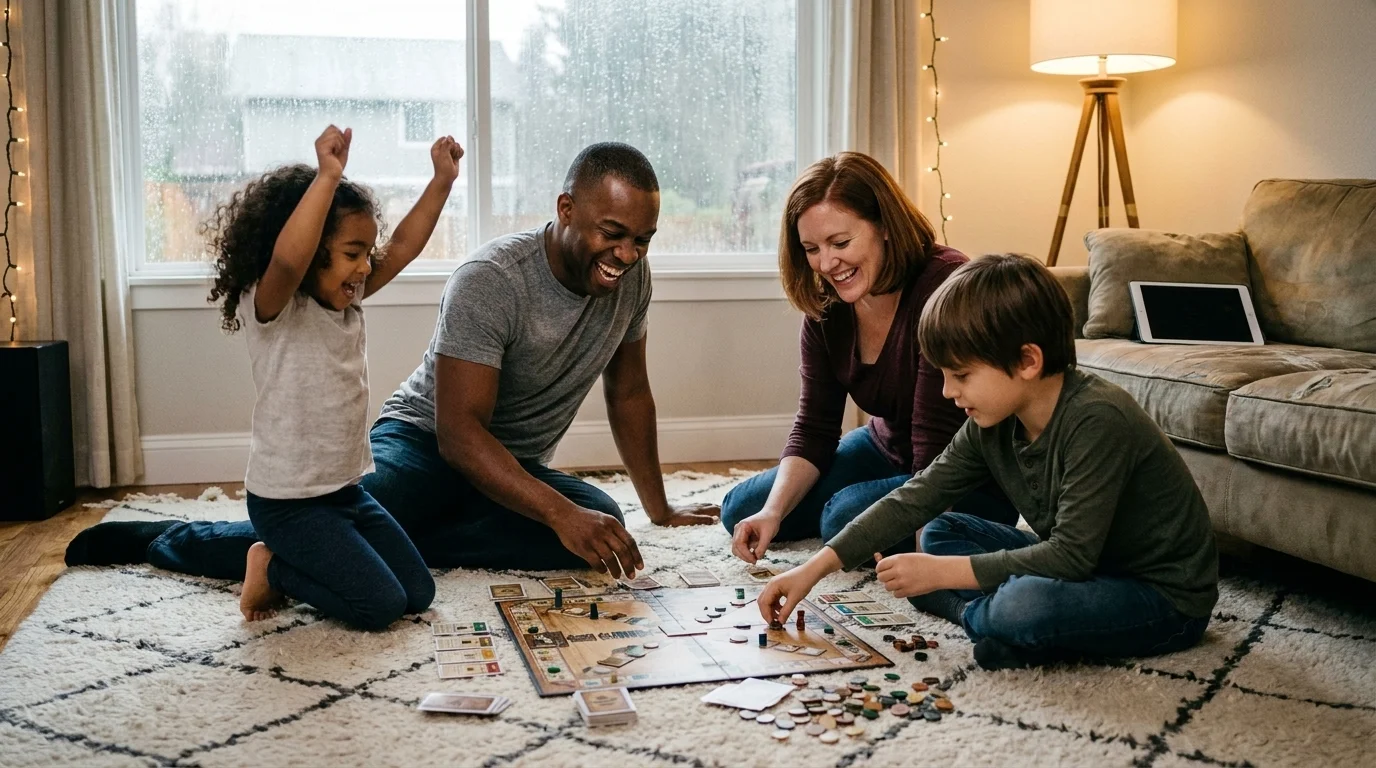
What Counts as a Family-Friendly Activity?
A family-friendly activity is any shared thing people of different ages can do safely together and that invites everyone to take part, rather than sit side by side watching separately.
That last clause is the whole test. Six people each on their own screen in the same room is proximity, not participation. The activity doesn't have to be wholesome in a greeting-card way, and it certainly doesn't have to cost anything. It has to have a place for the toddler and a place for the teenager, and a reason for the grown-ups to stay in the room instead of drifting to the kitchen to answer email. What qualifies, in practice:
- A board-game or card night everyone can play or referee
- A backyard or park scavenger hunt
- Cooking or baking something together, with real tasks handed out by age
- A library visit, a walk, a build-a-fort afternoon
What doesn't: everyone on separate devices, or one parent "supervising" from behind a phone. Everything below is sorted three ways — by setting, by age, and by cost — because those are the three questions that actually decide what you'll do this afternoon. If you want more in this vein, our family activities section is the deeper well.
Why Family Activities Matter More Than Ever
Because the default has quietly changed, and not in our favour. A generation ago the competition for a child's attention on a Saturday was boredom. Now it's a device engineered by people far smarter than me to be more interesting than I am. Nearly half of parents say they lean on screens every day just to get through (Lurie Children's, 2025), and I'm not going to stand over anyone for that — I've done it, on the wet Saturday above and plenty of others. But the research on what fills the gap when we don't is hard to look away from.
The American Academy of Pediatrics now talks about play the way it talks about vegetables and sleep. In its Power of Play report, lead author Dr. Michael Yogman writes that play "can improve children's abilities to plan, organize, get along with others and regulate emotions." The AAP's clinical report goes further, describing shared play as a way to build "executive function and a prosocial brain," and now encourages pediatricians to write, in its phrase, "a prescription for play." Dr. Alyssa Cohen at Lurie Children's puts the practical version plainly: "Quality time with family helps children thrive. We recommend designating screen-free times or home areas, such as mealtime."
Here is the part I keep turning over. I grew up among Irish men — my father, my grandfather in Cork — who were present in the sense of being in the house and largely absent in the sense of being in the room. The script I inherited was that a father provides the afternoon and watches it from the doorway. What the research describes isn't a nicer version of that. It's a different job: participant, not supervisor. That's why every idea below is tagged by age and by what it actually gives a child — "do something together" is only useful once you know what the something is for.
Indoor & Rainy-Day Family Activities
What can families do indoors on a rainy day? Build something, make something, or turn the living room into a small arena — the trick is to give the day a shape so nobody defaults to a screen out of sheer inertia.
The wet Saturday that started this piece ended, once I'd put the tablet away, with a fort that took over the entire lounge and survived until Tuesday. A rainy day at home isn't a problem to be managed; it's a blank afternoon, which is a rarer and better thing than we admit. Ideas, roughly youngest to oldest:
- Living-room fort or den — blankets, a clothes-horse, every cushion in the house (toddlers up; they'll defend it for hours)
- Indoor scavenger hunt — a written or picture list of things to find (picture clues for pre-readers, riddles for school-age)
- Baking something start to finish — toddlers stir, school-age measure, teens run the recipe
- Board-game or card tournament — a bracket on the fridge turns one game into an afternoon
- Freeze-dance or the-floor-is-lava — pure sweat-it-out energy for the under-eights
- A make-and-mend craft session — cardboard, tape, whatever's in the recycling
- Simple kitchen science — a bicarb volcano, a glass of water and food colouring
- Reading aloud in a heap — the most underrated rainy hour there is
Match the ambition to the age and you'll rarely need the screen you reached for out of habit.
Outdoor & Nature Family Activities
What are good outdoor activities for families? Anything that gets everyone moving in the same direction — a walk with a purpose beats a walk without one, and kids will forgive almost any weather if there's a mission attached.
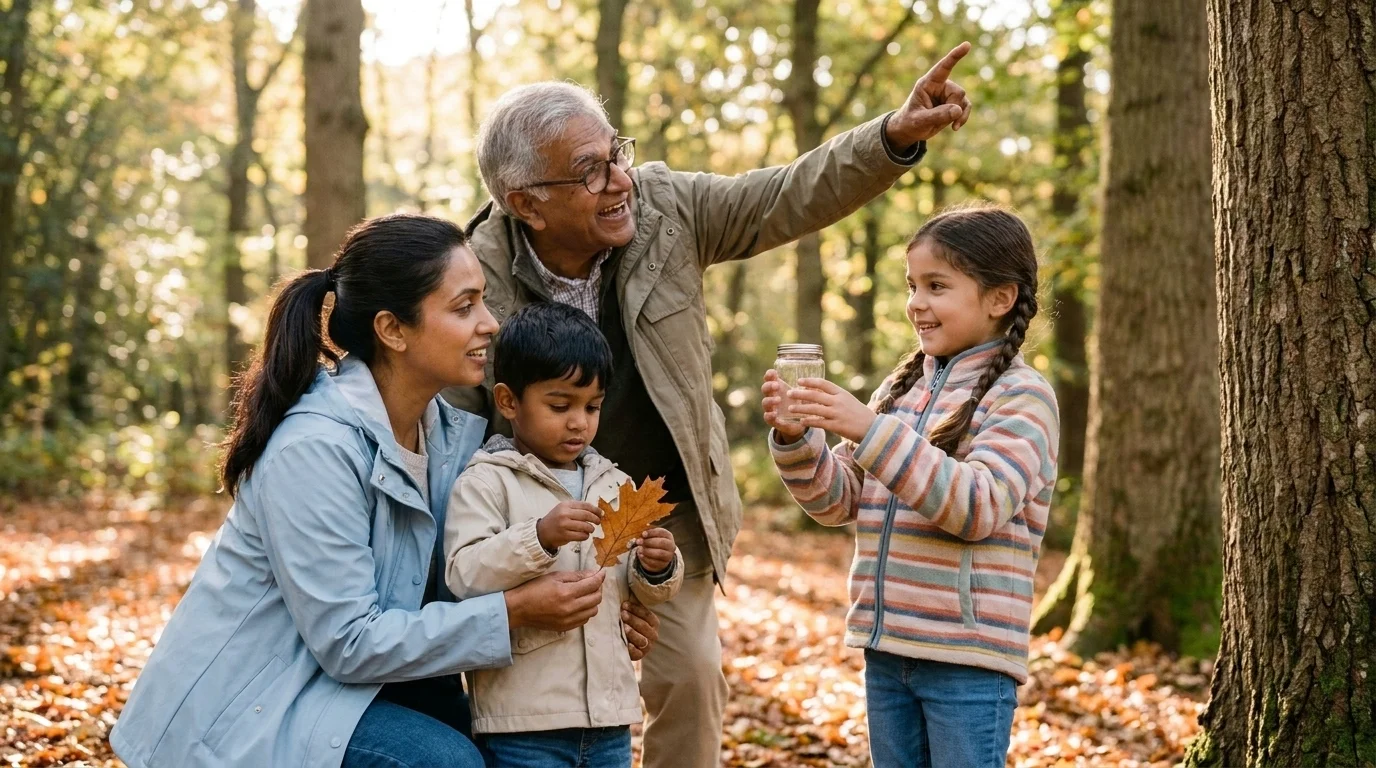
- Nature scavenger hunt — a made-up list (a red leaf, a smooth stone, a bird you can name)
- A proper hike, scaled to the shortest legs — turnaround snacks are non-negotiable
- Backyard camping — a tent in the garden is ninety per cent of the magic at ten per cent of the effort
- Park picnic with a game — a frisbee, a ball, a deck of cards
- Bike rides or scooter loops — around the block for the little ones, further for the bigger
- Gardening a single pot or bed — planting, watering, the long wait, the payoff
- Stargazing — one app, a blanket, staying up past bedtime as the whole point
- Geocaching — a real-world treasure hunt the teenagers will pretend not to enjoy
Outdoor play is seasonal by nature — the same family does hikes in October and sprinkler-tag in July — so treat this as a rotating menu rather than a fixed one; our guide to spring activities for kids picks up the warmer end. And the walking-and-noticing isn't filler: naming what you see and telling the story of where you're going is exactly the kind of shared attention that makes these afternoons worth more than the step count.
At-Home Family Activities
What can families do together at home, once the fort's been built and the weather's beside the point? Cook, read, make, and turn ordinary evenings into something with a small ritual attached.

- Cook or bake a meal together — one real task each, plated and eaten as the reward
- Family movie night with a twist — themed snacks, a vote, subtitles on for a spelling game
- A DIY craft or building project — a cardboard city, friendship bracelets, a repair you've put off
- Reading aloud or story-time — one book, one voice, everyone else horizontal
- Puzzle nights — a jigsaw left out on a side table, added to in passing all week
- Indoor gardening — herbs on a windowsill, a bean in a jar for the small ones
- Family journaling or a scrapbook — a shared page about the week, drawings allowed
I'd single out that fourth one. A 2025 peer-reviewed study in Children & Society found that reading to children and telling or singing them stories were among the strongest predictors of positive social-emotional development in young kids — boys and girls alike. It costs nothing, needs no clean-up, and is the activity a tired parent can still manage at the end of the long shift. If you do one thing on this whole list, do that one.
Free & Budget-Friendly Family Activities
What can families do together for free? More than the ad-heavy corners of the internet would have you believe — and with grocery and outing costs where they are, "free" has stopped being a compromise and started being the point.
The screen-free afternoon and the free afternoon turn out to be the same afternoon more often than not. Almost nothing here needs a ticket:
- Library story times and events — free, weekly, and quietly excellent almost everywhere
- Parks and playgrounds — the original free entertainment
- Nature walks and trails — see the outdoor section; the entry fee is a pair of shoes
- Backyard or living-room camping — no campsite booking required
- At-home movie or game nights — you already own the gear
- Free community festivals and outdoor concerts — check the town or city calendar
- Museum and gallery free days — most have one; a few are always free
- A "yes afternoon" — the kids plan it, within reason, and it usually costs nothing
There's a quiet relief in discovering that the best of this doesn't come with a price tag. The pressure to buy the experience — the paid play centre, the theme park — is real, and it's largely manufactured. A scavenger hunt in your own street isn't a lesser version of a family day out. Some weeks it's the better one.
Family Activities by Age — Toddler, School-Age & Teen
How do you pick activities for your child's age? Match the challenge to the stage — enough to stretch them, not so much that it tips into frustration — and lean on what each age is actually built to practise. This is the dimension the destination guides skip, and it's the one that most changes whether an afternoon works.
Toddlers (1-3)
At this age the activity is the sensation. Sensory play — water, sand, dough — plus simple hide-and-seek, stacking and knocking down, and board books read on repeat. Toddlers aren't playing to win or to finish; they're playing to feel the world's edges. Keep it short, keep it repetitive, and follow their lead — the Power of Play report notes that the back-and-forth of simple play is where the earliest thinking and language get built. If you want the developmental picture, our piece on how young children learn goes deeper.
School-Age (4-12)
Now the game has rules and the project has a finish line. Team games, cooking with real tasks, sports, builds, science experiments, board-game tournaments — anything with a role to play and a result to see. This is the age that thrives on being trusted with a genuine job: measuring the flour, holding the map, keeping score. Give it to them badly done rather than not done at all.
Teens (13+)
The instinct is to conclude they're gone. They're not — the terms have changed. Teenagers show up for activities that respect their autonomy: cooking a whole meal, a day trip they helped choose, a shared hobby you take as seriously as they do. Less "family activity time" announced from above, more a standing invitation they can accept without losing face.
A note on fit and safety: these age bands are a guide, not a verdict — children arrive at things on their own timetable. Match the activity to the child in front of you, keep water, height, tools, and small craft parts supervised (anything smaller than a toddler's fist is a choking risk under three), and if you ever have a real question about your child's development, your pediatrician is the person to ask, not a listicle.
How to Find Family-Friendly Activities Near You
When the ideas above run dry, the good news is that finding family-friendly activities near you is mostly a matter of knowing which few places to look:
- Your library and parks-department calendars — the most reliably under-used listings there are; story times, craft sessions, free movie nights, nature programs
- Local parent and community Facebook groups — where the pop-up and the last-minute get posted
- The town or city tourism site — not just for visitors; it's where festivals and seasonal events live
- School and community noticeboards — the analog network still works, especially for the free stuff
- Seasonal festival and market listings — check the council calendar at the turn of each season
The pattern you'll notice quickly is that the best options are usually the closest and the cheapest — the branch library a ten-minute walk away, the park you drive past without stopping. You rarely have to go far to find something worth doing. You mostly have to decide to look.
None of this is about the perfect Pinterest afternoon. I've chased that version, and it mostly ends in someone crying — occasionally me. The honest promise of these family-friendly activities is smaller and better: trade a little of the passive screen time for something shared and active, one idea a week, and you tilt the odds — measurably, the pediatricians would say — toward a kid who thrives. Pick one thing from any section and do it before Sunday, then keep the rest as a rotating bank you can raid when the weather closes in and your imagination goes flat, as mine reliably does. My father provided the afternoon and watched it from the doorway. The whole of the job, it turns out, was to come in and sit down.
Frequently Asked Questions
Indoor game nights and forts, outdoor hikes and nature scavenger hunts, at-home cooking and crafts, and low-cost outings like library visits and park picnics.
Library story times, park and playground visits, nature walks, backyard camping, at-home movie or game nights, and free local festivals or outdoor concerts.
Build a living-room fort, run an indoor scavenger hunt, host a baking or craft session, or throw a board-game or freeze-dance party.
There's no fixed rule, but U.S. families average about 6 hours a week of quality time (Backyard Oasis, 2024); pediatricians stress that regular device-free time, even short daily moments, helps kids thrive.