Parenthood and the Quest for Identity: Nurturing Individuality Within Family Systems


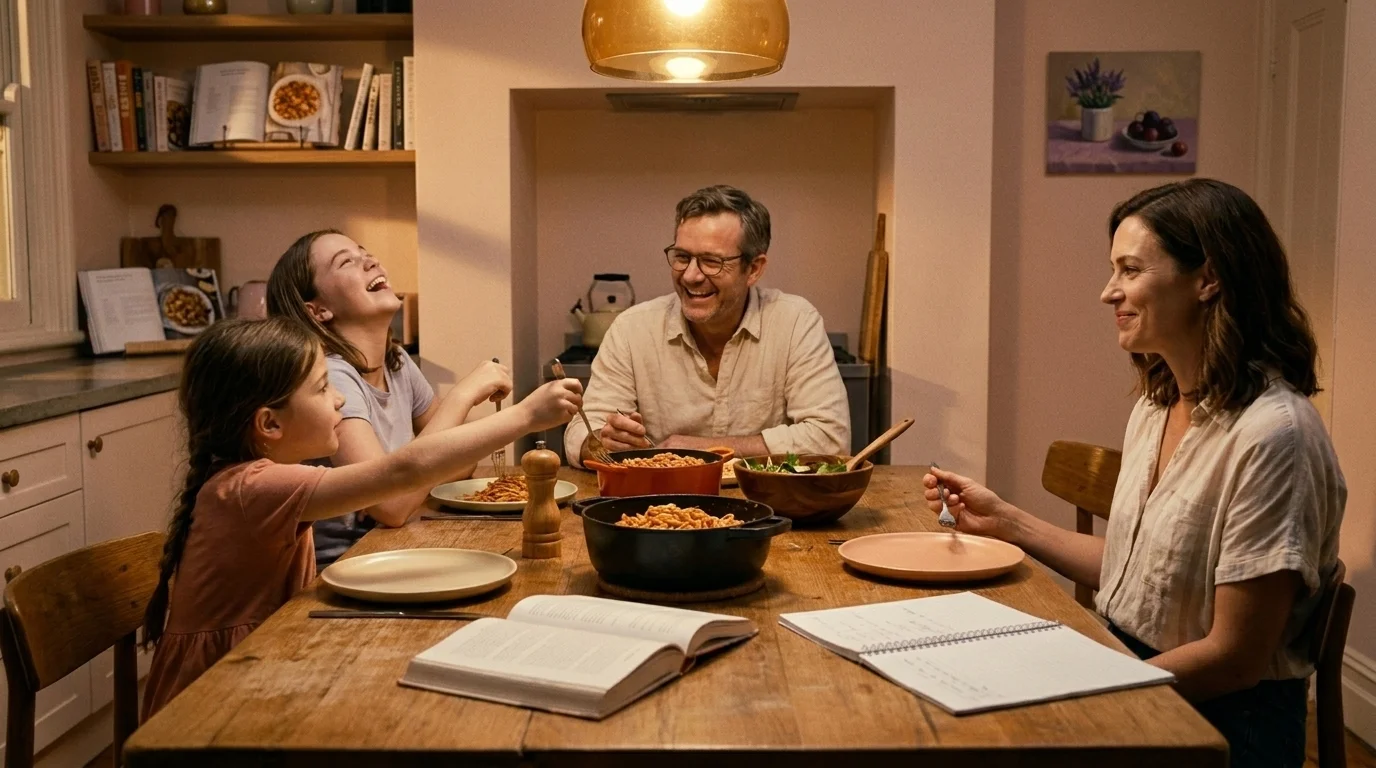
There is a particular question about family identity my eldest started asking me, around the time she turned eight, that I had not been ready for. The form of the question varied; the substance was always the same. Why are we the kind of family that does this thing and not that thing? Why do we read out loud at the table when other families don't. Why do we walk to school instead of drive. Why do we celebrate the small birthdays this way and the big ones that way. The questions were not, mostly, complaints. They were the daughter beginning to notice that her family had a shape, that the shape was not the only available one, and that she had been formed by it.
What she was asking about, although neither of us had the vocabulary for it then, was family identity — the shared story a family tells about who it is, the rituals and values and small accumulations of habit that hold a household together, and the question, central to this article, of how that shared story makes room for the person each member is, separately, becoming.
What family identity actually is
A short answer for the reader who has come here from a search engine. Family identity is the felt sense of a "we" inside a household — the values and routines and inside jokes and inherited habits that make this family this family and not another one. It is distinct from family values (the moral framework a family agrees on) and from family resemblance (the genealogical and physical inheritance). Family identity is the part of a family that a child, asked to describe it to a friend, would describe — and that the child, much later as an adult, will either choose to carry forward or quietly amend.
A family identity is not built once. It is built daily, in the small structural moves nobody photographs: who sits where at dinner, what the family reads, what the family is for. It can, in healthy form, leave each member's individuality intact. It can, in less healthy form, flatten it. Most of this article is about the difference.
Examples of family identity
It helps to have concrete examples on the page, because "family identity" in the abstract is the kind of phrase that floats. Some recognisable archetypes, drawn from the families I know best:
There is the outdoors family — the one whose weekends start at the trailhead, whose holidays involve tents, whose children are conversant in the names of trees before they are conversant in the names of pop stars. There is the books-and-debate family — the one whose dinners run long because someone has brought up something that requires a citation, whose shelves are double-stacked, whose children grow up assuming that conversation is a contact sport. There is the music family, whose entry hallway has more instruments than coats, whose Sunday afternoons are loud and not always tuneful. There is the service family, in which volunteering at the food bank or the local school is not occasional but structural — the way the family says, plainly, that this is what people do. There is the interfaith blended family, holding two traditions in the same house without asking either to give up its weight. There is the single-parent or chosen-family household, whose rituals are built from scratch because the inherited ones do not quite fit. There is the neurodivergent family, whose identity has organised itself around the way the people inside it actually work — predictable, gentle on transitions, allergic to performance.
None of these archetypes flattens individuality. Each of them gives individuality a place to belong. The reader will, almost certainly, recognise their family in two or three of the descriptions, and will recognise none of them in some particulars. That is also part of what a real family identity is — a description that fits, mostly, with the corners that don't.
Related Article: Embracing Imperfection: The Art of Realistic Parenting
The tension, named: differentiation of self
The central tension this article exists to think about — how a strong family identity can coexist with a strong individual self — is one the philosophical literature has, in its slow way, given a name to. The family-systems theorist Murray Bowen called it differentiation of self, and the most useful contemporary reframing I have read describes it as "the capacity to stay connected while also holding onto autonomous thinking and goal direction" (RSIS International, 2024). The capacity is not innate, the capacity is not fixed, and the capacity is the one most family-systems clinicians now treat as the real goal of healthy family life.
What the older lay literature on the subject — including, often, the religious traditions I was raised inside — sometimes implied was that closeness and autonomy were inversely related. The closer a family, the less room for the individual. The more individual the member, the looser the family's hold. The 2020s research has, with quiet authority, taken that assumption apart. A 2025 paper in Frontiers in Psychology (Frontiers, October 2025) and earlier NIH-indexed work (NIH PMC) both found that strong parent–adolescent connection and the parental support of individual identity-formation are not in trade-off. They are complementary. The adolescents with the worst outcomes are the ones inside the unbalanced profiles — enmeshed-fused, or detached. The adolescents with the best outcomes have both.
This is not what most parenting writing told my parents' generation. It is closer to what most parents I know now, when I ask them about how they were raised and how they are trying to do it differently, intuit.
The five functions, and why self-actualization is one
A useful piece of recent scholarship for thinking about this, and one I had not seen before working on this essay, is Jensen, Duh-Leong, Tamkin and Verbiest's 2025 qualitative study in the Journal of Family Issues (SAGE Journals). Their interviews with seventeen U.S. adults produced what they call the five prioritised functions of a family: (1) to secure and maintain connection, (2) to procure resources, (3) to bolster development, (4) to foster safety and well-being, and (5) to support self-actualization.
The inclusion of self-actualization on that list, as a function of equal weight with connection and safety, is the part I keep returning to. The traditional accounts of what a family is for sometimes positioned individuality as a luxury that came after the basic functions were met — as if a teenager's pursuit of their own selfhood was something the family permitted only when the household was otherwise in order. The recent literature is, in plain language, saying the opposite. Helping each member become themselves is one of the core jobs of being a family. Not a side effect. Not a luxury. A function.
I find this useful because it gives the philosophical tension a clean operational frame. The two beats — being a family that holds its members together, and being a family that helps each member become themselves — are not opposites. They are paired functions of the same arrangement.
What this looks like across ages
The abstract argument needs a concrete temporal frame, because what nurturing individuality means in a household differs sharply by age. Three short notes.
Early childhood (roughly 0–6). The work is mostly about secure attachment and predictable routines. Individuality, at this age, expresses itself in small preferences — the colour of the cup, the order of the bedtime books, the right side of the bed. Honour the small preferences when they are honourable; do not perform indifference to them. The child is, structurally, learning that her preferences are seen.
Middle childhood (roughly 6–11). The age at which my eldest started asking the questions I opened this essay with. The child has the cognitive equipment now to notice that the family has a shape, and to be curious about the shapes of other families. Talk plainly about why your household does what it does. Acknowledge that other households do otherwise. Avoid the temptation to defend the household's choices as universally correct. The child is, at this age, beginning to learn that the family is one of many possible arrangements, and that the family is, nevertheless, hers.
Adolescence (roughly 11–18). The most fraught and most important window. The work shifts from holding the family identity stable to letting it become more porous. The teenager is structurally required to test which parts of the inherited identity are theirs and which are merely the parents'. A family that holds itself too tightly here produces, in clinical literature, what gets called identity foreclosure — a young adult who has not done their own work and will, often, do it ten years later, more painfully. A family that holds itself too loosely here produces a different kind of difficulty. The right answer, and the hard one, is to remain available without insisting on continuity. The teenager will, in most healthy families, come back to many of the inherited threads in their own time. The ones they do not come back to were never going to be theirs to keep.
The digital age, and the family group chat
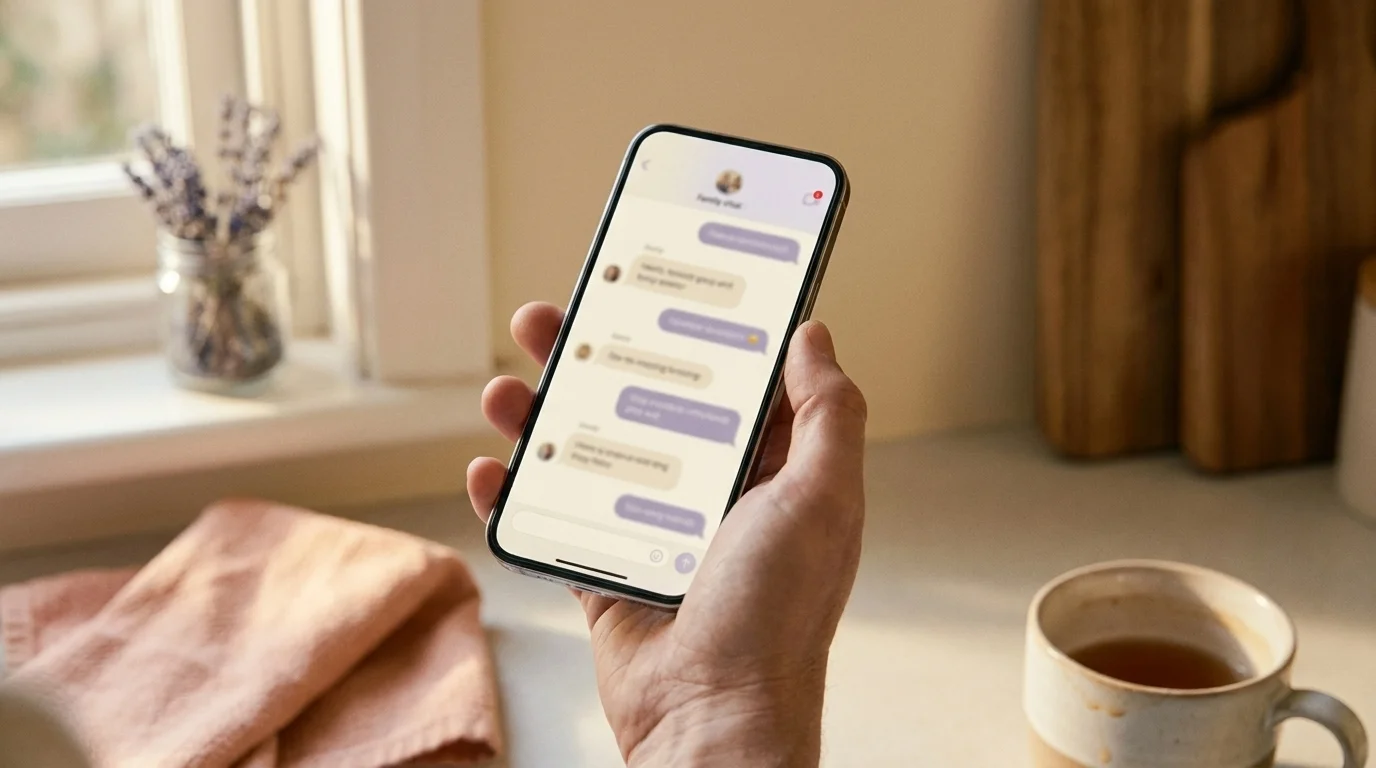
A short observation that the older family-systems literature could not anticipate. A 2025 chapter in the Handbook of Systemic Approaches to Psychotherapy Manuals explicitly added what its authors call a "digital level of analysis" to Bowen-derived family-systems frameworks (Springer, 2025). The family of 2026 is no longer only the people who eat dinner together; it is, also, the family group chat, the shared streaming queue, the shared photo stream, the shared playlist, the family WhatsApp that pings at the top of every evening and the bottom of every morning.
I will say what the literature is starting to say. The digital layer is not a separate layer. It is part of the family identity. The household whose group chat is mostly logistics has a different identity from the household whose group chat is mostly jokes, and both have a different identity from the household whose group chat carries inside language that nobody outside the family would parse. The teenager scrolling away from the dinner table is not necessarily, as the early-2010s discourse worried, doing the work of leaving the family. He may be doing the work of being inside it, by a route the family did not have when his parents were his age.
The literature on this is younger than my younger child. We will, all of us, be working out together what it implies.
A short self-check, adapted from the Do You Know scale
I want to give the reader something to do. The strongest single piece of evidence I have read for why family identity matters in measurable terms is the "Do You Know" scale developed by Marshall Duke and Robyn Fivush at Emory University (Seattle Foundation, NCPH PDF). The original twenty questions ask children what they know about their family's narrative history — from "Do you know how your parents met?" to "Do you know an illness or something terrible that happened in your family?" to "Do you know the source of your name?". Across multiple studies, children who scored higher on the scale tested higher on self-esteem, on sense of personal control, on emotional health, and — most strikingly, in the data Duke and Fivush gathered after a national trauma — on resilience.
The mechanism, on Duke and Fivush's reading, is roughly this: a child who knows that her family has weathered things, who can name the people and events that came before her, holds an "intergenerational self" larger than her own moment in it. That larger self is, when the difficult moment arrives, structural ballast.
Three questions, adapted from the scale (the full twenty are at the Psychology Today link below), that I would invite the reader to consider asking their own child this week. Not as a quiz. As a conversation.
- Do you know how your parents met?
- Do you know about something difficult that happened in our family, and how we got through it?
- Do you know where your name came from?
I have, in fairness, tested these on my own children. The conversation that resulted was longer than I had expected and warmer than I had hoped. The full twenty questions are at Psychology Today's reprint of the scale.
A small note to close
Maggie Nelson, in The Argonauts, writes about the strange paradox of being inside a relationship that has changed you — a relationship in which the "I" that is doing the changing and the "we" inside which it is happening are, somehow, both real and both rearranging each other in real time. She is writing about romantic and parental love. She could just as well be writing about family identity.
The household I am writing this from has, as I write, three children, two adults, a partly-painted hallway, an ongoing argument about a hamster the older two would like and the younger is unsure about, a Friday-night ritual I am refusing to break, and a daughter who keeps asking the questions I opened this essay with. The shape of the family is recognisable from the outside. The lives inside it are, increasingly, their own.
I do not think the work is to choose between them.
Frequently Asked Questions
Family identity is the shared story a family tells about who it is — its values, rituals, traditions, and the way each member's distinct self contributes to that whole. Unlike family values (the moral framework a family agrees on), family identity is the felt sense of we-ness that holds a family together while leaving room for each person's individuality.
Family identity shows up in recognisable archetypes: the outdoors family whose weekends start at the trailhead; the books-and-debate family with the long dinner conversations; the music family with more instruments than coats in the hallway; the service family that volunteers together; the interfaith blended family holding two traditions; the single-parent or chosen-family household whose rituals are built from scratch; the neurodivergent family whose identity is built around how everyone actually works. None of these flattens individuals — each gives individuality a place to belong.
The strongest data point is the 'Do You Know' scale developed by Marshall Duke and Robyn Fivush at Emory University. Across multiple studies, children who knew more about their family's narrative history scored higher on self-esteem, sense of control, and — measured after a national trauma — resilience. Family identity is not just sentimental; it's a measurable protective factor.
The family-systems theorist Murray Bowen called this differentiation of self — the capacity to stay emotionally connected to your family while holding onto autonomous thinking and goals. Recent 2025 research in Frontiers in Psychology and NIH-indexed work confirms that connectedness and individuality are complementary, not competing — the children who do best have both strong family bonds and parental support for becoming their own person.
Because supporting each member's self-actualization is, in the most recent scholarship, one of the five core functions of a family — peer to securing connection, providing safety, and procuring resources (Jensen et al., Journal of Family Issues, 2025). Individuality is not a luxury added after the basics; it is one of the basics.
A 2025 chapter in the Handbook of Systemic Approaches to Psychotherapy Manuals added a digital level of analysis to family-systems theory. Group chats, shared streaming queues, shared photo streams, and shared playlists are now part of how family identity forms. The household whose group chat carries inside jokes has a different identity from the household whose chat is mostly logistics — and both are real.