
Thriving Amidst Single Parenthood Challenges: Inspirational Stories of Strength and Resilience


The question I hear most often from new single parents in my consult room is whether the single parent challenges they have read about — the elevated poverty rate, the income gap, the child-outcome statistics — apply to them specifically, or whether they describe a population they are not yet inside. The honest answer is that the figures are real, and that they describe an average rather than a fate, and that nearly all of them shift considerably once a household plugs into the named support programs already on offer. About twenty-three million children in the United States — roughly one in three — now live in a single-parent household, with the count having peaked in 2012 and slowly declined since (Annie E. Casey Foundation, 2024; Statista, 2025). This is not a rising tide. It is a stable feature of the American household landscape, and the single most useful framing for the challenges that travel with it is structural rather than personal.
By the numbers
Among those twenty-three million children, about 14.4 million live with a single mother and about 3.5 million live with a single father, with the remainder in cohabiting parental households (Annie E. Casey Foundation, 2024). The Census counts roughly ten million single-parent families with children under eighteen, of which about 67 percent are headed by a single mother (Single Mother Guide, citing 2024 US Census). Twenty-seven percent of single-parent families live below the federal poverty line, compared to six percent of married-couple families. For single-mother households specifically, the poverty rate is 31.3 percent, against 5.5 percent for married-couple families. The median income gap is the single most consequential number on the page: a typical single-mother household earned approximately $41,305 in 2024, while a typical married-couple household earned approximately $132,959 — a roughly three-to-one gap that drives almost every downstream outcome the popular discourse attributes to family structure itself.
A few additional figures put the structural picture in focus. About 36.8 percent of single-mother households are food-insecure; 23.4 percent receive SNAP benefits. Geographic distribution is wide: the share of children in single-parent families ranges from about 20 percent in Utah to 45 percent in Louisiana and Mississippi at the state level, and from about 23 percent in Seattle to 73 percent in Detroit at the city level (Annie E. Casey Foundation, 2024). And roughly 40 percent of all U.S. births are now to unmarried women — a figure approximately double the 1980s rate (US Census, via Single Mother Guide), which is the reason that "entry pathway" into single parenthood is no longer dominated by divorce.
A note on interpretation. These are population-level descriptors, not predictors of any individual household's trajectory. They tell us that single-parent households, at scale, contend with a specific structural pattern: lower median income, higher poverty exposure, higher food-insecurity rate, and uneven geographic concentration. They do not tell us that single parenthood causes the elevated poverty rate. The most plausible mediator is income, which is itself the product of education, regional labor markets, and the absence of a second earner — none of which are the moral content of the parent's effort.
The financial picture as a structural pattern, not a personal failing
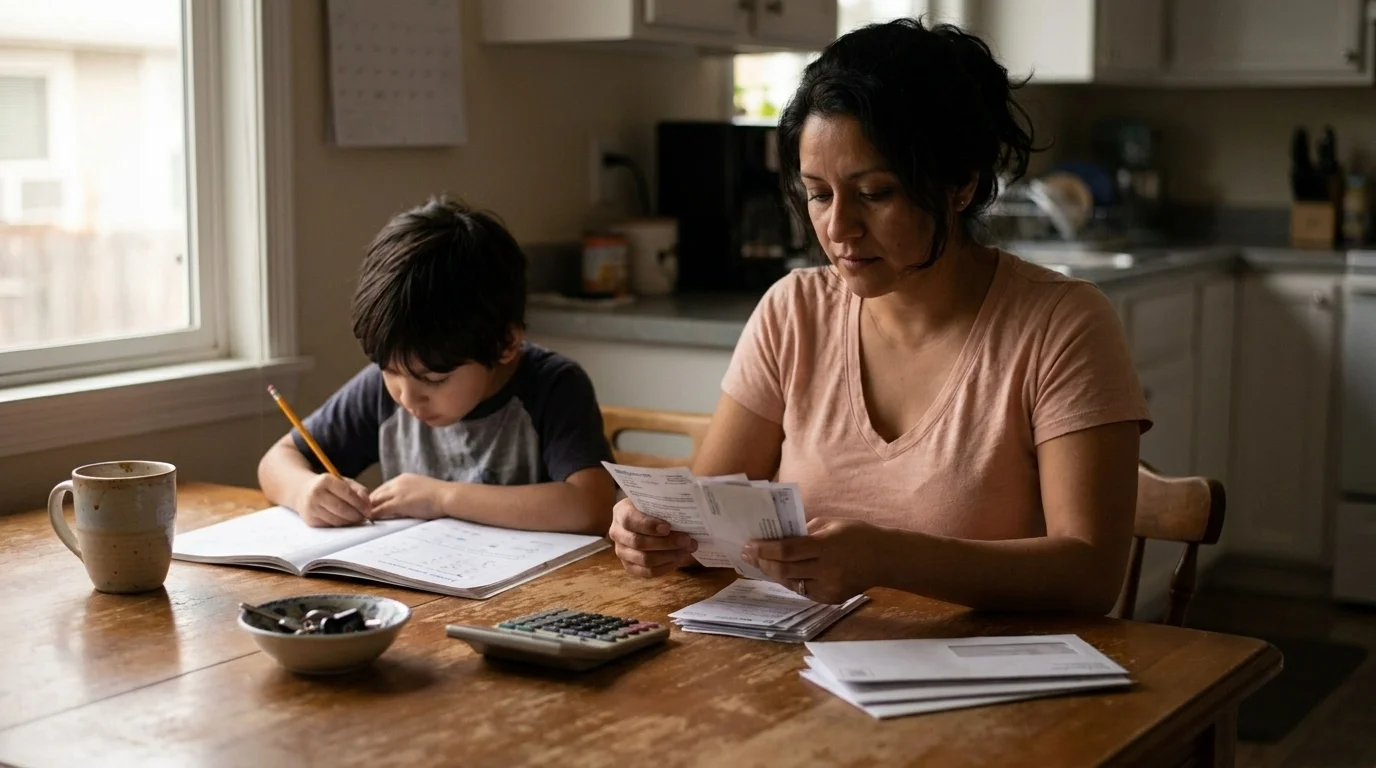
The dominant single-parent challenge in the data is financial, and the dominant misframing of that challenge in the popular advice literature is to treat it as a budgeting problem. Budgeting is occasionally part of the answer, but the population data is unambiguous that the gap is structural rather than behavioural. A single earner cannot, on a typical wage, replicate the household income of two earners; the surrounding tax-and-benefit system was largely built for two-earner households; and the cost lines that hit single-parent households hardest — childcare, housing, healthcare — are precisely the lines that scale poorly to one income. The Annie E. Casey Foundation's 2024 framing of what it calls "two-generation" services is, in my read, the most evidence-anchored response: programs designed so that the parent and the child are supported in the same building or under the same agency on the same day — early-childhood education paired with adult education, or Head Start paired with workforce supports — are explicitly built to address the structural pattern above rather than its surface symptoms (AECF, 2024). Two-generation services are not yet the default in most U.S. jurisdictions; where they exist, they are usually reachable through the resource ladder below.
Where to start: the U.S. resource ladder
The most useful concrete answer I can give a single parent in a first appointment is to call 211 before doing anything else. 211 is a free, twenty-four-hour national information-and-referral helpline (also reachable as a website search by ZIP code) that maps a caller to the local food, housing, childcare, mental-health, and financial-assistance programs in their specific area. The reason 211 is the right first step is that the resource landscape is highly local, and most single parents who delay asking for help do so because they cannot find a single front door to the system. 211 is the front door.
Beyond 211, the federal programs that single-parent households use most often are SNAP (food assistance, formerly food stamps) and WIC (nutrition assistance for women, infants, and children under five); the Earned Income Tax Credit and the Child Tax Credit, both of which are refundable and worth filing for even if no taxes are owed; Section 8 / Housing Choice Vouchers for rent assistance, which is administered locally and almost always operates a waitlist; LIHEAP for energy bills in winter and summer extremes; and Head Start and Early Head Start for free or low-cost early-childhood education from birth through age five. State-level TANF programs add cash assistance and work-support layers on top of the federal floor. None of these are charity; they are the support layer that the same population data above describes as under-utilised, partly because eligibility paperwork is genuinely burdensome and partly because the ask itself has historically been framed — wrongly, in the current literature — as a last resort rather than a first move.
On the named-nonprofit side, the strongest single-parent-specific organisations I am aware of in the U.S. include the Single Parent Project (which publishes the most carefully curated single-parent statistics digest I have seen), Single Mothers Planet, Single Parent Advocate, and Solo Moms by Choice for single mothers who arrived at solo parenthood by deliberate choice rather than circumstance. Each of these is a starting point, not a substitute for the federal-program ladder above.
Single fathers, briefly and specifically
About 3.5 million U.S. children live with a single father as their primary parent, in roughly three million single-father households (Annie E. Casey Foundation, 2024; The Single Parent Project). The median single-father household income runs near $40,000 — somewhat higher than the single-mother median, somewhat lower than the broader middle-class median, and well below the married-couple median. The most useful structural fact about this cohort is that the entry pathways are now diverse: roughly 52 percent of single fathers are separated, divorced, widowed, or never-married, distributed across all four categories, which means the older default assumption of "custody after a contested divorce" describes a minority of single-father households rather than the norm.
The peer-support ecosystem for single fathers has matured considerably in 2024–2025. Named hubs include Dear Fathers (a multi-author magazine with a recurring single-father financial-strategies column), Dads Supporting Dads (a peer-led network with both online and in-person dad groups), and the informal "dad squad" peer model that has spread through urban areas during the same period. For depression and mental-health support that has been built and tested with men specifically — including single fathers — HeadsUpGuys remains, in my read, the most evidence-anchored free option available. The literature on single-father child outcomes is thinner than the literature on single mothers, and what does exist tracks the same pattern as the rest of the single-parent data: outcomes vary primarily with household resources and stability, not with the gender of the single parent in the home.
What the outcomes literature actually says
One of the most misread findings in the single-parent literature is the correlation between family structure and child outcomes. Children in single-parent families do, on average, perform worse on a range of measures — academic, behavioural, mental-health — than children in married-couple families. This is robustly replicated. What the research cannot tell you — not yet, in my reading of the strongest longitudinal designs — is how much of that gap is family structure itself and how much is everything that tends to travel with family structure: lower household income, higher housing instability, less access to early-childhood education, more parental stress. When the structural confounders are controlled for, the residual effect of being in a single-parent household shrinks substantially. This is the recurring shape of the literature: structure predicts outcomes at the population level, and resources mediate most of that prediction at the individual level. The leverage is on the resources, not on the structure.
This is also the reason that the 2024–2025 reframe of "asking for help" as a resilience signal rather than a last resort is, in my view, the correct evidence-anchored framing (AECF, 2024; NPR, July 2025). The single-parent households whose children do measurably better than the population average are not the households with the most heroic individual coping; they are the households that pulled the maximum number of available supports into the home as early as possible. Two-generation services, the resource ladder, a stable childcare arrangement, and one or two reliable adults who can step in for emergencies — these are the load-bearing factors. None of them are about grit.

Where the data ends
The data tells us, with reasonable confidence, what the population pattern looks like and where the structural levers sit. It does not tell any individual single parent which combination of the supports above will fit their household's specific configuration of income, jurisdiction, child ages, work schedule, and personal capacity. That part of the work is done, as it has always been done, in conversation — with a 211 referral specialist, with a school social worker, with a paediatrician who knows the local services, with a peer-group facilitator who has met the same paperwork before. If you are reading this at eleven o'clock at night because something specific has been worrying you, the named ladder above is a reasonable first stop and a call to 211 is the right next stop. The structural picture is real; the room for individual leverage inside it is wider than the framing of "single parent challenges" usually allows.
Frequently Asked Questions
About 23 million children — roughly one in three — live in single-parent households in the U.S. Around 14.4 million live with a single mother and about 3.5 million with a single father, with the remainder in cohabiting parental households. The total single-parent-household count peaked in 2012 and has slowly declined since. (Sources: Annie E. Casey Foundation, 2024; Statista, 2025.)
The most useful first call is 211 — a free, twenty-four-hour national information-and-referral helpline that maps you to local food, housing, childcare, mental-health, and financial-assistance programs. Beyond that, the main federal layer includes SNAP and WIC (food assistance), the Earned Income Tax Credit and Child Tax Credit (both refundable), Section 8 / Housing Choice Vouchers, LIHEAP (energy bills), and Head Start / Early Head Start (free early-childhood education). State TANF programs add cash assistance and work supports.
Single fathers — roughly 3.5 million in the U.S. — face many of the same structural challenges as single mothers, but with a slightly higher median income and a less-developed peer-support infrastructure. Roughly 52% are separated, divorced, widowed, or never-married, distributed across all four pathways. The named single-father support ecosystem has matured considerably in 2024–2025, with Dear Fathers, Dads Supporting Dads, and the informal 'dad squad' peer model joining HeadsUpGuys for mental-health support.
Children in single-parent families do, on average, score lower on a range of academic, behavioural, and mental-health measures than children in married-couple families. What the research cannot tell you yet is how much of that gap is family structure itself versus everything that travels with it — lower household income, less stable housing, less access to early-childhood education, more parental stress. When structural confounders are controlled for, the residual effect of family structure shrinks substantially. The leverage sits on the resources, not on the structure.
Call 211. It's free, twenty-four-hour, and exists specifically to map you to the local programs that fit your household — food, housing, childcare, mental health, financial assistance. Most single parents who delay asking for help do so because they can't find a single front door to the support system; 211 is that front door.
The single-parent households whose children do measurably better than the population average are not the ones with the most heroic individual coping — they are the ones that pull the maximum number of available supports into the home as early as possible. Two-generation services (programs that support parent and child simultaneously), a stable childcare arrangement, the federal benefit layer, and one or two reliable adults who can step in for emergencies are the load-bearing factors. The 2024–2025 literature reframes asking for help as a resilience signal rather than a last resort, and that framing is the evidence-anchored one.
The financial picture is structural rather than behavioural — a single earner cannot, on a typical wage, replicate the income of two earners, and the surrounding tax-and-benefit system was built largely for two-earner households. The single biggest leverage points are the refundable Earned Income Tax Credit and Child Tax Credit (file even if no taxes are owed), SNAP and WIC for food, Section 8 vouchers for housing, LIHEAP for energy bills, and Head Start for early-childhood education. 211 is the front-door referral. Budgeting helps; structural supports help more.
Community support — peer groups, neighbourhood ties, school-community contacts — addresses the social isolation that population studies consistently flag as a mediator of single-parent stress and depression. It also distributes the cognitive load of solo parenting: a school-pickup swap, an emergency-contact list, a neighbour who can pick up a sick child are all functional reductions in load, not just emotional support.
Check Out These Related Articles
Breaking Barriers: Empowering Single Dads to Thrive in Modern Parenthood

The Art and Science of Nursery Colors: Creating Stimulating Yet Soothing Environments for Infants

Navigating Parenthood Milestones: Expert Insights on Raising Children