
4 Types of Parenting Styles


It is late, the kids are finally asleep, and you have typed "which parenting style am I" into your phone with the specific dread of someone waiting for a bad grade. I want to take that dread off the table before we start. The 4 types of parenting styles you are about to read about are a map, not a report card — and almost nobody lives at a single address on it.
Here is the short version. Developmental psychologist Diana Baumrind sorted parenting into three styles in the 1960s, and researchers Eleanor Maccoby and John Martin later added a fourth, so the classic model is: authoritative, authoritarian, permissive, and uninvolved (sometimes called neglectful). In the next few minutes you'll see the two dials every style is built from, get a real-life example and honest effects for each, learn which one the research actually favors (with numbers from December 2025), and find out where today's viral labels — "gentle parenting," "FAFO" — fit. Spoiler: not as a fifth style.
The Two Dimensions Behind the 4 Parenting Styles
Before you can place yourself, you need the two dials. Every one of the four styles is built from the same pair: demandingness (how much structure you hold — expectations, limits, the word no) and responsiveness (how much warmth you give — listening, explaining, taking a feeling seriously). Turn each dial up or down and you get four combinations. That's the entire model.
Here is the plain-English version. Demandingness is the "I need you to do the thing" dial: bedtimes, homework, chores. Responsiveness is the "I see you and I'm on your side" dial: hugs, listening, explaining the reason instead of just issuing a verdict. High on both, low on both, or high on one and low on the other — four quadrants, four styles.
This isn't a blog invention. Baumrind defined the original three styles using exactly these two dimensions, and Maccoby and Martin added the fourth; you can read the clinical version in the NIH's StatPearls reference. The matrix below is that model with the labels filled in, so you can already start guessing your own quadrant.
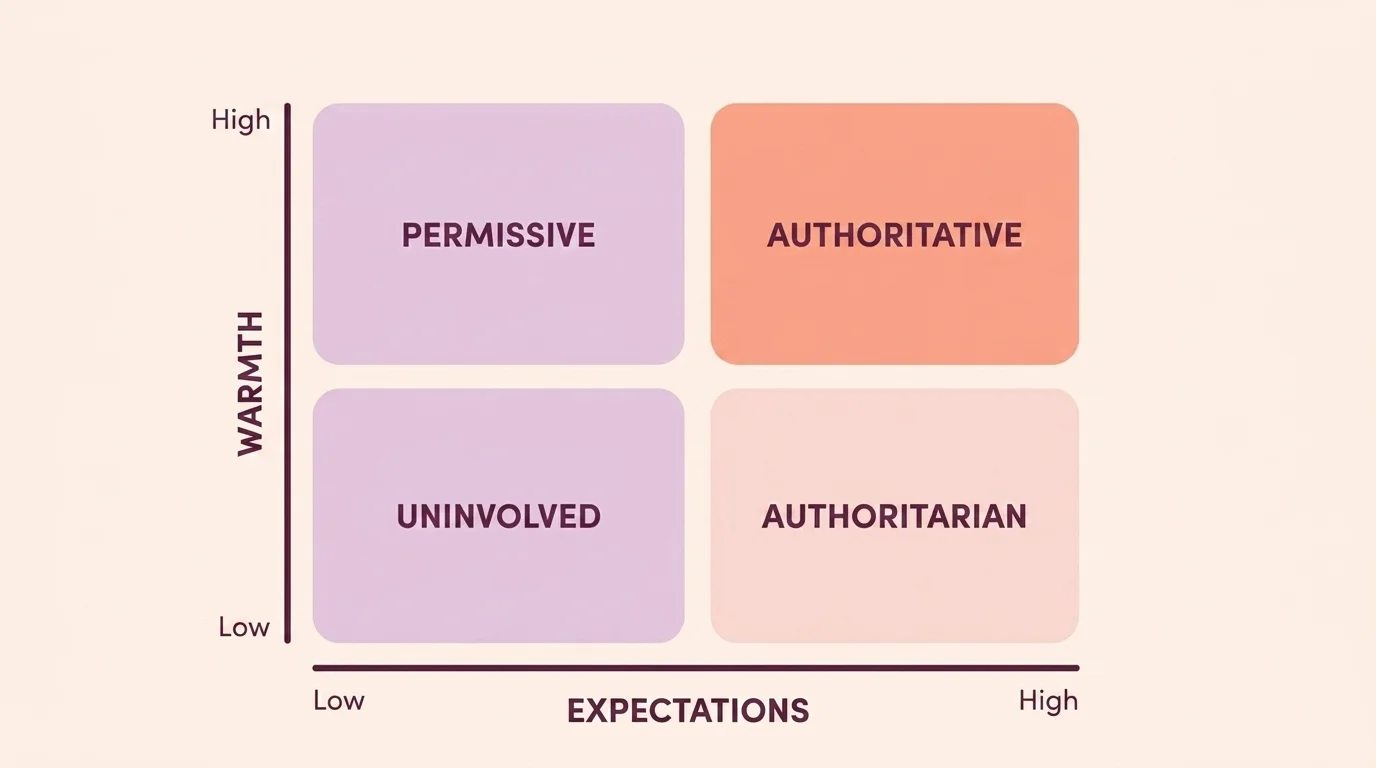
One thing to flag now, because it's the reason this article exists: the parenting labels crowding your feed in 2025 — "gentle parenting," "FAFO" — are not new categories. Gentle parenting done as advertised lands squarely in one of these four quadrants, and December 2025 research puts real numbers on which quadrant is healthiest. We'll get to both. For the strategy underneath all of it, browse our parenting strategies guides.
Authoritative Parenting (High Warmth + High Expectations)
Definition. Authoritative parenting is high warmth and high expectations at the same time: firm boundaries delivered with empathy, and rules that arrive with a reason instead of just a verdict.
Real life. It's 9pm and the homework isn't done. The authoritative move isn't "because I said so," and it isn't a shrug. It's: "The rule is homework before screens — here's why it matters to me — and I can see you're wiped, so let's make a plan." You set the limit, you explain it, you listen, and then you hold the line kindly. Same warmth, same boundary, every time.
Effects on the child. This is the style the research most consistently ties to the outcomes parents actually want — self-regulation, resilience, the ability to take a no without coming apart (NIH/StatPearls). A 2025 meta-analysis in the Review of Educational Research went further, finding that of the four styles, only authoritative parenting was positively associated with children's academic outcomes.
Pros and cons. The pro is that it produces the best-documented outcomes and flexes as kids grow. The con, and it's a real one, is that it's the most effortful style to run day to day — staying warm and holding a limit and explaining the why is exhausting when you're depleted. If "gentle parenting" is your thing, good news: done right, this is exactly where it lives (more on that below).
Authoritarian Parenting (High Expectations + Low Warmth)
Definition. Authoritarian parenting is high demandingness with low responsiveness: strong rules and a premium on obedience, with less emphasis on explaining, negotiating, or coaching the feeling underneath the behavior. The shorthand is "because I said so."
Real life. The curfew got broken. The authoritarian response is a swift, non-negotiable consequence — grounded, phone gone — with little discussion of what happened or why. The standard is clear and the child knows it; what's thin is the conversation around it.
Effects on the child. Firm rules can feel like they are working, at least in the short term. But the newer research keeps pointing one direction: a 2025 longitudinal study in Frontiers in Psychiatry linked authoritarian parenting to reduced well-being, on the reasoning that rigid rules leave little room for a kid to express and regulate emotion. And in a December 2025 study, the authoritarian pattern was associated with higher odds of adolescent depression, not lower (PLOS One — read this directionally; more on that below).
Pros and cons. The pro is genuine: structure and high standards are good things, and kids need both. The con is that standards without much warmth tend to cost you the self-regulation and the closeness. Here's the part I want to be clear about — if you recognize yourself here, you are not a bad parent. High expectations are an asset. Pairing them with more explaining and more listening is the whole upgrade, and it's a smaller move than it feels like.
Permissive Parenting (High Warmth + Low Expectations)
Definition. Permissive parenting is the mirror image of authoritarian: high warmth, low demandingness. Plenty of love and responsiveness, but few firm limits, and consequences that tend to bend the moment a kid pushes.
Real life. Bedtime is 9pm, in theory. In practice it's one more show, then one more, then a negotiation you lose at 10:40 — because the connection between you is genuinely lovely and you don't want to blow it up over a screen. The warmth is real. The boundary is a suggestion.
Effects on the child. The warmth itself is protective, and that part is worth keeping. But in that December 2025 study, the permissive pattern was associated with higher odds of adolescent stress (PLOS One, directional). My own read, for what it is worth: kids feel steadier when someone is visibly holding the frame.
Pros and cons. The pro is closeness and low day-to-day conflict; permissive homes are often warm places to be. The con is that boundary-setting is genuinely hard here, and kids will keep testing for the edge until they find one. One thing worth naming, because it's where a lot of well-meaning parents land in 2025: this is exactly the quadrant "gentle parenting" slides into when the empathy stays but the boundaries quietly disappear.
Uninvolved (Neglectful) Parenting (Low Warmth + Low Expectations)
Definition. Uninvolved parenting — the fourth style, the one Maccoby and Martin added — is low on both dials: limited warmth and limited structure. Little engagement, few expectations, not much emotional availability.
Real life. It's the checked-out evening. The basics are handled — there's food, the lights are on — but there isn't much connection, much follow-through, or much noticing. And here's the thing most guides skip: this is very often not a choice. It's what parenting looks like through burnout, depression, a punishing work schedule, or a stretch where a parent is simply out of gas.
Effects on the child. I'll be straight, because softening it wouldn't help you: this is the pattern the research most consistently ties to poorer outcomes across the board (NIH/StatPearls). There isn't a real "pro" column here, and I'm not going to invent one.
But this is also the most fixable spot on the entire map, because small increases in warmth and structure move a parent out of this quadrant fast. And if the checked-out feeling is coming from something heavier — you're exhausted, you're low, you can't find your way back in — that's a medical conversation, not a character verdict. Talk to your pediatrician or your own doctor. Being tapped out is a condition to treat, not a failure to confess.
Which Parenting Style Is Healthiest? (What 2025 Research Shows)
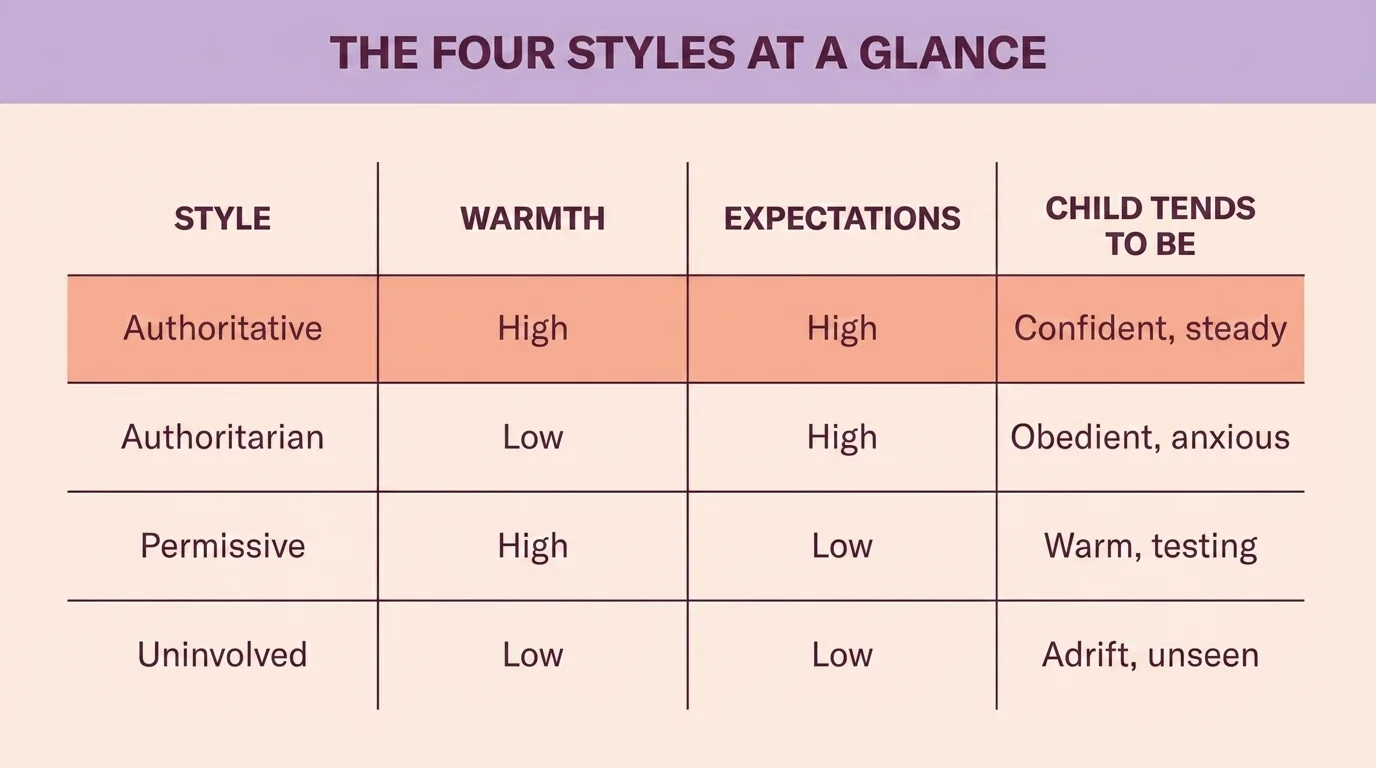
The short answer: authoritative — high warmth plus clear expectations. December 2025 research links it to lower teen depression, anxiety, and stress, and separate 2025 work ties it to better academic outcomes.
Now the detail, because the numbers are the reason to trust the answer instead of just nodding at it. A December 2025 study published in PLOS One found that adolescents with authoritative parents had roughly half the odds of depression, anxiety, and stress compared with their peers — the study's adjusted odds ratios landed around 0.40 for depression, 0.50 for anxiety, and 0.54 for stress. In the same data, the authoritarian pattern was tied to higher depression odds and the permissive pattern to higher stress odds. From a different angle, that 2025 Review of Educational Research meta-analysis found only authoritative parenting was positively associated with academic outcomes.
Two honest caveats, because I'm a writer and a parent of two teenagers, not a psychologist, and I'd rather you trust the shape of this than the decimals. Those PLOS One numbers come from a single cross-sectional study of 583 adolescents in Nepal, so treat them as direction, not as a US prevalence rate — the same sample even showed a small exception, slightly lower self-esteem, which is precisely the kind of wrinkle a real body of evidence has. The direction, though, is strikingly consistent across studies and cultures: warmth plus structure protects.
Is There a 5th Parenting Style? Where Gentle Parenting and FAFO Fit
The short answer: no — the classic model has four. The labels flooding your feed — gentle, free-range, "FAFO" — aren't a fifth category. They're new names for old quadrants.
Gentle parenting. Strip off the branding and gentle parenting's actual ingredients are empathy plus firm boundaries — which is authoritative parenting in better clothes. Psychology writers have been making this point for a while (see Simply Psychology and WholeMind Psychology). The catch is the one from the permissive section: when "gentle" keeps the empathy but lets the boundaries go, it stops being authoritative and slides into permissive. Done as written, though, it's the healthy quadrant — which is partly why Gen Z parents are increasingly blending authoritative and gentle on purpose.
FAFO ("fool around and find out"). This one went viral in 2025 as a natural-consequences reaction against gentle parenting — let the kid feel the fallout of the choice. But FAFO is a discipline tactic, not a Baumrind style (ConsultYES). You can use natural consequences inside an authoritative home or a permissive one; the tactic doesn't tell you which quadrant you're standing in.
So put every trendy label back on the same two-dial matrix from the top of this piece. It's the same map. Which is oddly freeing — you can stop auditioning labels and just aim for the high-warmth, high-structure corner.
How to Shift Toward Authoritative Parenting
You don't need a personality transplant. Almost everyone reading this is already partway there, and the move is usually one dial, not both. Here's the realistic version.
- Add one boundary — or one degree of warmth — at a time. If you lean permissive, keep all that warmth and add a single firm limit; pick one and hold it. If you lean authoritarian, keep the high standard and add the "why" plus thirty seconds of listening. You're nudging a dial, not rebuilding the machine.
- Pair every limit with a reason and a feeling-check. "Connect, then correct." The boundary and the empathy aren't in tension; delivering them together is the skill.
- Use calm, consistent consequences instead of either harshness or caving. Predictable and slightly boring beats loud, and it beats negotiable.
- Repair after the blow-ups. You will lose your temper; the authoritative move is coming back afterward and naming it. That repair models the exact emotional skill you're trying to build.
- Practice on one flashpoint first. Don't reform everything on Monday. Pick the recurring fight — bedtime, homework, screens — and run the new script there until it's muscle memory.
If you want the broader picture of showing up as a hands-on parent day to day, our guide to active parenting habits is a good next step.
Which Style Are You? A 60-Second Self-Check
Ready to place yourself? Two quick counts. Don't overthink them — answer for a normal week, not your best day or your worst.
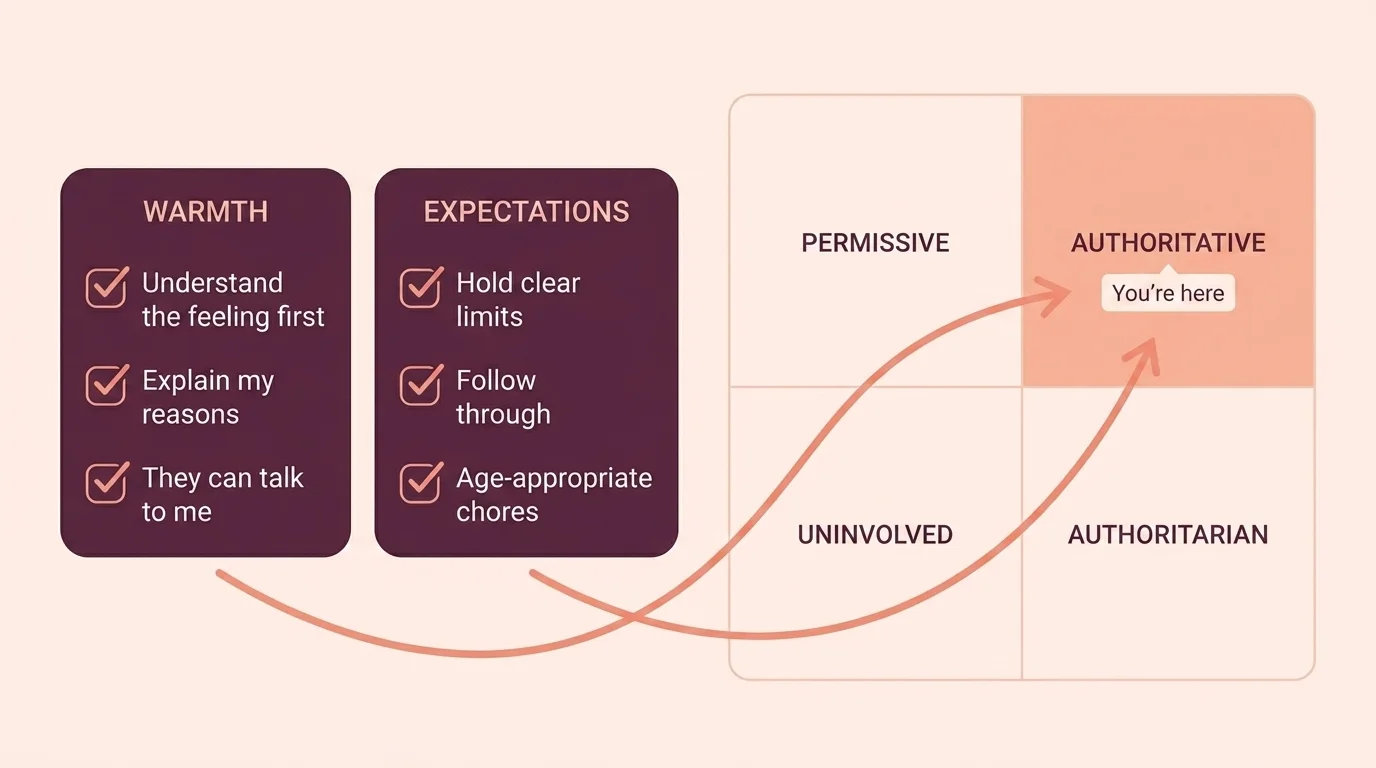
Warmth (responsiveness) — how many are mostly true?
- When my kid is upset, I try to understand the feeling before I fix the behavior.
- I explain the reasons behind my rules.
- My kid would say they can talk to me about hard things.
Expectations (demandingness) — how many are mostly true?
- I hold clear, consistent limits even when it's inconvenient.
- I follow through on consequences instead of letting them slide.
- I expect age-appropriate responsibilities and hold that line.
Now read your result: high warmth and high expectations → authoritative; high expectations, low warmth → authoritarian; high warmth, low expectations → permissive; low on both → uninvolved.
Two things before you close the tab. This is a snapshot of this week, not a diagnosis and not a verdict on the kind of parent you are — a self-check can't do what a professional can, and it isn't trying to. And wherever you landed, the move is the same one from the section above: pick one dial, nudge it, start tonight.
So — the 4 types of parenting styles are a map with four addresses, and here's the reassuring truth I promised at the top: most parents don't live at just one, and no quadrant is a life sentence. Authoritative (warmth plus structure) is the healthiest corner, today's trendy labels mostly point back to it, and you get there in small, deliberate nudges rather than one grand reinvention.
Tonight, do one thing: take the 60-second self-check, pick a single flashpoint, and try the authoritative script there. Then keep going — browse more parenting strategies, and for how one parent's style plays into the whole household, see our piece on family systems theory.
Frequently Asked Questions
"Gentle parenting" is the trending label, but psychologists note it's essentially authoritative parenting rebranded — empathy paired with firm boundaries. Stripped of the branding, its core ingredients match the healthiest of the four classic styles.
FAFO ("fool around and find out") is a viral 2025 natural-consequences discipline tactic, not a new Baumrind style — a reaction against gentle parenting. You can use natural consequences inside an authoritative or a permissive home, so the tactic doesn't define your style.
They map to the two dimensions behind all four styles — warmth/responsiveness and structure/demandingness — usually expressed as connection, communication, consistency, and boundaries.
There's no separate "four domains" model. The domains behind every parenting style trace back to Baumrind's two dimensions: warmth/responsiveness and structure/demandingness.
Yes — most parents blend styles depending on the child, the situation, and the day, and can deliberately shift toward authoritative over time. A style is a tendency, not a fixed identity.