
Family Systems Theory


There is a particular argument my house has been having, on and off, for about six years. The subject changes — shoes, screens, whose turn it is to be disappointed — but the shape of it never does, and the frame that finally made sense of that shape has a name: family systems theory, the idea that a family is a single emotional unit rather than a collection of separate individuals, so that no one person's behavior ever fully makes sense on its own. I met the theory first as a family mediator, sitting across from parents who loved each other and their kids and were still stuck in the same loop every week. The psychiatrist Murray Bowen built the framework in the 1950s, and clinicians have leaned on it ever since. What follows is a plain-English walk through Bowen's eight core concepts, a real-home example for each, a map of how this differs from the "IFS" and "structural" models people constantly mix it up with, and the one skill — differentiation of self — that research links to calmer parenting. It's written for the family living it, not for the psychology exam.
What is family systems theory?
Family systems theory, developed by the psychiatrist Murray Bowen, views a family as one interconnected emotional unit whose members constantly shape each other's behavior. The Bowen Center, which keeps the official version of his work, puts it this way: it is "a theory of human behavior that views the family as an emotional unit and uses systems thinking to describe the unit's complex interactions". Bowen worked most of it out in the 1950s during his family-research years at the National Institute of Mental Health.
Here's the shift that matters for a parent. When something goes wrong at home, the instinct is to ask what's wrong with this person — the child who won't settle, the partner who's gone quiet, the teenager who slams the door. Systems thinking asks a different question: what is this whole family doing right now, and what is this behavior trying to manage? The behavior is a signal from the unit, not a fault in one member.
Bowen organized that idea into eight linked concepts. Here they are in one place, one line each:
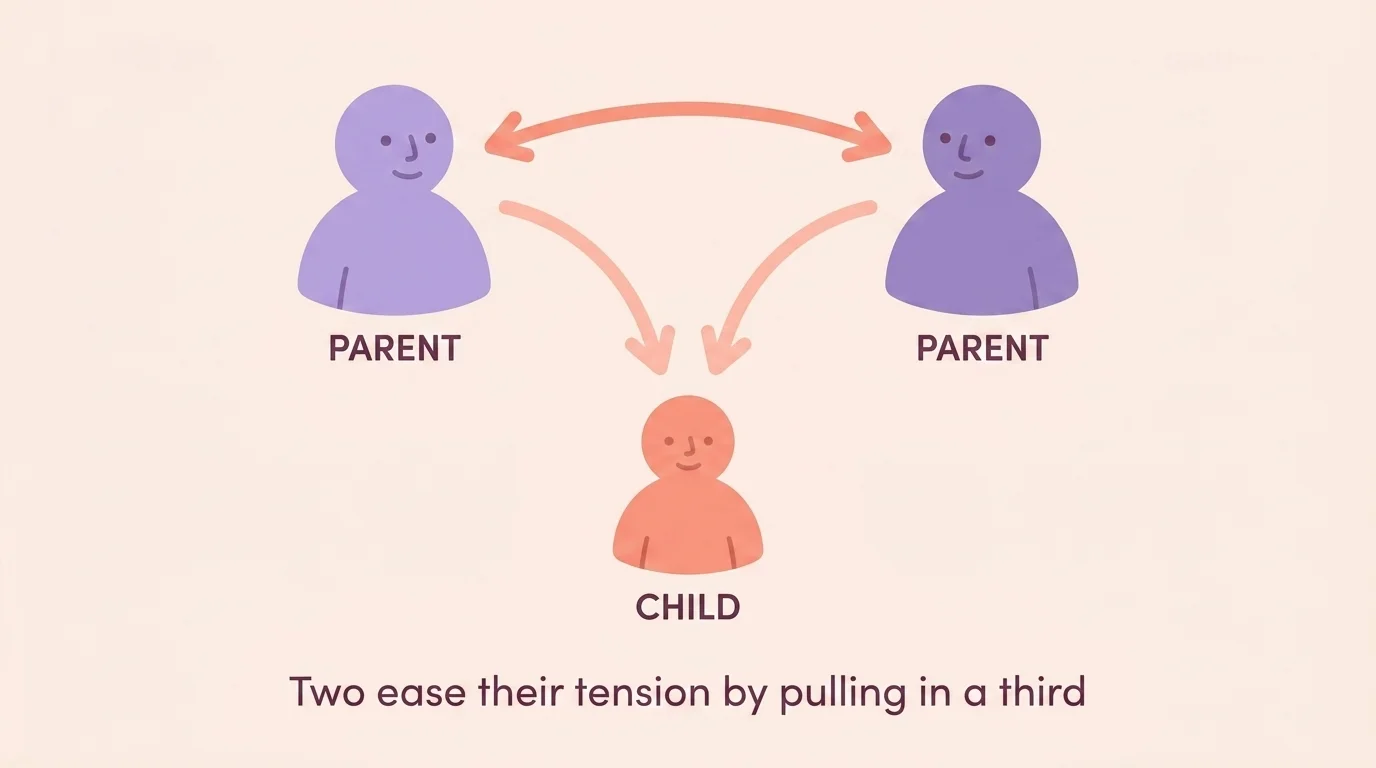
- Triangles — two people ease their tension by pulling in a third.
- Differentiation of self — staying yourself under family pressure.
- Nuclear family emotional process — the routes anxiety travels through a household.
- Family projection process — parents' anxiety landing on one particular child.
- Multigenerational transmission process — patterns handed down the family line.
- Emotional cutoff — managing tension by going distant or no-contact.
- Sibling position — how your spot in the birth order shapes you.
- Societal emotional process — the same forces at work in schools, workplaces, communities.
The next section gives each of these a real-home example. If you want the wider lane this sits in, that's what our family dynamics hub is for.
The eight concepts — a real-home example for each
Concepts stay abstract until you can see them at your own table. The eight-concept list comes straight from the Bowen Center; the examples under each are the kind of thing I watched play out in the mediation room, and at my own kitchen table, for years.
Triangles
Two people under tension pull in a third to steady themselves. A couple who can't talk about money directly start talking, instead, about the child who's overspending — the child becomes the safer subject, and the tension gets routed through them. In my own house, when my wife and I are out of step, I've caught myself over-managing the nine-year-old's homework. The homework isn't really the point. The triangle is doing its quiet job of absorbing what the two of us haven't said out loud.
Differentiation of Self
Staying yourself — calm, thinking, still connected — when the people you love are anxious and pulling on you. Your teenager is catastrophizing about an exam; low differentiation means you either catch the panic and start catastrophizing along with them, or shut it down cold to make it stop. Staying steady without going cold is the middle path. It's the concept that matters most for parents, so I've given it its own section below.
Nuclear Family Emotional Process
This is the map of where a household's anxiety goes. The Bowen Center describes four main routes it travels: marital conflict, emotional distance, one partner over-functioning while the other under-functions, and anxiety focused onto a child. Most families run mainly on one or two. Ours defaults to distance — when things are tense, my wife and I get politely, efficiently busy, orbiting the same kitchen without ever landing. Naming your household's default route is half the work of changing it.
Family Projection Process
The process by which parents' anxiety settles, disproportionately, on one particular child. It's rarely deliberate. A parent worried about their own competence starts watching one kid especially closely for signs of struggle — and the child, sensing the searchlight, often supplies the very struggle being watched for. The other siblings, oddly, are left freer. I sat with more than one family where the "problem child" was mostly the child who'd been handed the family's worry to hold.
Multigenerational Transmission Process
Patterns don't start with you, and they don't stop with you unless someone notices them. Ways of coping and levels of anxiety get handed down the family line, tuned slightly at each pass. My grandfather in Cork managed feeling by not mentioning it; my father inherited a quieter version of the same; I'm trying to hand my own children something with a few more words in it. Three generations, one long negotiation with the same inherited silence.
Emotional Cutoff
When tension becomes unbearable, some families manage it by cutting the cord — going no-contact, or staying in the room but emotionally gone. It looks like a solution because the heat drops. It isn't one: the unresolved feeling just goes underground and tends to surface in the next relationship. The estranged uncle nobody explains, the parent who's "fine" but hasn't been truly spoken to in a decade — that's cutoff doing its work.
Sibling Position
Bowen took seriously the idea that where you land in the birth order shapes the role you learn to play. The oldest who becomes a deputy parent, the youngest who stays the baby long past babyhood, the middle who learns to negotiate — these are rehearsed positions, and adults carry them into their own marriages and parenting. It isn't destiny. But if you've ever felt yourself slot straight back into your childhood role at a family dinner, that's the pull.
Societal Emotional Process
The last concept scales the whole thing up: the same emotional forces that run a family also run schools, workplaces, and communities. Anxiety spreads through a staffroom or a group chat the way it spreads through a kitchen, and it gets managed with the same moves — scapegoating, distance, over-functioning. It's the concept that reminds you the patterns you're spotting at home aren't a personal failing. They're how human groups behave under pressure.
What is differentiation of self — and why it matters most for parents
Differentiation of self is your ability to stay calm and think clearly under family pressure without either fusing with everyone else's emotions or cutting them off. Bowen described it as "a capacity to gain a balance between emotional and intellectual functioning without fusion" — being able to feel a great deal and still keep a hand on the wheel.
Here's why it's the concept I'd put in a parent's hands first. Peer-reviewed research links higher differentiation to lower anxiety, better emotional regulation, and — the line that stops me every time — better parent–child relationships. In one open-access study in PLOS One, the researchers found that more differentiated people have better relationships with their partners and children precisely because they "do not tend to regulate their anxiety through couple conflicts, emotional distancing from the partner, under or overfunctioning, or focusing anxiety on their children." Read that list back: it's the four routes of the nuclear family emotional process, closed off one by one. A separate 2024 study of 378 people put a small but positive number on the link between differentiation and marital satisfaction — worth noting, though it's a single sample, not a headline.
Low differentiation, at home, looks like taking your child's mood as your own weather. High differentiation looks like staying warm and available while the storm stays theirs, not yours. The good news buried inside Bowen's difficult word is that it's a skill, not a fixed trait — and it shapes the way you parent more than almost anything else.
Dysfunctional family roles — where parents recognize themselves
This is usually the section where a parent goes quiet, because it's the one where you see yourself. When a family is under sustained stress, its members tend to fall into fixed roles that keep the whole system running — and once you've named them, they're hard to unsee.
An honest note on lineage first: these roles come mostly from the addiction-and-family tradition — the work that grew up around families living with a drinking or using parent — not from Bowen's strict eight concepts. They're adjacent to family systems theory, not the same thing. But they map so cleanly onto ordinary stressed households that they've become the common language:
- The scapegoat — the one who carries the blame, whose "acting out" conveniently locates the family's trouble in a single person.
- The hero / golden child — the high-achiever who makes the family look fine from outside, at the cost of ever being allowed to struggle.
- The lost child — the one who fades into the background, asks for nothing, and gets praised for being "no trouble."
- The mascot — the joker who breaks tension with a laugh, defusing rooms they're far too young to be defusing.
- The enabler / caretaker — usually a parent, smoothing everything over so the underlying problem never has to be faced.
In the mediation room I watched families move these roles around like furniture. The point Bowen would make is that none of it is fixed personality — it's the system absorbing anxiety and redistributing it onto whoever's positioned to carry it. Which is also the hopeful part: a role that was assigned can be reassigned, and naming it out loud, gently, is often the first move toward building healthier family dynamics. If the role in your house is organized around addiction, abuse, or a member in real crisis, that's the point to bring in help rather than manage it alone — more on that below.
Bowen vs. Internal Family Systems vs. Structural (Minuchin) — clearing up the confusion
If you go searching for "family systems," you'll hit a wall of confusion within about three clicks, because the phrase gets stretched across three different models built by three different people. They're worth separating, because they lead to genuinely different advice.
| Model | Whose idea | What it actually looks at |
|---|---|---|
| Bowen Family Systems | Murray Bowen | Relationships between family members; mapped with a genogram; the goal is differentiation |
| Internal Family Systems (IFS) | Richard Schwartz | The "parts," or sub-personalities, within one person's own mind |
| Structural Family Therapy | Salvador Minuchin | The family's structure — its boundaries, alliances, and hierarchy |
The one that trips everyone up is IFS, because it also uses the words "family" and "systems." The cleanest distinction I've found is Wikipedia's: internal family systems "identifies the sub-personalities (or 'parts') within one person, whereas traditional family systems therapy examines relationships between family members." One looks inward at a single mind; the other looks outward at the space between people.
And the confusion isn't only yours. A 2025 scoping review of IFS therapy worked through 27 studies and concluded its evidence base still hasn't consolidated — the field itself hasn't fully sorted these models out, so a little reader whiplash is fair enough.
How to map your own family: the genogram
A genogram is the tool Bowen practitioners use to make all of this visible, and it's the one piece of the theory you can genuinely do yourself this weekend. Think of it as a family tree that also records the emotional relationships — not just who married whom and who was born when, but who's close, who's in conflict, and who's cut off. GenoPro's guide is a decent primer if you want the full symbol set.
The basics are simple. Squares are men, circles are women, and the lines between them carry the meaning: a solid line for a close bond, a jagged one for conflict, a broken one for cutoff. That's most of what you need.
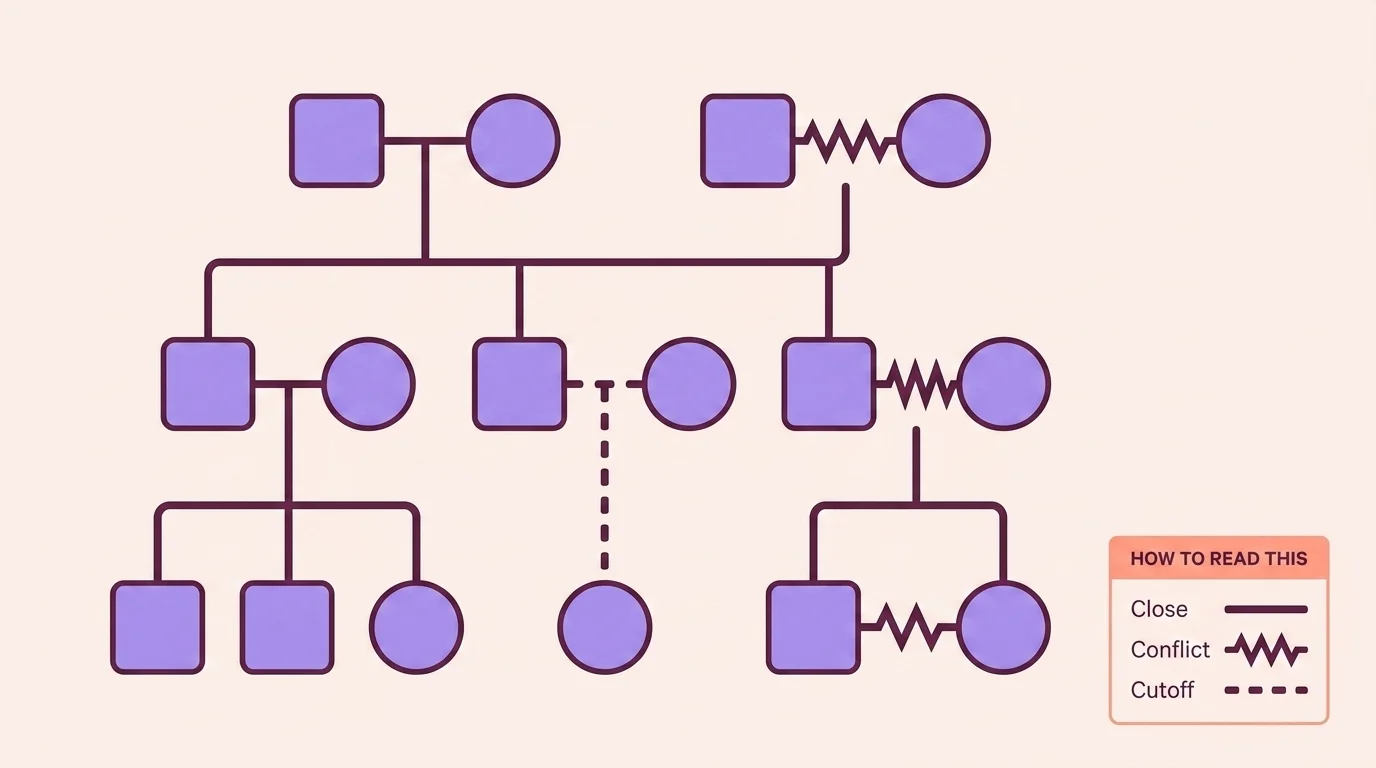
To map your own, sketch three generations — you, your parents, your grandparents — then draw in the emotional lines honestly. Mark where the tension sits and where the triangles form. What tends to jump off the page is the repetition: the estrangement that skipped a generation and came back, the closeness that always seems to route around one particular person. You're looking at the patterns you've been repeating without noticing.
From theory to therapy — how families actually use this
In a therapist's hands, this framework changes what "the problem" even is. Rather than trying to fix the one member everyone arrived to fix, a family systems therapist coaches the whole unit — helping people raise their own differentiation and step out of the triangles they've been feeding. It shows up in family therapy, in social work, and increasingly in ordinary care settings: a Swiss university's Family Systems Care Unit had run structured therapeutic conversations with 34 families as of June 2025, treating the family, not just the patient, as the unit of care.
You don't need a therapist to borrow the moves. Notice the triangle before you step into it. Resist the reflex to take a side. Work on your own reactivity first, since it's the one part of the system you fully control.
But borrow is the right verb, and here's the limit worth stating plainly: this is a lens, not a treatment. Where a family is dealing with abuse, addiction, or a member in genuine crisis, systems insight is no substitute for a licensed family therapist — and in an emergency, a crisis line or your local emergency number comes first. Naming a pattern is a good start. It is not the same thing as being safe.
The limits — criticisms and weaknesses of family systems theory
A framework this sweeping earns some fair criticism, and naming it is part of using it honestly. Family systems theory was developed in a Western context and doesn't map neatly onto every culture's idea of what a family is or how it should work — the boundaries it treats as healthy aren't universal. It can also under-weight the individual: a lens that sees everything as the system risks obscuring personal agency, temperament, and plain biology. It has been critiqued on its gender-power assumptions, and for resting on a relatively thin empirical base for something so influential.
None of that makes it useless — it makes it a model, which is all it ever claimed to be. And it's still moving. A 2024 chapter, Family Systems Theory in the Digital Age, argues for adding a "digital level of analysis" — treating the screens and devices in a house as a genuine part of the family emotional unit rather than an outside intrusion. Anyone who's watched a dinner table lose three people to three phones will recognize the point. A theory that's still being rewritten sixty years on is doing better than most.
What a healthy family system is really "for"
It's easy to finish a piece like this thinking of your family as a tangle of problems to be diagnosed. So it's worth ending somewhere warmer. A 2025 study in the Journal of Family Issues asked what families are actually trying to do, and landed on five jobs: to secure and maintain connection, to procure resources, to bolster each member's development, to foster safety and well-being, and to support each person becoming fully themselves.
Read Bowen's concepts back through that list and they stop sounding clinical. Triangles, differentiation, cutoff — these aren't diagnoses. They're just the mechanics of how a family does those five jobs well, or badly, on any given Tuesday. The theory isn't describing a broken machine. It's describing the ordinary, effortful work of a group of people trying to take care of each other.
The pattern isn't the person
Once you can see your family as a system, the loops stop feeling like anyone's fault. The same argument on repeat, the child who always gets blamed, the relative nobody talks to — they turn from character flaws into patterns, and patterns can be named and shifted. That's the quiet gift of family systems theory: it moves the question from who is to blame to what is the system doing. The lever, if you want one, is differentiation of self — staying warm and steady while the storm belongs to someone else, and it's learnable. So pick one triangle you recognized in your own house this week and try stepping out of it. Sketch a rough genogram at the kitchen table. You're not fixing anyone. You're just, finally, in the room and paying attention.
Frequently Asked Questions
Psychiatrist Dr. Murray Bowen developed it in the 1950s, defining the family as a single emotional unit whose members constantly influence one another.
Triangles, differentiation of self, nuclear family emotional process, family projection process, multigenerational transmission process, emotional cutoff, sibling position, and societal emotional process.
No. IFS looks at the 'parts' inside one person's mind, while Bowen's theory looks at relationships between family members. They share systems thinking but are different models.
A 'triangle' is the classic everyday example: two parents in tension who each pull a child onto their side to relieve the pressure between them.
It was developed in a Western context and may not fit all cultures, can under-weight the individual, has been critiqued on its gender-power assumptions, and rests on a relatively limited empirical base.
Check Out These Related Articles

Reweaving the Fabric of Family Communication: A Historical Perspective

From TikTok Trends to Table Talks: How Youth Culture is Shaping Family Traditions

Unveiling Ancestral Parenting Wisdom: Integrating Tradition into Modern Motherhood